Pressure Curve on PXT Barrel/Peak Case

SloppyJ

WKR
Shoot2HuntU
Joined
Feb 24, 2023
Messages
2,902
Been trying to think wholistically about this entire situation as new products have been trickling out in the past month. Has anyone seen a pressure curve for a PXT barrel? I struggled with what subforum to put this in but figured my reloading nerds would have the most interest in it. Second, I'm just a redneck nerd that works in engineering for a living but I'm no ballistician or anything close. I've been mulling this around:

All factors remaining equal, what does the pressure curve of a PXT barrel look like compared to a conventional barrel? I'd have to imagine there's not as big of a peak right at the start because we aren't jamming a bullet down the rifling and expecting it to spin up to 250k rpm as fast. I would also imagine that as the twist rate tightens up down the barrel, it would elongate that pressure curve so maybe we have the same area under the curve but the distribution is more spread out. If that's actually true, what does that mean in terms of powder choice and charge? Is there now a little more head room to bump that "spike" up?

If any part of #1 is true, how does that tie into the peak cases? We've now upped our top end pressure limit, supposedly up to an additional 18k psi, and now we need to change quite a bit to take advantage of that. Do we have a further advantage with the exponential twist barrel? To me this would come down to powder choice and adjusting the burn rate to see what works by messing with that peak pressure.

Maybe I'm retarded and need to focus on something productive? I don't have pressure testing equipment nor the means to size the cases but I'd love to test some loadings out of standard barrels and the PXT barrels in both case types to see if I could gain any insights on any of this. I can't find much information out there yet.

Anyone played with this yet?
 
I am admittedly not so bullish about the peak ammo or how much benefit the gain twist actually will have on prolonging barrel life.

So far we have a lot of internet hype, and exactly 1 video of a 7prc going 4000 rounds iirc.
I think this will need to be out in the public hands for many months of high volume shooting before we see if it actually holds up.

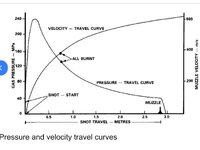
That being said, I found a pressure curve from a howitzer barrel life study:
IMG_1244.jpeg

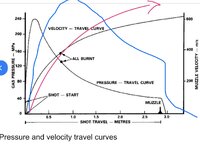
I’m imagining peak pressure will be higher, but the slope to peak pressure will be slightly more gradual. Total area under the curve will be higher, and exit velocity will correspondingly be higher.

Something like this:
IMG_1244.jpeg
 
My concerns:
1. suppressors: muzzle pressure will be higher. Cans with structural problems will fail. Probably catastrophically, and probably causing injury in some cases.
2. The barrels will be strong enough not to burst. But actions, recoil lugs, bedding compound, and scope internals will also be subjected to the increased pressure moving through the system.
3. Reloading: I don’t think these will be as easy to load as we may be thinking. Also the safety margin is going to be a concern. Guys not knowing what they don’t know, or looking to push the envelope for ++peak velocities could get to 100kpsi pretty easily. What does a pierced primer look like under 100kpsi? Do the necks work harden to the point of rupture after 2-3 resizings?

I have so many questions, and I don’t think any answers will be available for quite some time. But I’m here for the discussion 😎
 
Been trying to think wholistically about this entire situation as new products have been trickling out in the past month. Has anyone seen a pressure curve for a PXT barrel? I struggled with what subforum to put this in but figured my reloading nerds would have the most interest in it. Second, I'm just a redneck nerd that works in engineering for a living but I'm no ballistician or anything close. I've been mulling this around:

All factors remaining equal, what does the pressure curve of a PXT barrel look like compared to a conventional barrel? I'd have to imagine there's not as big of a peak right at the start because we aren't jamming a bullet down the rifling and expecting it to spin up to 250k rpm as fast. I would also imagine that as the twist rate tightens up down the barrel, it would elongate that pressure curve so maybe we have the same area under the curve but the distribution is more spread out. If that's actually true, what does that mean in terms of powder choice and charge? Is there now a little more head room to bump that "spike" up?

If any part of #1 is true, how does that tie into the peak cases? We've now upped our top end pressure limit, supposedly up to an additional 18k psi, and now we need to change quite a bit to take advantage of that. Do we have a further advantage with the exponential twist barrel? To me this would come down to powder choice and adjusting the burn rate to see what works by messing with that peak pressure.

Maybe I'm retarded and need to focus on something productive? I don't have pressure testing equipment nor the means to size the cases but I'd love to test some loadings out of standard barrels and the PXT barrels in both case types to see if I could gain any insights on any of this. I can't find much information out there yet.

Anyone played with this yet?


I have been thinking some similar thoughts. I suspect that compromises have been made to work with existing twists, powders, etc. to get mass adoption. I am really looking forward to how much more can be gained (accuracy, velocity, etc.) beyond the current implementation of 7BC or 6.5 peak with optimization for higher pressure. I would be willing to bet tweaks to powder amount and burn rate are needed to build an ideal pressure curve with a PXT when they are designed for a straight 1:8 twist.

I think about this from a combustion efficiency, PV curve, etc. perspective. It seems logical that for any given final twist rate there will be an optimal gain function, not only the twist but also the pressure, BUT that optimal gain function will be made up of countless trade offs.

My concerns:
1. suppressors: muzzle pressure will be higher. Cans with structural problems will fail. Probably catastrophically, and probably causing injury in some cases.
2. The barrels will be strong enough not to burst. But actions, recoil lugs, bedding compound, and scope internals will also be subjected to the increased pressure moving through the system.
3. Reloading: I don’t think these will be as easy to load as we may be thinking. Also the safety margin is going to be a concern. Guys not knowing what they don’t know, or looking to push the envelope for ++peak velocities could get to 100kpsi pretty easily. What does a pierced primer look like under 100kpsi? Do the necks work harden to the point of rupture after 2-3 resizings?

I have so many questions, and I don’t think any answers will be available for quite some time. But I’m here for the discussion 😎
It's kind of funny, I am not really worried about any of your concerns.

1. From what I have seen on the 7BC, muzzle velocity doesn't change as much as I am used to with barrel length changes from 16.5" to 20. This is an indicator to me that by the time you get to 16" of barrel length the pressure has dropped far more than typical brass cases, likely below them.

2. Feel free to calculate out hoop stress and strain yourself (or have AI do it) and pick a barrel thickens with a safety factor that makes you feel warm and fuzzy.

3. Quite a number of guys are reloading them with good success, and have more than 2-3 firings on a case.
 
My concerns:
1. suppressors: muzzle pressure will be higher. Cans with structural problems will fail. Probably catastrophically, and probably causing injury in some cases.
2. The barrels will be strong enough not to burst. But actions, recoil lugs, bedding compound, and scope internals will also be subjected to the increased pressure moving through the system.
3. Reloading: I don’t think these will be as easy to load as we may be thinking. Also the safety margin is going to be a concern. Guys not knowing what they don’t know, or looking to push the envelope for ++peak velocities could get to 100kpsi pretty easily. What does a pierced primer look like under 100kpsi? Do the necks work harden to the point of rupture after 2-3 resizings?

I have so many questions, and I don’t think any answers will be available for quite some time. But I’m here for the discussion

1&2: Do we have any reports of catastrophic failures yet? I this is genuinely asking out of curiosity. I haven’t seen anything but I don’t know how widespread adoption of these high pressure cases has gone so far. I do think the 6.5 peak cases are gonna see a whole lot more real world use than 7 bc so I think some answers to this will be evolving as this stuff get out into the wild. Just my thoughts anyway. FWIW I do have a 7bc barrel on my Seekins ph3 right now. I’m about 40 rounds in of testing and still have all digits and eyeballs so farand my aero lahar can has survived it too


Sent from my iPhone using Tapatalk
 
I am admittedly not so bullish about the peak ammo or how much benefit the gain twist actually will have on prolonging barrel life.

Please don't misconstrue this as me being hyped up for it. I'm more interested in the science and what it can really unlock when you don't have to account for it being used in legacy barrels. Maybe there's not much gain in it at all but the velocity increases in 6.5 are enough to pique my curiosity for sure.
 
16" 7 BC velocities:
170g TA 2950fps
175g Tipped Fusion 2814 fps

I don't feel more recoil with the new barrel vs the 20" 280AI barrel it replaced. I doubt any of the systems like the scope, bedding or the action will feel the difference either.

Remember the case contains much of the pressure so the action doesn't have to take it.
 
16" 7 BC velocities:
170g TA 2950fps
175g Tipped Fusion 2814 fps

I don't feel more recoil with the new barrel vs the 20" 280AI barrel it replaced. I doubt any of the systems like the scope, bedding or the sction

Remember the case contains much of the pressure so the action doesn't have to take it.
Are you perchance measuring the wear at the throat?

How is it grouping?

How many down the pipe so far?
 
Please don't misconstrue this as me being hyped up for it. I'm more interested in the science and what it can really unlock when you don't have to account for it being used in legacy barrels. Maybe there's not much gain in it at all but the velocity increases in 6.5 are enough to pique my curiosity for sure.
Oh for sure dude.
And I’m not trying to high jack with negativity.
I’m also interested in the science and a high level discussion.
I just wanted to be upfront with my skepticisms.
Carry on
 
Back
Top