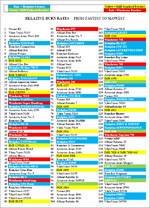
Powder Burn Rate Charts

Ok - i have seen this one but how is it used? What is a good powder for 125 or 110 gr 30 cal bullet thru a 22” barrel?
 
Ok - i have seen this one but how is it used? What is a good powder for 125 or 110 gr 30 cal bullet thru a 22” barrel?
That would be cartridge dependent. For a .308 Win, H335 would do a good job, among others. For a 30-06, H4895 would be better.

If you already know a powder, you can use this chart to suggest others to try. Perhaps you hit pressure early with H335, and want to try a slower powder, then maybe TAC or H4895 would be better. Or, you can't get the velocity you want and can't get more powder in the case, then bump down to a faster powder.

The burn rate is only part of the equation. You also need to know bulk density of the powder to get to proper case fill. A powder may have the same burn rate, but be more or less bulky.

There isn't a chart for this outside of the reloading manuals. The starting point is the manual, then you see what your rifle likes.

Jeremy
 
Ok - i have seen this one but how is it used? What is a good powder for 125 or 110 gr 30 cal bullet thru a 22” barrel?
Start here -


Or here -


Or here -

 
Sorry - Is there a metric for burn rate? For instance a metric for velocity is feet per second (f/s)

- the charts that were shared have the metric of fastest and slowest - whomever put the chart together based it on some measurable value -

Inches per something?

Something per inch at a given caliber and bullet weight.
 
Last edited:
There are no "units" or metrics for the burn rates that determine position of the various individual powders on these charts. There are other charts published, by the way, and they do not agree about powder relative burn rates (i.e., about position on the charts of the individual powders). The methods for determining the burn rates for these charts are not universal amongst the various publishers of the charts. And, they do NOT represent burn rate within any particular handloading (or, commercial loading) application. As I understand it, they are laboratory-determined based on crucible testing. The burn rates do not describe how one powder relates to the burn rate of any other powder in any real world metallic cartridge and firearm combination. And, there are some powders that are inapplicable for most cartridges despite where they fall on the burn rate chart. For example, LeverEvolution can only be used in a handful of cartridges (calibers/cartridges) because of additives and retarders added to the powder when it is being made in order to optimize it for its intended applications. Another example would be that you can not use StaBall 6.5 in 308 because the way it is made one can not get enough of it into a 308 cartridge case to make it a useful powder. Etc, Etc. So, you can not just pick a powder based on its position on the burn rate chart.
 
Where did you find this information?

So….. For example I select H110 and perform all my ladder tests for my 125 grain 30 cal bullet and find my max charge allows me 1800 fps - then…. I am told H110 was intended for 8 to 9 inch barrels. I have a 22” barrel - should pick a slower burn rate powder to fully use the length of my barrel? Is so is it trial and error? Or is there a way to be intelligent in selecting a slower burn rate powder?

Can burn rate be identified by carbon failing?
 
Sorry - Is there a metric for burn rate? For instance a metric for velocity is feet per second (f/s)

- the charts that were shared have the metric of fastest and slowest - whomever put the chart together based it on some measurable value -

Inches per something?

Something per inch at a given caliber and bullet weight.
There is a whole scientific process to it but it's a pain to explain and then you get factors like single or double base, temperature sensitivity, position sensitivity...

Find data for the cartridge and bullet weight you want, then possibly refer back to the burn rate chart if you're getting sooty brass or signs of excessive pressure.
 
I am told H110 was intended for 8 to 9 inch barrels. I have a 22” barrel - should pick a slower burn rate powder to fully use the length of my barrel? Is so is it trial and error? Or is there a way to be intelligent in selecting a slower burn rate powder?
Right.
I totally understand what you are asking because I too had the same question. For me, it was an issue of having a lot of Titegroup and not needing it for 9mm or 38 Special, so I wanted to use it to load 357 for rifle, 16 inch, 18 inch, and 20 inch barrel rifles. What I find is that it is OK in terms of velocity and flat-shooting for the 16 inch, but the velocity actually slows down in the 18 inch barrel rifle, and then slows even more in the 20 inch barrel rifle. Powder must be too fast. But I don't want to use the traditional highest power 357 powders for various reasons not necessary to this discussion. I could look at the burn rate chart and try to select a powder that is a lot slower than Titegroup. Could do that, but that would not really help me much for all the reasons already explained. Instead, I did what you should be doing, which is consult load data (manuals, and the online resources, particularly Hodgdon's reloading data center online) and find powders that give higher velocities in the caliber/cartridge you want to use. Sometimes you have that "different barrel length thing" of the test barrel for the load data being very different length from the barrel you will use, but the load data applies to the safety of the firearm's chamber which is not dependent on the barrel length. And, you can compare powders based on the load data, even if the barrel length used for their testing is different from your firearm's barrel length. You can at least get a good idea what the different powders listed in the load data can do for you, relative to each other. The actual velocity, as you know, would need to be measured by you once you have some loads made up. For me, it is easier, because for 357 there are rifle-specific loads, so I don't have to depend entirely on short-barrel handgun load data, but I could if I needed to if what I wanted was to get an idea of valid other powders to consider trying.

Burn rate chart not really for doing the kind of thing you asked about. It is better for trying to find powders that might be very close in performance to a given powder with which you have experience. Even that can be a bit dicey in terms of accurately determining from a burn rate chart, and don't forget that the published charts do not agree with each other in significant ways, so that should be telling you something important right there.

Another use of burn rate charts is finding candidate powders for wildcat cartridges and that's a whole different monkey for a whole different circus.
 
What question did you hear me ask?

if i boil it down … I hear you saying ….. I should be using load data and dont worry about burn rate charts…? …. That is unless I am dabbling in the wildcat territory?
 
Maybe buy a reloading manual, or find online data from powder/bullet manufactures.
 
The loading manuals will give you some choices to start with.

If you don't like those, you can try the powders close to them on the burn rate chart.


Example:
I can't find varget, so I tried 4064.
 
You might try QuickLoad, if it’s still around. I don’t think it will answer your question about how burn rate is measured or the units. But it may be able to point you towards some answer like %powder burn for a given load and barrel length.
 
Back
Top