Pew Science

No, but I also don't rely on KDP to compare various beverages. An industry standard should be open to the public. Like this: https://saami.org/technical-information/ansi-saami-standards/

Not necessarily an argument with what you said, but I'd be more concerned if he shared his algorithm and manufacturers started to use it themselves.

Would you trust it more or less if manufacturers put out their own "pew" numbers? Or would some of them take liberties to made adjustments to the algorithm and we end up with more noise than signal?

Would the average consumer be able to tell where the calculations were "adjusted"? Is Jay now to audit all other results to keep the standard he created?

There's ample opportunity for someone to create their own scale and write their own reports. I think that the lack thereof is telling.

If they published both the raw data (and we knew the underlying formulas for the standard) that wouldn't be possible. Any adjustments would be obvious.

If we can trust the manufacturers to proof their own guns, then why not trust them to do their own sound testing. If the US was setup like Europe with proof houses and substantial third party testing infrastructure (CIP requires third party testing) then it would be possible, but we don't have that. We have a system where manufacturers do their own testing.
 
If they published both the raw data (and we knew the underlying formulas for the standard) that wouldn't be possible. Any adjustments would be obvious.

If we can trust the manufacturers to proof their own guns, then why not trust them to do their own sound testing. If the US was setup like Europe with proof houses and substantial third party testing infrastructure (CIP requires third party testing) then it would be possible, but we don't have that. We have a system where manufacturers do their own testing.
I think one of the overall themes of this site is that almost no manufacturers test their products like we think they do. And consumers sure aren't going to check everyone's math with formulas so esoteric theres very few that actually understand them.

Furthermore, all suppressor manufacturers have access to sound metering devices, yet no one trusts anyone else's numbers and they are all different.

I'll keep saying it, but Jay charges manufacturers to run through his program because if he didn't, he'd be doing R&D for free. He'd also get overwhelmed by samples and prototypes from everyone with a printer. Then he'd have to select what he tests and people would cry foul.

He charges consumers if you want access to the full reports. That's his product. Why wouldn't he charge for it? To use that as a criticism is not logical.

He provides plenty of data for free to consumers. Every time someone pounds the table and says "people have to pay for his results!" I just shake my head.
 
If we can trust the manufacturers to proof their own guns, then why not trust them to do their own sound testing.

Because people in this industry fluff, lie, and BS the consumer to get market share.

I'm trusting a 3rd party source over anything. And the composite formula is the only thing that's some "secret". Literally, all of the data is there for you to see. Muzzle and ear numbers, impulse readings, etc.

If you don't care about rankings, then why would the composite score matter? All of the information you need is literally right there for you to read. It's not like he's hiding anything.

I don't know Jay's exact formula for said total composite score, but I literally keep saying it. Ear and muzzle numbers are a part of the equation, just as the impulse readings are. He's literally taking everything into account and giving you, the consumer, the best suppressors by using the entire picture of data.

It's not rocket science. Things like first round pop, inconsistent impulse, and poor gas management tend to not do well on PEW Science. That's why the ear and muzzle numbers are important but not everything. A suppressor can literally average better dB, but be worse due to impulse spiking and hanging around longer, which exposes your ear. To break it down barney style, think of it like radiation. The longer you stay in the X Ray..the more exposure you get and the more long term damage occurs versus a short stay in the X Ray resulting in less exposure and damage.
 
The way you talk to people is what I have a problem with.

People can read that thread if they want to see how I “talked to you”. Don’t gaslight.


IMG_4873.jpeg


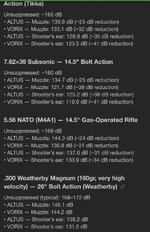
We fixed the way we meter cans.


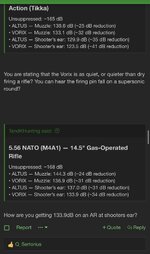
So you are upset that I tried to point out that something was wrong with your numbers and metering, you got upset that I did so- then fixed it?

And we never claimed 120 on an AR. It was more like 134 or 135, which we now know wasn't accurate now, but that is indeed what the meter said during that time. As soon as we researched heavily, talked with HBK, and did more testing...we took those numbers off.

133.9- my apologies. Completely, and totally impossible for an AR at SE.

IMG_4872.jpeg


My problem with you is that you are not using unweighted, using a 48 kHz meter, and not capturing any impulse data.

“Me”? First, every single video has unweighted numbers shown. Second, I am not stating what my companies suppressors meter at. Third, you aren’t capturing imulpse data either- again, why are you gaslighting? Fourth, please shown where numbers of any known can that I have done is outside the bounds of what it should be from TBAC data- this should be easy because I’m all effed up, right?

“I’m all jacked up” in how I am metering cans- yet you know so much that you couldn’t understand that 133.9 dB SE wasn’t even possible with a AR? As well, what I’m doing is soooo bad, but Ryan using the exact same meter, with far less experience is all good?


The Only reason that I ever started metering any cans on here is because I was tired of companies putting absolutely BS numbers to things, and people claiming that numbers that were being stated were bs on cans I had used. Go back and actually read.


Yet acting like nobody knows anything except you.

What are you talking about? You literally posted absolutely bonker numbers, then got butthurt when I asked you if you were sure- it’s screenshot above. You got upset because someone challenged your numbers, and have turned it personal.
I have not engaged with you since that time until your BS comment today.

I don’t know anything about sound, audiology, etc- and never have claimed too. But at least I’m not a manufacturer making cans, telling people what right and wrong looks like and how everyone is so wrong for not using the meter I am, not using the Z weighting (that is shown every time), that everyone that isn’t using PEW science is all wrong…. all while being ignorant of what port pop on an AR is.
 
People can read that thread if they want to see how I “talked to you”. Don’t gaslight.


View attachment 1045394


So you are upset that I tried to point out that something was wrong with your numbers and metering, you got upset that I did so- then fixed it?


133.9- my apologies. Completely, and totally impossible for an AR at SE.

View attachment 1045395


“Me”? First, every single video has unweighted numbers shown. Second, I am not stating what my companies suppressors meter at. Third, you aren’t capturing imulpse data either- again, why are you gaslighting? Fourth, please shown where numbers of any known can that I have done is outside the bounds of what it should be from TBAC data- this should be easy because I’m all effed up, right?

“I’m all jacked up” in how I am metering cans- yet you know so much that you couldn’t understand that 133.9 dB SE wasn’t even possible with a AR? As well, what I’m doing is soooo bad, but Ryan using the exact same meter, with far less experience is all good?


The Only reason that I ever started metering any cans on here is because I was tired of companies putting absolutely BS numbers to things, and people claiming that numbers that were being stated were bs on cans I had used. Go back and actually read.


What are you talking about? You literally posted absolutely bonker numbers, then got butthurt when I asked you if you were sure- it’s screenshot above. You got upset because someone challenged your numbers, and have turned it personal.
I have not engaged with you since that time until your BS comment today.

I don’t know anything about sound, audiology, etc- and never have claimed too. But at least I’m not a manufacturer making cans, telling people what right and wrong looks like and how everyone is so wrong for not using the meter I am, not using the Z weighting (that is shown every time), that everyone that isn’t using PEW science is all wrong…. all while being ignorantly of what port pop on an AR is.

You don't have the proper equipment to be an expert man. Plain and simple. I don't either. I have actually stated that in other threads recently. That's why we took those numbers off the website and are sending cans to PEW Science. Unlike you, I can admit when I'm wrong, which I am wrong a lot, and then correct myself. We have since learned and changed a lot since we first did those tests. We are now within about 1 dB of PEW Science muzzle numbers based on mic orientation. 1.2dB less to be exact because, as I'm sure you are aware, we are sampling at 64 kHz and not 262. Still figuring out how to get ear orientation more accurate, but rest easy man. We are getting above 140 numbers on the AR-15 / M4.

This is why PEW Science is in fact important. And Silencer Summit, which we will be sending cans to as well, is also important.

You are far from anything near an expert. I think pretty much everybody on here should be referencing two official sources at this point. Pew Science and Silencer Summit. Both of which we will be referencing when the reports come out. All of our testing on our meter from now on will be either internal or used in conjunction with PEW and Silencer Summit results.

Though I don't really like you, based on how you interact with me and others on here, I do appreciate you trying to get a meter and "help". My problem is that you criticize PEW Science and Jay when, in fact, you are not even remotely on the same level as him. That's okay. None of us are.
 
Pew’s testing procedure and waveforms for every suppressor that he tests are published and free. If the data collection isn't repeatable, it's open to being debunked. The proprietary part is simply the mapping function (Suppression Rating) used to distill that data into a more digestible single number score.

It's a stretch to call it a lack of transparency when the test setup, waveforms, peak dB, and analysis are all published and provided for free. Protecting the specific weighing algorithm IP doesn’t seem unreasonable to me to keep his business viable.

He is effectively providing for free all the same data other testing groups do (and more), and then adds a proprietary layer of analysis on top. If the test setup or data is flawed, call it out. If the algorithm is the issue, that's a disagreement on weighting, not a lack of science. And a better alternative algorithm and justification could then be discussed. Ironically it seems he is the most transparent and rigorous, yet gets criticized as the opposite, despite giving us richer data than anyone else.

I’m not asserting that others doing suppressor testing are wrong or worthless, but what Pew provides appears to be the current gold standard in rigor, transparency, and depth. My only gripe is I wish he could sustain higher throughput so more suppressors were tested.


Edit: A couple links to substantiate my claims. This does not strike me as a lack of transparency (and certainly not more so than other suppressor testing).

0. SSS.2 - Methodology Introduction https://pewscience.com/silencer-sound-standard-methodology-introduction

1. SSS.4 - Test Method and Results
https://pewscience.com/silencer-sound-standard-test-method

2. Dead Air Nomad-L - .308 Suppressor Test
https://pewscience.com/sound-signature-reviews-free/sss-6-55-dead-air-nomad-l-savage-308
 
You don't have the proper equipment to be an expert man.

You’re gaslighting again. At no point have I said I was an expert. Nor have I tried to do anything here that would warrant that statement.


Plain and simple. I don't either. I have actually stated that in other threads recently. That's why we took those numbers off the website and are sending cans to PEW Science. Unlike you, I can admit when I'm wrong,

Stop gaslighting. I admit on here immediately when I am wrong- I literally screenshot me saying something wrong and apologized to you for it. Then went back and added a note to the original post saying that I was wrong and again apologizing to you for it.


You are far from anything near an expert.

Again- what are you talking about? You keep saying that I am not an “expert”- no kidding. Please show one single instance of me trying to say that I am an expert on metering suppressors. Questioning ridiculous numbers is not claiming to be an expert. Showing cans metered with a baseline can is not claiming to be an expert.
If you want to be a dick, then I could say “well, at least I actually I know enough about suppressors to know what port pop is”. Believing a 133.9 dB is correct for a right side SE number in an AR, is about as “smart” as believing a velocity speed gun when it tells you a child is running 72mph.
The fact that you didn’t understand that isn’t the issue, the issue is that this entire thing and your comments are because you got asked about a ridiculous number and made it a personal thing.


I have no care about you or your cans. I haven’t engaged with you or commented in your threads since the first interaction- which anyone can go back and see what was actually stated, and your reaction to it. You have made this personal, and then in this thread are continuing to state untrue and nonsensical things. Again, I do not care about you or your cans- I hope they do great. Stop gaslighting and stop stating nonsensical things about me or to me and it’s good. If you continue, then I will keep posting to and correcting what you say.
 
You’re gaslighting again. At no point have I said I was an expert. Nor have I tried to do anything here that would warrant that statement.


Stop gaslighting. I admit on here immediately when I am wrong- I literally screenshot me saying something wrong and apologized to you for it. Then went back and added a note to the original post saying that I was wrong and again apologizing to you for it.


Again- what are you talking about? You keep saying that I am not an “expert”- no kidding. Please show one single instance of me trying to say that I am an expert on metering suppressors. Questioning ridiculous numbers is not claiming to be an expert. Showing cans metered with a baseline can is not claiming to be an expert.
If you want to be a dick, then I could say “well, at least I actually I know enough about suppressors to know what port pop is”. Believing a 133.9 dB is correct for a right side SE number in an AR, is about as “smart” as believing a velocity speed gun when it tells you a child is running 72mph.
The fact that you didn’t understand that isn’t the issue, the issue is that this entire thing and your comments are because you got asked about a ridiculous number and made it a personal thing.


I have no care about you or your cans. I haven’t engaged with you or commented in your threads since the first interaction- which anyone can go back and see what was actually stated, and your reaction to it. You have made this personal, and then in this thread are continuing to state untrue and nonsensical things. Again, I do not care about you or your cans- I hope they do great. Stop gaslighting and stop stating nonsensical things about me or to me and it’s good. If you continue, then I will keep posting to and correcting what you say.

Good deal. You said your peace and we can move on now.
 
Think of it like the drop test. People already don’t trust that because of variability.

Now let’s say Rokslide charges us and the manufacturer to drop the scopes.

Then they publish a durability number on the scope, with a proprietary formula.

it’s not hard to see why people don’t care for pew business model. I don’t spend my money there, and if I made suppressors I would not either.
 
Think of it like the drop test. People already don’t trust that because of variability.

Now let’s say Rokslide charges us and the manufacturer to drop the scopes.

Then they publish a durability number on the scope, with a proprietary formula.

it’s not hard to see why people don’t care for pew business model. I don’t spend my money there, and if I made suppressors I would not either.
A better analogy would be if the drop test used very high grade testing equipment and setup (sensors to measure force curves experienced by the scope and reticle alignment, drop height and angles, etc), published in detail what the standard drop test procedure is (free to see), published the detailed results of the tests showing those force curves and reticle deviations with multiple plots and peak numbers (free to see), did an in depth analysis on those results with explanations and comparisons to prior tests and commentary on design choices (free to see), and then used a proprietary algorithm to distill that free and open data to a single rating to make it easier to compare (rating and rankings are free to see). Scope manufactures pay for this deep testing and potential consulting to inform future design/manufacturing choices.

And no company who got rated well or poorly on the test exposed any dubious information on the test or tester, nor did anyone over the last few years of testing effectively debunk the free and open data or test procedure.

Disclaimer: I am a fan of the drop tests and not saying they aren’t transparent. Just trying to make a fairer comparison in this hypothetical.
 
I think one of the overall themes of this site is that almost no manufacturers test their products like we think they do. And consumers sure aren't going to check everyone's math with formulas so esoteric theres very few that actually understand them.

Furthermore, all suppressor manufacturers have access to sound metering devices, yet no one trusts anyone else's numbers and they are all different.

I'll keep saying it, but Jay charges manufacturers to run through his program because if he didn't, he'd be doing R&D for free. He'd also get overwhelmed by samples and prototypes from everyone with a printer. Then he'd have to select what he tests and people would cry foul.

He charges consumers if you want access to the full reports. That's his product. Why wouldn't he charge for it? To use that as a criticism is not logical.

He provides plenty of data for free to consumers. Every time someone pounds the table and says "people have to pay for his results!" I just shake my head.
Manufacturers are pretty good at testing when there is an applicable industry standard. There isn't a SAAMI or ANSI standard for optic "rough handling" (drop testing). Do you think there's a rampant issue of manufacturers making firearms that wouldn't pass proof testing?
 
Two suppressors can meter the exact same at the muzzle and ear, but behave completely differently.

For example:

Suppressor A might have a sharp impulse that drops off quickly
Suppressor B might have an impulse that lingers longer or has secondary spikes

Even though they meter the same, Suppressor B can deliver more total energy to the ear and be more fatiguing or damaging over time.

That’s why peak dB alone doesn’t determine overall performance.
This is what I've been alluding to for the past year or so. It's complicated, and we don't yet have the right standards. I would expect CIP or DIN to have something sane before we do.

I'd still like to see waterfall plots for suppressors.
 
Manufacturers are pretty good at testing when there is an applicable industry standard. There isn't a SAAMI or ANSI standard for optic "rough handling" (drop testing). Do you think there's a rampant issue of manufacturers making firearms that wouldn't pass proof testing?
I think there are a lot of issues (rampant!) with cycling reliably, magazine feeding, and questionable safety mechanisms. I, and others, recently received Sauer 100s with chambers rough enough to cause failures to extract.

I will disagree with others and say I don't believe there is a parallel to be made with scope drop testing. The suppressor equivalent would be a burn down or durability test. As we have seen, cough* Scythe*, manufacturers can't be counted on to perform those, either.
 
This thread went sideways quick. Am I correct in understanding that they give accurate #'s, but that pew also has a proprietary formula for other ratings as well? In other words, they test all cans at the same environment, same weapon and show those DB #'s, but they also roll those into a formula to give, in their experience, a more accurate #?
 
Back
Top