Peterson 's Hunting - Small caliber article

You’re correct, of course. I do find it absurd that some people are so heavily invested in their position that using a highly frangible .22 caliber bullet on elk is ideal. It’s not ideal, period. It works, but there is very little room for error. It’s not optimal or ideal. I suspect a lot more elk are wounded with them than their proponents will ever admit.

Larger caliber bullets that are heavier and more stoutly constructed also work, and they work well in far more circumstances. Thus, they are a more optimal choice than a specialized bullet that is being used at the far end of its capabilities. But the .22 caliber frangible fanboys are so invested in their position that most of them can’t accept that it’s not the best choice when hunting elk.
Please show one post where anyone stated the RSS combo is the ideal elk combo
I’ll wait …….
 
It’s funny you mention shooting a dik dik with .338. I did shoot a klipspringer with it once, using a 250 grain Partition. I won’t do that again as it made a mess. Solids only in future.

Big cartridge too destructive so neuter it with a hard bullet instead of opting for a smaller cartridge. Classic.
 
I have a buddy who shoots really big calibers. Can’t shoot under a 2” group at 100 but swears he can kill anything better than anyone else because he’s shooting 225-245gr bullets until he doesn’t and it turns into a rodeo. He’s seen a lot of guys around him shooting smaller calibers with great results and he still won’t downsize.
 
In all seriousness, I bet the .338 Win. Mag with a poly-tipped match bullet would kill a buff quicker than any premium controlled-expansion big-bore like your .375s, .416s, or .458s, or .577s. Having used the .338 on coyotes, deer, black bear, elk, moose, and brown bear, I think it's an excellent cartridge for the biggest critters.

My problem is I don't see myself chasing big enough critters to justify it. That's sad.
Actually, it wouldn’t with a match/target frangible bullet. A buffalo has a fairly thick hide, is heavily muscled and its ribs (which are pretty thick) overlap each other so there’s quite a bit a bullet has to get through before it does any damage to speak of. And once it gets inside the chest cavity, it’s gotta wreck both lungs and/or heart. A buffalo shot only in one lung can live a very long time, longer than you’d ever believe unless you see it yourself. And…. A buffalo only shot in one lung will be extremely dangerous following up.

When I asked the PH I’m hunting with if he minded me shooting one with my .338, he first asked how much experience I had. Then he said he’d be OK with it as long as I used a really good bullet and only took a broadside shot. When I said a 225 TTSX he gave me thumbs up.

It’s unfortunate you don’t see yourself ever chasing them. They’re great fun to hunt.
 
I have a buddy who shoots really big calibers. Can’t shoot under a 2” group at 100 but swears he can kill anything better than anyone else because he’s shooting 225-245gr bullets until he doesn’t and it turns into a rodeo. He’s seen a lot of guys around him shooting smaller calibers with great results and he still won’t downsize.
He should start using a rifle he can shoot well. No reason anyone should shoot more gun than they can handle well.
 
You’re correct, of course. I do find it absurd that some people are so heavily invested in their position that using a highly frangible .22 caliber bullet on elk is ideal. It’s not ideal, period. It works, but there is very little room for error.

I don’t want this to come off as me being a complete jerk and trying to start drama. I take no issue with the .22 caliber not being ideal. I don’t think any cartridge could be considered ideal for anything. There are lots of options, and the ideal cartridge is entirely dependent on the shooters ability and confidence.

But can you better articulate the room for error comment? It gets thrown around a fair amount in the small vs. large debate and it seems like nobody will ever expound on what that margin is. Or quantify it in a way that really makes any sense.
 
I don’t want this to come off as me being a complete jerk and trying to start drama. I take no issue with the .22 caliber not being ideal. I don’t think any cartridge could be considered ideal for anything. There are lots of options, and the ideal cartridge is entirely dependent on the shooters ability and confidence.

But can you better articulate the room for error comment? It gets thrown around a fair amount in the small vs. large debate and it seems like nobody will ever expound on what that margin is. Or quantify it in a way that really makes any sense.
I doubt I’ll answer this as well as some others could, but I’ll try. Let’s take the smaller caliber, highly frangible bullets first. I’m guessing most hunters will agree that where these bullets get good results is on broadside to slightly quartering away shots where the only bones one of these bullets will hit are ribs for a shot placed behind the shoulder. The bullet can get into the chest cavity where all the pieces do massive damage to the lungs.

But, what about a quartering to you shot, especially on a mature bull where the neck and shoulder are much heavier and, god forbid, that explosive little bullet hits the humerus or scapula and most of it never gets inside the chest? What about straight on facing you? Neither of those scenarios favor highly frangible bullets, especially little ones. Now, take a bigger, heavier controlled expansion bullet, like the 225 grain .338 TTSX I like so much. Quartering to me, I put that bullet right on the point of the shoulder, knowing it’ll destroy any bone it encounters and keep right on going into the chest cavity. Facing me directly, that bullet drives all the way through the chest lengthwise and ends up in the paunch or maybe back leg.

I don’t think most shooters of small frangible bullets would try a shot on a bull facing away as they know the bullet won’t get all the way into the chest cavity. The bullet I chose for this example will get all the way there nearly every time unless it hits major bones in the back end, and then it’ll do a lot more damage than 5-10 grain bullet fragments.

The biggest bull I’ve ever killed, a 12 year old New Mexico giant bodied bull, was a frontal shot at about 80 yards. I was shooting a 50 caliber muzzleloader with a Barnes monolithic bullet. The bullet drove deep, destroying the blood vessels coming out of the heart as well as a lung and ended up somewhere in the paunch. The bullet penetrated close to 3 feet. I wouldn’t have even attempted that shot with a small caliber, frangible bullet.

Unless a small, frangible bullet destroys both lungs and/or heart, an elk can live a long time. An elk that is only shot in one lung can go a very long way and live a long time. Unfortunately I know this from personal experience.
 
*sigh*….

Hi. Small caliber guy here, former big boomer guy.
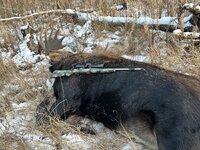
There isn’t a bull elk walking the planet that comes close to the body size of this moose.
223AI. 88 gr ELD m. 176 yards. Quartering to me at the shot, shot squarely and on purpose through the humerus.
That bone (and there isn’t a bone on ANY elk that comes close to the size of that one, was shattered to the point that when I was quartering that bull that front leg just folded over on itself while I was skinning.
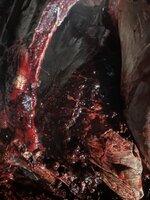
Both lungs mush and bloodshot. Literal gallons of lung, turned to black mush.
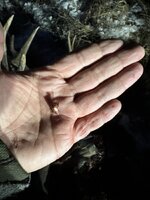
Found the jacket for that bullet lodged in the last rib on the opposite side of the impact, and parts of it under the hide. 3’+ of penetration.

Long, heavy for caliber bullets spun from a fast twist and not pushed faster than the jacket can handle flat out work. The diameter is a lot less important than guys think. IMG_0199.jpegIMG_0194.jpeg
IMG_0184.jpeg
The part that you continually miss is that it isn’t only the weight of the bullet that matters. It’s the weight in relation to its diameter, coupled with its shape and construction. Just because a bullet of larger diameter is heavier that doesn’t necessarily mean that it’s going to penetrate deeper.

 
But, what about a quartering to you shot, especially on a mature bull where the neck and shoulder are much heavier and, god forbid, that explosive little bullet hits the humerus or scapula and most of it never gets inside the chest? What about straight on facing you? Neither of those scenarios favor highly frangible bullets, especially little ones. Now, take a bigger, heavier controlled expansion bullet, like the 225 grain .338 TTSX I like so much. Quartering to me, I put that bullet right on the point of the shoulder, knowing it’ll destroy any bone it encounters and keep right on going into the chest cavity. Facing me directly, that bullet drives all the way through the chest lengthwise and ends up in the paunch or maybe back leg.
I’ve never been a big magnum shooter, but I grew up in a family where 30-06 was king. I’ve heard my whole life that a .270 Win was marginal for elk. I shot several elk with 165 TTSX and thought that was the ideal elk and deer setup. With what I’ve personally seen over the last few years, plus what guys have posted on here( see moose post above) I wouldn’t hesitate to take a frontal shot on any any bull walking with a heavy ELDM or TMK from a .22 or 6mm.
I don’t think most shooters of small frangible bullets would try a shot on a bull facing away as they know the bullet won’t get all the way into the chest cavity. The bullet I chose for this example will get all the way there nearly every time unless it hits major bones in the back end, and then it’ll do a lot more damage than 5-10 grain bullet fragments.

I’m not shooting an animal in the hindquarters unless there’s already a serious rodeo going on. And if that did have to happen, I’d prefer the damage caused by a heavy TMK over what a Barnes would do.
 
That's some impressive killing!

Sent from my SM-S911U using Tapatalk
To be fair, I did shoot him twice in about 3 seconds., because the shooting is the fun part. At the first shot he hopped forward three steps and when the trigger broke on the second shot he was already falling over sideways. That one exited but it was just broadside ribs.
 
I’m not shooting an animal in the hindquarters unless there’s already a serious rodeo going on. And if that did have to happen, I’d prefer the damage caused by a heavy TMK over what a Barnes would do.
I’ve caught a surprising number of TSX’s from a 300 RUM in 168/180/200 gr weights on quartering in/out and broadside shots on moose/elk/bears(black and grizzlies) and I know I wouldn’t expect to drive one up the hoop and make it to lungs 100% of the time. If I had a rodeo and was of a need to shut it down on a straightaway shot I’d hold for spine or hip with an 88, and expect to stop the bull and finish him with another.
 
To be fair, I did shoot him twice in about 3 seconds., because the shooting is the fun part. At the first shot he hopped forward three steps and when the trigger broke on the second shot he was already falling over sideways. That one exited but it was just broadside ribs.
I was taught to keep shooting until the animal goes down, so I don't blame you! With smaller cartridges, it's way easier to place a second shot

Sent from my SM-S911U using Tapatalk
 
*sigh*….

Hi. Small caliber guy here, former big boomer guy.
There isn’t a bull elk walking the planet that comes close to the body size of this moose.
223AI. 88 gr ELD m. 176 yards. Quartering to me at the shot, shot squarely and on purpose through the humerus.
That bone (and there isn’t a bone on ANY elk that comes close to the size of that one, was shattered to the point that when I was quartering that bull that front leg just folded over on itself while I was skinning.
Both lungs mush and bloodshot. Literal gallons of lung, turned to black mush.
Found the jacket for that bullet lodged in the last rib on the opposite side of the impact, and parts of it under the hide. 3’+ of penetration.

Long, heavy for caliber bullets spun from a fast twist and not pushed faster than the jacket can handle flat out work. The diameter is a lot less important than guys think. View attachment 1079821View attachment 1079822
View attachment 1079814
The part that you continually miss is that it isn’t only the weight of the bullet that matters. It’s the weight in relation to its diameter, coupled with its shape and construction. Just because a bullet of larger diameter is heavier that doesn’t necessarily mean that it’s going to penetrate deeper.
I’m sure he will come back to this post and say “man I was wrong. I learned something new! Thank you.”

He will come back….right?
 
*sigh*….

Hi. Small caliber guy here, former big boomer guy.
There isn’t a bull elk walking the planet that comes close to the body size of this moose.
223AI. 88 gr ELD m. 176 yards. Quartering to me at the shot, shot squarely and on purpose through the humerus.
That bone (and there isn’t a bone on ANY elk that comes close to the size of that one, was shattered to the point that when I was quartering that bull that front leg just folded over on itself while I was skinning.
Both lungs mush and bloodshot. Literal gallons of lung, turned to black mush.
Found the jacket for that bullet lodged in the last rib on the opposite side of the impact, and parts of it under the hide. 3’+ of penetration.

Long, heavy for caliber bullets spun from a fast twist and not pushed faster than the jacket can handle flat out work. The diameter is a lot less important than guys think. View attachment 1079821View attachment 1079822
View attachment 1079814
The part that you continually miss is that it isn’t only the weight of the bullet that matters. It’s the weight in relation to its diameter, coupled with its shape and construction. Just because a bullet of larger diameter is heavier that doesn’t necessarily mean that it’s going to penetrate deeper.
That's gross bro! Overkill! You should probably step down to a 204 ruger!


If there was some circumstance where I was teleported to the side of a mountain with a 223 then id have no problem sending it at an elk. And my "bear gun" (6#, built for scouting with an off chance of bear sighting), and my "bear fighting gun" (5# 14.5, putting it together for pack outs in grizzly country) are both stoked with bh 77 tmks.

But I'll be carrying a 18" 6 creed this year with 116s. Or a 26" 25 prc with 135 tmks. I want the extra terminal range, but more importantly less wind drift. Ive shot that 25 prc at a bunch of nrls and got my mulie with it last year. I cant see exactly where the bullets hit on the plate everytime. But I can usually make out where I miss (and that was rare, I placed well with it).

I see no reason to shoot a round with any more juice then a 6.5 prc. I do prefer a little more damage then a 223 and 77s but its adequate.

Ive shot 2 deer with TMKs. Doe and a spike.

The doe was quartering too me more then I accounted for, quick opportunity, 80 yards, kneeled and sent it. Hit her slightly high in the middle angled back into the guts. She bounded right, them back left towards her friend. I sent another. Entered the exact same hole but angled forward. So pretty neat to contrast both shot placements on the same opportunity.

First Bullet under the offside hide. Damage to the guts wasnt much. I'd clearly put it in the underwhelming category. The second bullet turned the front half into liquid and even broke the spine. Some bullet almost to the offside hide in the shoulder meat, some in the backstrap.

I think the bullet likes the juicyness of the front half.

Shot the spike last year at 40 yards with a 20". 2800ish fps. Treestand, heart shot low exit. 50 and down. Soupy soupy with a 2.5" exit and blood all over the palmettos.

Im 100% on board with small caliber shootability. But I do know that 6 creed and that 25 prc will give a lot more margin on wind calls then a 223, and a bit more margin on terminal effect.
 
Back
Top