Opinion on water resistant or non-water resistant barefoot boots for all season hunting?

I wasn't wearing the kenetreks daily...just when hiking/hunting. I made the switch to barefoot shoes the day after that post I made and am glad I did. I now wear them all day everyday. I've been doing mtn tough workouts in them daily and my feet, ankles and knees are doing much better and feeling stronger. I have been stretching every day (heel raises, etc) and some short easy trail hiking with my barefoot shoes and am slowly working up to longer distances. I used them for my first off trail hiking experience on Saturday. I was side hilling in some super steep rocks/shale (not on purpose, but I ended up there lol). I was sliding like crazy and it required some flex in my ankles. It felt really odd to be honest.

I may have transitioned faster than I should have, but here we are.

It was a situation that I have rolled my ankles many times in my kenetreks. It was a different feeling with these shoes but I didn't roll an ankle or hurt my foot or knees. I honestly wish I would have switched over sooner but again it was something I never knew existed and I thought stronger boot would save my ankles.

I'm definitely not gonna go full send hunting on the barefoots though yet. I'm gonna take some regular boots too.
You do you. After “The Book” came out back in 2009, a lot of people got injured, myself included, doing exactly what you’re describing.

I was a cocky dumbass and immediately bought and started wearing minimalist shoes with no transition period. It didn’t turn out well. A decade later, I tried barefoot shoes again, but transitioned over about 14 months without issue or injury.

My main thing is I want to have the boots to at least get them broken in and start using them a little bit before I start scouting for archery in June. Mainly so they aren't foreign to me and I know what to expect. I'm definitely not gonna go full send though.
Break-in with any of the options listed in this thread will not be a problem. Most will be perfectly fine out of the box, with JG’s taking a bit longer.
 
You do you. After “The Book” came out back in 2009, a lot of people got injured, myself included, doing exactly what you’re describing.

I was a cocky dumbass and immediately bought and started wearing minimalist shoes with no transition period. It didn’t turn out well. A decade later, I tried barefoot shoes again, but transitioned over about 14 months without issue or injury.


Break-in with any of the options listed in this thread will not be a problem. Most will be perfectly fine out of the box, with JG’s taking a bit longer.
I didn't even know there was a book until last week. I listened to it this weekend on audible. I wasn't necessarily being a "cocky dumbass" I'm just new and hadn't read about people's injuries. I should have researched more. I'll definitely take it slower though.

I watched some videos on the lems and it seems like they don't have very good traction. I guess I'll have to order a pair and see.
 
For the last 4 years I have been wearing Kenetrek Hardscrabbles as my year 'round boot. They are all leather and I have mainly worn an all leather boot for hiking all my life. Due to some foot and ankle injuries that I have attributed to week feet/ankles from hiking in stiff boots all the time, I have switched over to barefoot shoes as my daily shoes for a month now and have started recovering nicely from my injury that happened while hunting in october. I have noticed way more strength in my feet and ankles just over this short amount of time. I have always had a waterproof/water resistant leather boot and am used to them in both hot/warm and cold weather. I have thought about buying some synthetic material boots/shoes for hiking but am worried about durability and water resistance.

In barefoot shoes there are very few boots that are water resistant and have the grip I want. I'm in Utah so from sept-december (even august sometimes) there is the possibility of snow and that is where I really get concerned not having a waterproof boot.

I'm wondering if people here use a non waterproof synthetic boot/shoe in the spring/summer/fall and then a separate boot in the colder months of october-december? Or if they have a barefoot boot they recommend for year round use? I'm not worried about insulation as I have never worn an insulated boot even when I go ice fishing. I use socks and moisture regulation to handle my foot warmth.

I'm interested in the vivo tracker esc or the magna tracker esc but am also open to other ideas since I am now buying all new footwear.
I used to hike, hunt, and generally do everything in stiff, leather, waterproof hunting boots, and two years ago made the switch to barefoot shoes for everything.

The best "all season" ones for hiking I have used are the vivo forest tracker esc. The leather breathes in the summer, is fairly waterproof when oiled/waxed in the fall/winter, and dries much quicker than a boot with a gore-tex or similar waterproof liner. After using them and other leather boots, I have come to greatly dislike the clamminess of boots with a modern waterproof liner.

There's some good information on vivo forest trackers and other barefoot shoes here if you haven't read it already:

More info on vivos and waterproof socks:
 
Oh okay, that makes sense! Out of curiosity what did you resole your troopers with and how much did that cost? That sucks that that the stock sole isn't sufficient.
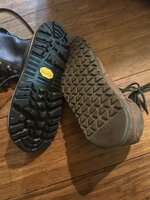
I got them resoled with a vibram sierra sole. Cost 120, they continue to be resolable as well. IMG_1794.jpeg

Alternatively nicks is now making a zero drop stitch down style boot, may try one eventually but these have been working well for me. I also have some Jim green barefoot rangers I use for every day and work. Been happy with them overall. They offer a bit more protection than the vivo and hold up a lot better.
 
I wonder how much of a stack height is too high to make it to where I have the danger of rolling my ankle more? Does anyone know?

I think the Lems Boulders that I looked at were like 17mm or something.
@Small-foot has used a variety of barefoot boots, including boulder boots and forest trackers, and might also be able to speak to at what point stack height is problematic.
 
I watched some videos on the lems and it seems like they don't have very good traction. I guess I'll have to order a pair and see.

I’ve gone through probably half a dozen pairs of boulder boots for work, they are very comfortable….. and probably the least durable and the worst traction of any minimalist boot that I’ve had. Lems has come out with a different model, I think the Summit? Looks like a better sole but I haven’t tried them yet. My current work boots are Beleville Mini-Mils, been very happy with them.
 
I wasn't necessarily being a "cocky dumbass" I'm just new and hadn't read about people's injuries.
I know. That was a reflection of my attitude back then and not an inference toward you.
I watched some videos on the lems and it seems like they don't have very good traction. I guess I'll have to order a pair and see.
It varies widely based on the model you’re looking at. The newer Summit models with the vibram sole are quite good.
 
I know. That was a reflection of my attitude back then and not an inference toward you.

It varies widely based on the model you’re looking at. The newer Summit models with the vibram sole are quite good.
Totally understand. I'm just grateful for all the advice and help I have recieved. Maybe you don't know the answer to this or maybe you do, but I ordered a pair of xero ridgeways to try out. Saturday was the first time I wore them and my foot was sliding all the way to the front and was hurting my toes while going down a steep hill. I tried some lacing techniques to try and lock my foot in place but that didn't do much good. I haven't ever had that issue with "regular" boots. Is that a common problem with barefoot boots in general? Or could it have been just those particular boots.

I did end up returning them because the stitching started coming undone the very first day.
 
Totally understand. I'm just grateful for all the advice and help I have recieved. Maybe you don't know the answer to this or maybe you do, but I ordered a pair of xero ridgeways to try out. Saturday was the first time I wore them and my foot was sliding all the way to the front and was hurting my toes while going down a steep hill. I tried some lacing techniques to try and lock my foot in place but that didn't do much good. I haven't ever had that issue with "regular" boots. Is that a common problem with barefoot boots in general? Or could it have been just those particular boots.

I did end up returning them because the stitching started coming undone the very first day.
Some shoe designs are better than others. Extra length helps. A good “rule of thumb” is to actually use your thumb as a ruler for extra toe space. Aim for 1-2 cm of extra room in front of your toes depending upon preference and use case.
 
Some shoe designs are better than others. Extra length helps. A good “rule of thumb” is to actually use your thumb as a ruler for extra toe space. Aim for 1-2 cm of extra room in front of your toes depending upon preference and use case.
I went up half a size from my normal boot size. I had at least a thumb width of room in the front of the toe box. That already felt kind of big. Hopefully whatever boot I decide to get end up being better about that. I was mainly just wondering if it is common and something I have to get used to.
 
I'd also caution you to take it slow. I'm glad you are making progress and feeling good but it's more than just the muscles that need time to adapt and the ligaments, tendons, bone density, etc. takes more time than the muscles.

I have more barefoot shoes and boots than I care to admit at this point. My favorite so far are the Vivobarefoot Forest ESC's. I picked up a pair of Freet Chamois not too long ago and really like them as well but have much less time on them so I can't comment on durability or even long term waterproofness. I did a really wet hunt with the Vivo's a couple of years ago and while my feet got drenched, I rotated socks and the boots were completely dry in a single day of use once the weather cleared up.

For most Barefoot boots, and especially the Vivo Forest Esc's, keeping the lacing loose actually really helps my foot stay in place. By loose I mean you can put two fingers easily under the tongue. It seems counterintuitive but really works. I've used them in some really steep country without issues of my toes hitting the front.

Sent from my Pixel 9 Pro using Tapatalk
 
I'd also caution you to take it slow. I'm glad you are making progress and feeling good but it's more than just the muscles that need time to adapt and the ligaments, tendons, bone density, etc. takes more time than the muscles.

I have more barefoot shoes and boots than I care to admit at this point. My favorite so far are the Vivobarefoot Forest ESC's. I picked up a pair of Freet Chamois not too long ago and really like them as well but have much less time on them so I can't comment on durability or even long term waterproofness. I did a really wet hunt with the Vivo's a couple of years ago and while my feet got drenched, I rotated socks and the boots were completely dry in a single day of use once the weather cleared up.

For most Barefoot boots, and especially the Vivo Forest Esc's, keeping the lacing loose actually really helps my foot stay in place. By loose I mean you can put two fingers easily under the tongue. It seems counterintuitive but really works. I've used them in some really steep country without issues of my toes hitting the front.

Sent from my Pixel 9 Pro using Tapatalk
Keeping the laces looser does seem counterintuitive, but hey so does the concept of barefoot shoes and ankle/foot support while hiking in the mountains. So I'm willing to give it a try. Thanks for the advice.
 
I wonder how much of a stack height is too high to make it to where I have the danger of rolling my ankle more? Does anyone know?

I think the Lems Boulders that I looked at were like 17mm or something.
Hey, as @24valve mentioned, I’ve worn both Lems and Vivo boots. I’ve worn inov-8, Xero, Altra, and Vivo shoes all to varying degrees and been in barefoot footwear >90% of my time for 3-4 years. I should note that I used to have ankle issues from HS sports and some structural issues in my feet, but rehabbed myself during PT school and haven’t had much issues since if I keep up with my stuff for them.

I’ve been wearing the forest trackers for about 4 years so far. I got the Lems summit boulder boot around Christmas, so much more experience in the trackers. I have quite a bit of daily miles in the Lems so far though as they’ve become my go to casual shoe. As others have said, Lems aren’t the most durable, the toe piece started to peel away from the leather on mine within a few weeks. I wrote customer service and they were willing to repair or swap them if I wanted, but I just put some shoe goo in there and said the heck with it. I don’t love that they’re waterproof because your feet get clammy and there’s nowhere for the moisture to go. By the end of the day I feel like I’ve got swamp feet if it’s warm out. I’ve worn them for some easy hikes so far and felt fine in terms of ankle stability. I have a friend that wore the summit for her trip to Africa and hiked Kilimanjaro in them though too and had no issues.

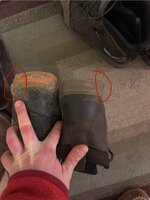
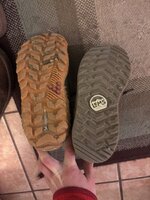
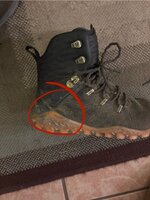
Stack height does become a concern at some point, but the forest tracker height is 7.5-10mm depending on the insole, so you’re looking at a 6-8mm difference between that and Lems’ claimed 16mm in the boulder. Not something many people will notice IMO. The Lems also have a wider footbed which gives stability. I’ve done some easier side hilling with a light pack and not noticed anything significant compared to the trackers. Your issue with stability gets more apparent in a narrow foot bed or with higher heel drop heights which obviously is a moot point in barefoot (zero-drop) shoes. The thing that I think helps in a lot of Vivos is the way their foot bed wraps up and cups the heel allowing for less side to side movement within the shoe so that your heel can’t slip past the sole/footbed and roll over the edge. That’s the circled part in the photo with just the tracker. As you can see in the comparison photos, Lems outsole is wider than the foot bed which helps with stability. Vivos curves back inward at the outsole, but they have a stiffer outsole with less give and more lateral support to prevent rolling. Two ways to attack the same problem.

As many have stated, waterproof footwear with liners will hold moisture and dry slower. In the trackers my feet are rarely damp, they breathe well enough that hiking I won’t sweat much which helps to be warmer once sitting. I’ve walked through wet grass, swampy areas, small creeks, and an entire day in wet snow with only slight dampness at the seams in my trackers. A little sno seal or something similar goes a long way in damp environments and they still dry overnight. I can’t tell you how the summits do in wet environments yet, but I also won’t likely be hiking in them as that’s why I have the trackers.
 

Attachments

  • IMG_6012.jpeg
    IMG_6012.jpeg
    354 KB · Views: 3
  • IMG_6013.jpeg
    IMG_6013.jpeg
    429.3 KB · Views: 3
  • IMG_6014.jpeg
    IMG_6014.jpeg
    409.5 KB · Views: 3
Back
Top