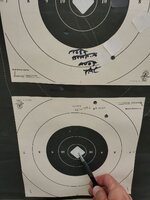
One flier in every group 308 load developement

Joined
Feb 12, 2014
Messages
377
Location
Oklahoma
I am working on getting a hunting load built for deer and elk. I'm shooting a Howa 1500 HS with a 22"bbl 1/10" .

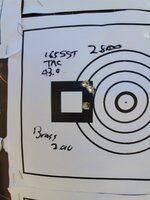
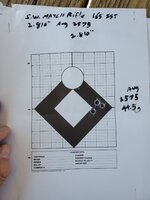
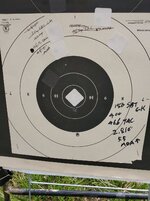
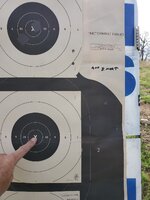
At 100 yards I have some 3 shot groups under 1". I wanted to see what my come ups are at 400 yards and the 3 shot groups seem to show a similar theme. One round is a flier and two shots decently grouped. The fliers even seem to be aproximately the same distance away from the other two shots each time.

Attached are some pics of some groups from each distance. I bedded the action yesterday and will test fire it this weekend to see if anything changes. Gun was WARM during most groups at 400. No idea which shot in the string is the flier. I'm going to guess the last but who knows?
 

Attachments

  • 167427852_893776814744248_4234866576057952300_n.jpg
    167427852_893776814744248_4234866576057952300_n.jpg
    109.1 KB · Views: 87
  • 167954087_933796273826322_367901734487639188_n.jpg
    167954087_933796273826322_367901734487639188_n.jpg
    170.8 KB · Views: 86
  • 168941863_354432679320651_1989746260572120953_n.jpg
    168941863_354432679320651_1989746260572120953_n.jpg
    234.1 KB · Views: 82
  • 169064858_174155311194619_1247834668909559643_n.jpg
    169064858_174155311194619_1247834668909559643_n.jpg
    178.9 KB · Views: 82
  • 170464180_1680350302173801_3313496908562549491_n.jpg
    170464180_1680350302173801_3313496908562549491_n.jpg
    188 KB · Views: 84
Last edited:
In your 3 round group, which shot is the 'flyer', or is it random (100 yard groups)?
Maybe try shooting a 5 round group. Some will advise shooting a 10 round group to establish a true zero.
It could be that it may not be a 'flyer', it may be that is just what your rifle / load shoots. A group with more rounds may help give you a better 'picture' of what is really going on.

Thank You For Your Service

Good luck with your shooting
 
10 shot groups was a revelation for me. Try it out at 100 yards. Suppose you do that, and the 10-shot group is 2” wide at its widest point (meaning you shoot about 2MOA). Then randomly pick any three out of the ten. If you had only shot those three, then depending on which three shots it is, it could easily look like two good shots and a flyer, or like a clover leaf, or like a 1” group for 1 MOA when it’s really just three shots out of an actual 2 MOA group.
 
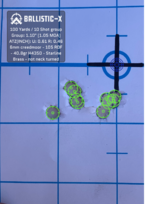
It has taken me years to figure out why I would always get flyers in my reloads. I kept trying different things, but brass quality was the main reason. The more consistent the brass the better the groups. To fix my cheaper brass I started neck turning it. Here is a test I did with starline brass, both 10 shot groups at 100 yards, all brass was from the same lot. The neck turned brass was almost half the size and very consistent. Hope this helps.
 

Attachments

  • A22AD345-9A18-45D8-86C9-05596F12DFD9.png
    A22AD345-9A18-45D8-86C9-05596F12DFD9.png
    1.7 MB · Views: 52
  • 23CA5C33-CA87-4201-9CB9-A9067A299DA8.png
    23CA5C33-CA87-4201-9CB9-A9067A299DA8.png
    1.7 MB · Views: 54
Thanks guys. As stated, I have no idea which one is the flier in each group. With primer shortage, I have limited my groups to 3 out of nessecity. When I test fire the rifle/loads again, I will update with results. Again, thank you all for responding.
 
It has taken me years to figure out why I would always get flyers in my reloads. I kept trying different things, but brass quality was the main reason. The more consistent the brass the better the groups. To fix my cheaper brass I started neck turning it. Here is a test I did with starline brass, both 10 shot groups at 100 yards, all brass was from the same lot. The neck turned brass was almost half the size and very consistent. Hope this helps.
Describe the neck turning process to me please.
 
Short of changing something while loading, I'd say slow down with your shots.

Also are you shooting over a chronograph? What are those numbers?
 
Short of changing something while loading, I'd say slow down with your shots.

Also are you shooting over a chronograph? What are those numbers?
Dont have them in front of me right now but they were fairly consistent at 100 when shooting slower(cooler barrel) At 400 the barrel was warmer and I did see some jumps in MZV.
 
Thanks guys. As stated, I have no idea which one is the flier in each group. With primer shortage, I have limited my groups to 3 out of nessecity. When I test fire the rifle/loads again, I will update with results. Again, thank you all for responding.

What is the difference in component usage between multiple 3 shot “groups” on multiple trips, and a single 10+ round group during one trip? Your “flyers”, aren’t flyers. They’re just rounds in a group with random distribution.
 
What is the difference in component usage between multiple 3 shot “groups” on multiple trips, and a single 10+ round group during one trip? Your “flyers”, aren’t flyers. They’re just rounds in a group with random distribution.
My reasoning was due to load testing with varying weight charges. 3 round groups gave me more powder charge tests. 46.2, 46.4, 465.6 etc.. running out of primers....
 
My reasoning was due to load testing with varying weight charges. 3 round groups gave me more powder charge tests. 46.2, 46.4, 465.6 etc.. running out of primers....

Except that doing what you’re doing is wasting both components and time. 3 rounds isn’t a group. It’s three random events. As an example- you fire 3 rounds of each at 46.2, 46.4, 46.5. Let say 46.2 shot the best today. You shoot the exact same loads tomorrow, and it is more likely that one of the other two will shoot better. And the next day it will change again. The reason is because you’re not actually getting any useful information off of those three shots.
To break it down even more- do you really want a load that is so finicky that .2 of a grain makes a noticeable difference? What are you going to do a couple hundred rounds from now do IF 46.4 shoots great, but 46.2 doesn’t and the throat wears?

The whole “3 shot group load work up” thing is complete and utter nonsense. It is ballistic and mental masturbation in totality.
 
Except that doing what you’re doing is wasting both components and time. 3 rounds isn’t a group. It’s three random events. As an example- you fire 3 rounds of each at 46.2, 46.4, 46.5. Let say 46.2 shot the best today. You shoot the exact same loads tomorrow, and it is more likely that one of the other two will shoot better. And the next day it will change again. The reason is because you’re not actually getting any useful information off of those three shots.
To break it down even more- do you really want a load that is so finicky that .2 of a grain makes a noticeable difference? What are you going to do a couple hundred rounds from now do IF 46.4 shoots great, but 46.2 doesn’t and the throat wears?

The whole “3 shot group load work up” thing is complete and utter nonsense. It is ballistic and mental masturbation in totality.
When a millionaire tells you that getting into the stock market with less than 100K is a waste of time.

Much respect for your expertise, but not everyone has the luxuries that are available to you sir. Some of us have to make due with what we have and accept the limitations of that.
 
When a millionaire tells you that getting into the stock market with less than 100K is a waste of time.

Much respect for your expertise, but not everyone has the luxuries that are available to you sir. Some of us have to make due with what we have and accept the limitations of that.

Actually, exact opposite sir. Load development for the last 6.5 CM involved 10 rounds of max load of RL16 and a 130gr TMK loaded to mag length resulted in about 1.2 for those ten. It’s done. Before that in another rifle, it took 11 rounds. One at .5fr under max to check pressure, then ten at max for a group. That went 1.3’ish. The last 308 was zero load development- loaded ten rounds at book max and mag length. Those ten went just under 1 moa.

The endless “load development” is the silly part. Load 5 rounds at book max or just under. Shoot them. If they shoot remotely decent, load 20. Shoot ten to zero, and ten to velocity true. Load development is done. .1, .2, .5 grain changes in powder isn’t going to make an actual real difference. Either it shoots, or you need to make a major change in components- change powder and/or bullet.

Incremental reductions in group size do not, and will not increase hit rates on animals in the field- group size isn’t why people miss.
 
Describe the neck turning process to me please.
I use a K&M neck turning kit, there are others out there. I just got super lucky and found a kit dirt cheap on Craigslist of all places. But I won’t lie, it’s an added expense to reloading and it’s time consuming. Once I bought the kit I had to add my caliber specific components. Basically when you neck turn you are uniforming the brass thickness on the neck. It’s like a mini lathe. It’s kinda hard to explain so here is a video to help you visual see it.


I don’t neck turn everything, not enough time in the day, but I neck turn my 6mm Creedmoor, which I use for long range practice and Antelope hunting and I neck turn my 300wm. If all this seems too much I would highly recommend investing in high quality brass, if you haven’t already done so. Lapua, Peterson, ADG, Nosler all make 308 brass. Hornady and Norma aren’t bad either. The high end stuff is still available if you watch it, i was able to grab 100 pieces of Peterson 300wm brass a couple weeks ago.
 
Actually, exact opposite sir. Load development for the last 6.5 CM involved 10 rounds of max load of RL16 and a 130gr TMK loaded to mag length resulted in about 1.2 for those ten. It’s done. Before that in another rifle, it took 11 rounds. One at .5fr under max to check pressure, then ten at max for a group. That went 1.3’ish. The last 308 was zero load development- loaded ten rounds at book max and mag length. Those ten went just under 1 moa.

The endless “load development” is the silly part. Load 5 rounds at book max or just under. Shoot them. If they shoot remotely decent, load 20. Shoot ten to zero, and ten to velocity true. Load development is done. .1, .2, .5 grain changes in powder isn’t going to make an actual real difference. Either it shoots, or you need to make a major change in components- change powder and/or bullet.

Incremental reductions in group size do not, and will not increase hit rates on animals in the field- group size isn’t why people miss.

Hmm...I get what you're saying. When I think back to all of the load development I've done I almost always end up with a load that is near the max for whatever powder/bullet combo I'm using. I don't have enough data to be confident that this hasn't been a coincidence though....I'm pretty confident that you do have the data to back up what you're saying.

For this reason I always go through the process of shooting three shot groups to find barrel harmonics that allow me to have a consistent POI if my charge weights and velocities vary from round to round. Once I've found that sweet spot (which I admit has always been around max load), that's when I shoot a 10 shot group to get the best zero I can and measure my velocity to work up a dope chart...then I go hunting. Had I followed your process and just started near max load I would have saved myself a lot of time and components.

As always you've given me a lot to think about.
 
The endless “load development” is the silly part. Load 5 rounds at book max or just under. Shoot them. If they shoot remotely decent, load 20. Shoot ten to zero, and ten to velocity true. Load development is done. .1, .2, .5 grain changes in powder isn’t going to make an actual real difference. Either it shoots, or you need to make a major change in components- change powder and/or bullet.
do you look at thinks like SD's when selecting a load? or does it really not make much of a difference?
 
do you look at thinks like SD's when selecting a load? or does it really not make much of a difference?

It depends on application. For hunting a shooting out to 600’ish yards- Nope. Once I get in the 1.2-1.5 moa for ten round range I quit messing with it and go worry about stuff that matters. For dedicated LR rifles or competition rifles where I will be shooting/hunting a lot at 800+ yards mainly... yeah a bit. But I actually haven’t had a load/ammo that I remember that does 1 moa or less for ten rounds at 100 and 300 yards that wasn’t capable of 800 yard animals. The reality is that we miss due to the largest source of errors. The largest errors aren’t group size or velocity variations; they are positional wobble zone, wind, excitement, and manipulation failures.
 
As stated, 3 shot "groups" aren't giving you enough data to build on. That and you aren't even sure which of those holes you would call the "flier." 5 at a minimum, 10 preferably. Form has explained in detail why so I won't rehash. I personally don't believe in "fliers;' that is how you, the rifle, or a combo of both, shoot. What I would call a "flier" is a shot I knew I messed up.

If you are truly that low on comps, skip the .2 increments. That kind of load development is for F class or similar, not a hunting load. Half grain increments, at most. I tend to do what Form said, load up at or close to book max and see what I get. Generally I achieve acceptable accuracy and velocity for my hunting ranges; 500 and under based on bullet design.
 
Back
Top