NHS Review

Carl Ross

WKR
Joined
Oct 30, 2014
Messages
349
@Ryan Avery @Unknown Suppressors sent me a NHS to use and review.
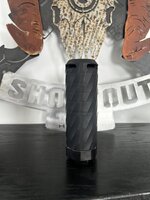
IMG_1574.jpeg

I got a hold of it Tuesday. It went on my 6 Dasher, which is a pretty standard PRS build (21ish lbs, MPA chassis, etc etc).

Took it to the range Friday to zero and do a little practice. After the first string I could tell I 100% was going to want to reduce mirage, so it got a wrap.
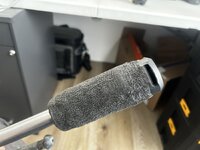
IMG_1586.jpeg

I've shot this rifle lots with both APA gen 3 Little Bastards and more recently a TBAC Magnus (pre-RR). I had to put the Magnus on for a night match, I left it on because it was more pleasant and because I think the concussion hurt my ability to spot shots more than the difference in recoil and muzzle rise.

The long and short of it is this NHS gives similar recoil characteristics to the brake, but without any concussion and with little enough noise to be a non-factor while wearing any single level of ear pro. It's just what I hoped it would be, it strongly reduces recoil and eliminates muzzle rise with Dasher powder levels. I would bet in an instrumented test it is slightly less in pure recoil reduction than the most aggressive brakes. When it comes to the overall dynamics of spotting your shots I'd favor the NHS vs anything I've personally used.

Shot a match with it Saturday and let some fellow competitors try it out too. They were impressed; I think some were underestimating it due to the size of the ports vs say a TBAC RR or Recoil X. In this case, port size isn't a good proxy for performance.

I'll be shooting it a whole lot more and keeping any new thoughts here. If you have any questions I'll do my best to answer them.
 
I have to ask as I’ve never shot in a competition or owned a rifle that weighed 21lbs. How much recoil is there to begin with on a heavy rifle shooting a pussycat cartridge like the dasher? I assume 4-6 lbs? Would this have the same efficiency on a sub 10lb CM hunting rig?

Is this all about staying in the scope to move to the next target?

Not being difficult, just trying to understand the use case. Would this be advantageous on an AR for moving to multiple targets?

I doubt I will shoot competitively, but I would be interested if it allows a quicker time on target for an AR. Help me figure out an alternative use case. Hogs with a thermal?
 
I have to ask as I’ve never shot in a competition or owned a rifle that weighed 21lbs. How much recoil is there to begin with on a heavy rifle shooting a pussycat cartridge like the dasher? I assume 4-6 lbs? Would this have the same efficiency on a sub 10lb CM hunting rig?

Is this all about staying in the scope to move to the next target?

Not being difficult, just trying to understand the use case. Would this be advantageous on an AR for moving to multiple targets?

I doubt I will shoot competitively, but I would be interested if it allows a quicker time on target for an AR. Help me figure out an alternative use case. Hogs with a thermal?

It's all about spotting your shots in the scope as well as possible. Top competitors go to GREAT lengths to improve their ability to see what happens on target. If you see where the shot you just took landed, assuming you did everything perfectly shooting it, you have the best possible information for where the next shot will land. The less the rifle moves under recoil, the more you can reduce input pressure on the rifle and still see your impact.

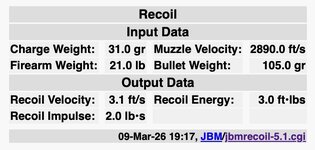
Recoil for the setup I shot this weekend without a muzzle device figured in:

Image 3-9-26 at 7.17 PM.jpeg


Now...with my rifle in particular it isn't difficult to shoot it with a can and still spot impacts from all positions found in competition. It does require SOME pressure on the rifle which can matter on a handful of wobbly props. A NRL Hunter Open Light rifle by comparison more or less has to be a 12 lb or under 6.5 Creedmoor, so the absolute recoil and the recoil difference both will be significantly larger and more impactful. A 8-9 lb 6.5 PRC would be another large step up the recoil ladder, therefore making recoil reduction that much greater.

I think the primary use case will be competition, and my understanding is that was the design intent. However I could see some people using them on lighter weight higher recoiling hunting rifles for improving shoot-ability and shot spotting.
 
It's all about spotting your shots in the scope as well as possible. Top competitors go to GREAT lengths to improve their ability to see what happens on target. If you see where the shot you just took landed, assuming you did everything perfectly shooting it, you have the best possible information for where the next shot will land. The less the rifle moves under recoil, the more you can reduce input pressure on the rifle and still see your impact.

Recoil for the setup I shot this weekend without a muzzle device figured in:

View attachment 1034361


Now...with my rifle in particular it isn't difficult to shoot it with a can and still spot impacts from all positions found in competition. It does require SOME pressure on the rifle which can matter on a handful of wobbly props. A NRL Hunter Open Light rifle by comparison more or less has to be a 12 lb or under 6.5 Creedmoor, so the absolute recoil and the recoil difference both will be significantly larger and more impactful. A 8-9 lb 6.5 PRC would be another large step up the recoil ladder, therefore making recoil reduction that much greater.

I think the primary use case will be competition, and my understanding is that was the design intent. However I could see some people using them on lighter weight higher recoiling hunting rifles for improving shoot-ability and shot spotting.
Primary use is competitions. I am however interested in seeing what interesting stuff folks find it useful for. It is very different what is available on the market!
 
Carl Ross. Could you also test on an AR off shooting sticks/ tripod. I would appreciate any tips or details for more stability as I assume it is similar to a competition regarding the speed required.

When we shoot hogs at night you have a very narrow FOV in the thermal. You can see a dozen hogs rooting but as soon as you shoot it’s a clown show. They run in every direction and you have to be very focused to shoot a second or third pig.

I am very interested if this works better than a standard suppressor such as my Ultra7 on a 6.5 Grendel AR.
 
Primary use is competitions. I am however interested in seeing what interesting stuff folks find it useful for. It is very different what is available on the market!
I think it’s the best form factor of the “competition” cans. Short and light.

Carl Ross. Could you also test on an AR off shooting sticks/ tripod. I would appreciate any tips or details for more stability as I assume it is similar to a competition regarding the speed required.

When we shoot hogs at night you have a very narrow FOV in the thermal. You can see a dozen hogs rooting but as soon as you shoot it’s a clown show. They run in every direction and you have to be very focused to shoot a second or third pig.

I am very interested if this works better than a standard suppressor such as my Ultra7 on a 6.5 Grendel AR.
I don’t have an AR that the NHS can would screw onto. I will try it on some lighter rifles for comparison. I can tell you it would make it easier to maintain sight picture vs an Ultra 7, but I can’t tell you by exactly how much.
 
Is the timing system repeatable when taking it off/on?

I don't know exactly what you mean by repeatable. What it is, is very easy to get it clocked how you want it. While your typical self timing brake takes me a few tries to get it "close enough", the NHS was easy to get right where I wanted it.
 
I don't know exactly what you mean by repeatable. What it is, is very easy to get it clocked how you want it. While your typical self timing brake takes me a few tries to get it "close enough", the NHS was easy to get right where I wanted it.
I guess my question is do I have to cloc it every time I take it off, or is it a set it and forget it (when taking on and off) kind of thing
 
I guess my question is do I have to cloc it every time I take it off, or is it a set it and forget it (when taking on and off) kind of thing

No- once the collar is set for that specific barrel, it tightens back to the same position.
 
Back
Top