Chris in TN
WKR
- Joined
- Jun 17, 2025
- Messages
- 1,918
Not much to offer here but, man, reading threads like this makes me thankful to live on land.

Follow along with the video below to see how to install our site as a web app on your home screen.
Note: This feature may not be available in some browsers.
Right? Everything has to be so complicated being in a hot sticky big cityNot much to offer here but, man, reading threads like this makes me thankful to live on land.
I wouldn't worry about getting all of your brass fired. Yes, there is some difference between fire-formed and virgin brass, but you are not going to realize any down-range difference between the two.Thanks guys! After hearing all this I think I'll probably go with 50 loaded rounds on my 1st trip with the 1st 5 or so rounds working up from low to mid range, a good handful loaded at mid range of book loads then have a few higher to test towards the end of the range session if pressure continues to look good as I work up.
Next range trip I'll take the remaining new brass loaded appropriately based on collected data from the 1st trip. And I'll load the fireformed brass down a bit from the initial work up with a few rounds to work up to if all checks out
My rangecraft should be showing up next week, so hopefully I can get out there next Saturday with some loaded rounds, and start the process.
Thanks, super helpful on mindset!I wouldn't worry about getting all of your brass fired. Yes, there is some difference between fire-formed and virgin brass, but you are not going to realize any down-range difference between the two.
I always want to go to the range and collect as much data as possible, so for my load development for new or fired brass, this is what I do.
I typically pick multiple different bullets and powders that I might want to use, and I load 3 just below the book max (refer to several manuals), 3 at .5gr under that load, and 3 at .5gr under that load. I repeat the same steps for different bullets/powders. Shoot them all low to high, looking for group size and signs of pressure in a single-range session to maximize my data and help find the right recipe. If one of those meets my goals, I load 20 and shoot to confirm things. If several meet my goals, then I load 10 of each and see which one comes out on top.
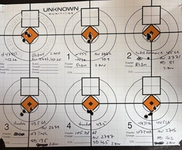
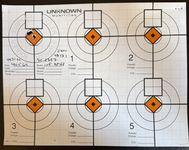
For example, the targets below: I used multiple different bullets and powders in one trip to the range. This gives me great data in one trip. Then, each trip to the range afterward, I am working with a proven load, so I can concentrate on my shooting skills and don't get into the habit of "I'm just shooting to fire form," which can encourage bad shooting habits because you don't care about what is going on with these loads.
Just my 2 cents, and sure not saying my method is the best, it's just my method.
View attachment 1046798View attachment 1046799

It feels backwards when only looking at the volume variable. However, I believe it's that the brass didn't have to move near as much with the once fired brass so more energy was put towards getting the bullet out of the barrel. That's about the only thing that makes sense to me at least. Regardless of the "why", now that I'm paying attention to that, it seems to happen across the board.I’m always trying to learn, so educate me. This sounds backwards to me. The fire formed brass should present a larger volume of chamber for the expanding gas to fill. Shouldn’t this result in slightly lower pressure?
To answer OP’s question from my point of view. I’m certainly not an expert and have been reloading on ly about 3 years, but approaching it from a very pragmatic angle. I’ve loaded for seven guns in 4 different calibers. My observation is that some barrels are picky about which projectile they like. The amount of any given powder that will shoot that projectile accurately can vary a bit, and is not super critical if your barrel likes a particular bullet. If it doesn’t like the bullet you can waste a ton of time trying to find a powder and not succeed. While there is no “magic bullet”, all of these rifles have shot pretty well using ELDX. Also had good luck with Sierra Game Kings and Nosler ABLR in a couple of those guns.

Definitely not a couple months. I’ve been loading for 30 years and I pick up/ learn new things along the way. Have fun in your loading journeyThanks I'll probably be the guy saying this in a couple of months as well.
There's a good chance I'm overthinking a lot over here as I am getting excited to begin the hobby, and am waiting for my press to arrive (tomorrow finally). So, I'm really just trying to think of ways to hopefully speed up that learning process you mentioned, and keep range fees, time and component costs to a minimum. I hate feeling like I wasted money or time when I do something, and come to find out in the moment, or later that I could have done something just slightly different, and saved time or money if I had just a bit of knowledge before taking action.
I know this hobby isn't cheap, but that doesn't mean I won't try my damndest to be efficient. Plus, the misses will be crawling up my backside if I'm spending too much money or time away from the family.
I wouldn't worry about getting all of your brass fired. Yes, there is some difference between fire-formed and virgin brass, but you are not going to realize any down-range difference between the two.
I always want to go to the range and collect as much data as possible, so for my load development for new or fired brass, this is what I do.
I typically pick multiple different bullets and powders that I might want to use, and I load 3 just below the book max (refer to several manuals), 3 at .5gr under that load, and 3 at .5gr under that load. I repeat the same steps for different bullets/powders. Shoot them all low to high, looking for group size and signs of pressure in a single-range session to maximize my data and help find the right recipe. If one of those meets my goals, I load 20 and shoot to confirm things. If several meet my goals, then I load 10 of each and see which one comes out on top.
For example, the targets below: I used multiple different bullets and powders in one trip to the range. This gives me great data in one trip. Then, each trip to the range afterward, I am working with a proven load, so I can concentrate on my shooting skills and don't get into the habit of "I'm just shooting to fire form," which can encourage bad shooting habits because you don't care about what is going on with these loads.
Just my 2 cents, and sure not saying my method is the best, it's just my method.
View attachment 1046798View attachment 1046799
I was going to mention that earlier but I have a bad habit of not being able to convey things without being abrasive, even when I'm trying to help. You said it much better than I probably would have.I used to do that as well. It led me to chase myself around in circles. I'm not saying it's wrong per-se but the three shot groups do not tell you literally anything in this case. Now if they were 5" apart, yeah, you can probably write that load off. But when comparing all of these on paper, it's not only possible, but likely, that some of those groups that have more dispersion actually perform as good or better than the groups that look good.
That's my opinion, take it with a grain of salt. Statistically speaking, there's not much useful data when comparing three round groups to one another.
Growing up is knowing your own strengths and weaknesses brother! I was surprised no one had said it. I certainly try not to come off that way but it's always hard via text. If your intent is well placed, then that's all that matters.I was going to mention that earlier but I have a bad habit of not being able to convey things without being abrasive, even when I'm trying to help. You said it much better than I probably would have.
Hornady 68 hpbt match, sig brass I have varget and super performance, probably going to try and find some h4350 to test out as well. I didn't spring for any super high quality stuff like lapua brass since I'm sure I'll mess something up and I don't want to be upset about ruining high end brass and bullets yet

Cartridge?Hornady 68 hpbt match, sig brass I have varget and super performance, probably going to try and find some h4350 to test out as well. I didn't spring for any super high quality stuff like lapua brass since I'm sure I'll mess something up and I don't want to be upset about ruining high end brass and bullets yet
22-250 8 twistCartridge?
I'd just pick something between 30.5 and 31.5gr of Varget and go shoot.22-250 8 twist
Ok, I'm open to learning something, so what is your process?I used to do that as well. It led me to chase myself around in circles. I'm not saying it's wrong per-se but the three shot groups do not tell you literally anything in this case. Now if they were 5" apart, yeah, you can probably write that load off. But when comparing all of these on paper, it's not only possible, but likely, that some of those groups that have more dispersion actually perform as good or better than the groups that look good.
That's my opinion, take it with a grain of salt. Statistically speaking, there's not much useful data when comparing three round groups to one another.
Man I'm in the middle of trying to go from one extreme to the other right now. My ultimate goal would be to be able to settle into something well below pressure that shot great with the least amount of work and wasted time/resources as possible.Ok, I'm open to learning something, so what is your process?
You were dead on on the 34 gn of Varget for the 68 gn bullet. Ran at 3,310 fps on average and had better SD and ES than 34.5 gn load.Great rifle, one of my favorites.
I have had great success with the 77 grain TMK and MK and 33.5 grains of Varget - 3230 fps
Also 33gn and an 80 Sierra - 3125 fps
I would try 34 gn with that 68.
An ES of 34.4 with a stick powder being charged with a measure ain't bad at all.Consistency in my lever pulls, sizing and powder charges is where I'll be spending my time next. I had large ES at 34.4 fps, and I think it's 100% due to my lack of consistency on the fundamental processes.