wowzers
WKR
- Joined
- Nov 22, 2012
- Messages
- 577
My one and only.

Follow along with the video below to see how to install our site as a web app on your home screen.
Note: This feature may not be available in some browsers.

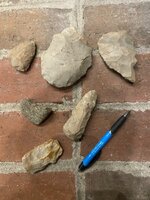
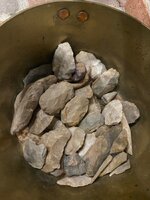
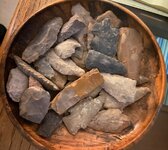
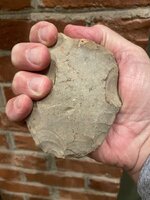
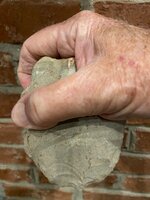

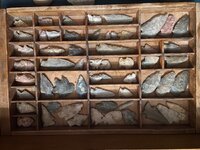
What are these impressions? Locations where people worked and created those wear marks?


https://www.projectilepoints.net/ is a WONDERFUL resource to look through.Cool thread, lots of unique items.
It would be interesting to learn more about these artifacts. How old are they, what do we know about the people that used them?
Can anyone recommend some reference material or web site so can learn more?
Shoeing horses one day and the client asked if I wanted to see the burial site they dug up when starting to build his arena. Lots of cool artifacts, including skeletal remains of a family. The archeologists placed the findings somewhere around 0 a.d.


Glossing right over this pretty heinous act....the client asked if I wanted to see the burial site they dug up when starting to build his arena


I would have moved the arena. Bad juju digging that up...
They put it all back, had the tribe out to do a religious ceremony, even though it was a completely different set of native people, and moved the arena to a different part of the property. They even re-buried the pot I was holding. Quite honestly it was all handled extremely respectfully. Super cool experience to learn something and have direct contact with the old Anasazi people.Glossing right over this pretty heinous act....
Ahh that is a much better end to the story. Thanks for sharing.They put it all back, had the tribe out to do a religious ceremony, even though it was a completely different set of native people, and moved the arena to a different part of the property. They even re-buried the pot I was holding. Quite honestly it was all handled extremely respectfully. Super cool experience to learn something and have direct contact with the old Anasazi people.

Ahh that is a much better end to the story. Thanks for sharing.
And people wonder why there is so much latent hatred and resentment toward Western Colonial society from indigenous people. The 1980s is SO recent. Once you start learning the history of what stood before all our matchstick homes and concrete infrastructure, it will make you see our society in a completely different light. There's a reason this history isn't taught in schools beyond some acute conflicts. The crimes are still happening.The hospital at which my mother worked was built on top of an indigenous village. When they built the extension in the early 1980s, it ended up on top of the burial ground. My father, an archaeologist who specializes in Europe, happened to be visiting her at work and ended up running in front of the bulldozers and collecting several artifacts, including several pots and a beautiful example of native copper jewelry. Due to small-town politics, the local museum would not step in to stop construction.

And people wonder why there is so much latent hatred and resentment toward Western Colonial society from indigenous people.
My father, an archaeologist who specializes in Europe, happened to be visiting her at work and ended up running in front of the bulldozers and collecting several artifacts, including several pots and a beautiful example of native copper jewelry. Due to small-town politics, the local museum would not step in to stop construction.
This is fair. But there is an undeniable difference in outcomes, comparing a few hundred years of colonialism to 10,000 years of indigenous societies on the American continents. The scale and one-sidedness of the violence is not the same.I see your points, and don't disagree on a couple of specifics. Two wrongs don't make a right. And yet, nobody can honestly, deeply study the US experience from the beginning without recognizing that all sides were brutal to each other - cyclically - and that no side is innocent of atrocity. The myth of the peaceful or noble native is one of the biggest lies of all. It was a time where you were either savage, or you were wiped out. Regardless of skin color. I'm quite tired of the one-sided narratives.
The scale and one-sidedness of the violence is not the same.
And people wonder why there is so much latent hatred and resentment toward Western Colonial society from indigenous people. The 1980s is SO recent. Once you start learning the history of what stood before all our matchstick homes and concrete infrastructure, it will make you see our society in a completely different light. There's a reason this history isn't taught in schools beyond some acute conflicts. The crimes are still happening.
I live and work in the Duwamish river delta. I learned about the history of the Duwamish people and river when I was growing up. I did NOT however know about the Black River diversion of the 1910s. Now I see the whole area in a completely different light. And I realize a lot more about why the Cedar River salmon populations are so
The violence only appears one-sided because one side was absolutely superior at fighting and winning wars. Our world is full of the ruined monuments of societies that met more capable or ruthless opponents. There's no habitable place on the planet that isn't soaked in blood. I've yet to find a people who are autochthonous. We are all settlers and colonists.This is fair. But there is an undeniable difference in outcomes, comparing a few hundred years of colonialism to 10,000 years of indigenous societies on the American continents. The scale and one-sidedness of the violence is not the same.