
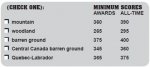
I see pictures of some of the Mountain Caribou bulls coming out of the NWT and the racks seem to consistently be bigger than the pictures of the Barren Ground bulls I see coming off of the North Slope of the Brooks. Is that just because the Mountain Caribou are coming out of top flight outfitter camps or is it because it is easier to find a big Mountain Caribou? I noticed that the B&C actually has a higher minimum entry for Barren Ground Caribou than it does for Mountain Caribou. That seemed to indicate to me that the Barren Ground might predictably be a little bigger. The other thought I had is that scoring caribou is a moot point because the B&C scoring is so weird. Is it possible that the Mountain Caribou just typically have cooler racks (ie more non-typical looking points for example) and those racks are really represented when the final scores get tallied? If the objective is to shoot a true trophy caribou does the sub species matter much or is it other factors?

Navigation
Install the app
How to install the app on iOS
Follow along with the video below to see how to install our site as a web app on your home screen.
Note: This feature may not be available in some browsers.
More options
Style variation
You are using an out of date browser. It may not display this or other websites correctly.
You should upgrade or use an alternative browser.
You should upgrade or use an alternative browser.
Mountain vs Barren
- Thread starter Gznokes
- Start date

charvey9
WKR
I think they are all slightly different sub-species, like the difference between Roosevelt and rocky Mountain elk...but I'm no expert.

Nick Muche
WKR
The biggest difference between the two is about $10,000.00 from what I can tell 
I'm no caribou biologist, but I know a few. I'll throw in my limited understanding:
Mountain caribou are a type of Woodland caribou. Boreal caribou are also a type of Woodland caribou. Woodland caribou live throughout the boreal forest in small family groups, don't really have big migration patterns and live in thicker cover. Woodland are pretty good size, think elk-sized. The NWT has one tag for boreal and mountain caribou - a woodland caribou tag, but that may be changing as boreal caribou are extremely threatened (a "species of concern") while mountain caribou numbers are doing just fine. The main distinction between mountain and boreal is where they live - fairly self explanatory.
Barren-ground caribou are the huge herd animals that migrate long distance and have calving grounds they visit, generally up above tree line on the tundra, in the summer. Then they generally migrate further south in the winter to spend some time in more sheltered areas during the snow and cold seasons. They are smaller body size than woodland caribou - think mule/whitetail sized.
I'm surprised that barren ground have a larger minimum for antler size for the book, since woodland bou are bigger bodied than barrenground, but I never get too caught up in the size of the antlers, just how tasty they both are. All caribou are ONE species (Rangifer tarandus). From there it gets confusing with sub-species and then eco-types of subspecies.
I'm happy to be wrong on any of this and learn more about the AK herds and if they are woodland or barrenground. It gets confusing because people just refer to caribou by their herd names (like 40 mile, or Bathurst) and not their scientific classification.
Mountain caribou are a type of Woodland caribou. Boreal caribou are also a type of Woodland caribou. Woodland caribou live throughout the boreal forest in small family groups, don't really have big migration patterns and live in thicker cover. Woodland are pretty good size, think elk-sized. The NWT has one tag for boreal and mountain caribou - a woodland caribou tag, but that may be changing as boreal caribou are extremely threatened (a "species of concern") while mountain caribou numbers are doing just fine. The main distinction between mountain and boreal is where they live - fairly self explanatory.
Barren-ground caribou are the huge herd animals that migrate long distance and have calving grounds they visit, generally up above tree line on the tundra, in the summer. Then they generally migrate further south in the winter to spend some time in more sheltered areas during the snow and cold seasons. They are smaller body size than woodland caribou - think mule/whitetail sized.
I'm surprised that barren ground have a larger minimum for antler size for the book, since woodland bou are bigger bodied than barrenground, but I never get too caught up in the size of the antlers, just how tasty they both are. All caribou are ONE species (Rangifer tarandus). From there it gets confusing with sub-species and then eco-types of subspecies.
I'm happy to be wrong on any of this and learn more about the AK herds and if they are woodland or barrenground. It gets confusing because people just refer to caribou by their herd names (like 40 mile, or Bathurst) and not their scientific classification.

Yellowknife
WKR
I see pictures of some of the Mountain Caribou bulls coming out of the NWT and the racks seem to consistently be bigger than the pictures of the Barren Ground bulls I see coming off of the North Slope of the Brooks.
I don't know anything about Mountain Caribou, but I will say that most of the caribou taken off the N. Slope, (and in Alaska in general), are typically either taken by residents on meat hunts or by hunters on "adventure" trips, where the size of antlers is secondary to the experience. Some of the biggest bull I've eaten were taken well after they had dropped antlers entirely! Random photos on the internet aren't really going to give you a good idea of true potential trophy quality. I don't believe I've ever even heard of somebody measuring a caribou for points, although I'm sure it happens occasionally.
I suspect that NWT Mountain Caribou is a different hunt all together.
Yk

bigeasygator
WKR
I'm no caribou biologist, but I know a few. I'll throw in my limited understanding:
Mountain caribou are a type of Woodland caribou. Boreal caribou are also a type of Woodland caribou. Woodland caribou live throughout the boreal forest in small family groups, don't really have big migration patterns and live in thicker cover. Woodland are pretty good size, think elk-sized. The NWT has one tag for boreal and mountain caribou - a woodland caribou tag, but that may be changing as boreal caribou are extremely threatened (a "species of concern") while mountain caribou numbers are doing just fine. The main distinction between mountain and boreal is where they live - fairly self explanatory.
Barren-ground caribou are the huge herd animals that migrate long distance and have calving grounds they visit, generally up above tree line on the tundra, in the summer. Then they generally migrate further south in the winter to spend some time in more sheltered areas during the snow and cold seasons. They are smaller body size than woodland caribou - think mule/whitetail sized.
I'm surprised that barren ground have a larger minimum for antler size for the book, since woodland bou are bigger bodied than barrenground, but I never get too caught up in the size of the antlers, just how tasty they both are. All caribou are ONE species (Rangifer tarandus). From there it gets confusing with sub-species and then eco-types of subspecies.
I'm happy to be wrong on any of this and learn more about the AK herds and if they are woodland or barrenground. It gets confusing because people just refer to caribou by their herd names (like 40 mile, or Bathurst) and not their scientific classification.
I'm certainly not a biologist and couldn't give you any genetic differences between the caribou, but B&C and P&Y recognize five different caribou species.
Barren Ground Caribou -- think Alaska and Yukon
Central Barren Ground Caribou -- think tundra of NWT and Nunavut
Mountain Caribou -- live in the mountains of Yukon, NWT, and BC
Woodland Caribou -- mostly hunted in Newfoundland, small herds in Saskatchewan and Manitoba
Quebec Labrador Caribou -- northern Quebec
As far as antler size, I've read that mountain caribou tend to have the heaviest racks though their spread may not be as big as the barren ground caribou. Not sure why the B&C entry criteria is lower and have heard a lot of people that were somewhat shocked by this given the size of this caribou relative to a barren ground caribou. So, I'd say yeah, the pictures you've seen are probably typical of the species.
Yellowknife
WKR
I'm happy to be wrong on any of this and learn more about the AK herds and if they are woodland or barrenground. It gets confusing because people just refer to caribou by their herd names (like 40 mile, or Bathurst) and not their scientific classification.
The Alaska herds are essentially all Barrenground Caribou, although I understand the Chisana herd of Woodland Caribou crosses the border between the Yukon and Alaska.
That said, not all Alaska barrenground caribou are migratory, and there are many small herds that live solely in the mountains and basically act like a Mountain Caribou. Although most the herds have names, the boundaries are really fuzzy at times and they can intermingle, particularly the small mountain herds. In fact I have observed what appears to be pockets of resident caribou inside the ranges of the major migratory herds.
Yk
Last edited:
Yellowknife
WKR
I don't believe all barrenland herds have the same average body size. Some of the interior and mountain caribou in particular can get pretty big (bodywise) and on the other hand the Western Arctic Herd is supposed to be considerably smaller than the state average. I know a big interior Alaska bull is going to be a lot closer to elk size than deer size.
No idea how that all plays into antler size though.
Yk
No idea how that all plays into antler size though.
Yk

luke moffat
Super Moderator
- Joined
- Feb 24, 2012
- Messages
- 137
Agreed YK....always wondered if someone shot one of the big bodied Nelchina bulls that didn't migrate out of Canada for the summer if it would transform into a "mountain caribou" The bodies on the Nelchina and interior AK range (20A) bulls seem to be much larger than the ones I have seen on the north slope. What that means for antler wise I have no idea. 

adventure907
WKR
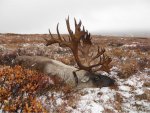
Here's the biggest caribou I've ever seen...

luke moffat
Super Moderator
- Joined
- Feb 24, 2012
- Messages
- 137
Here's the biggest caribou I've ever seen...
Yup Adventure907 that thing is a toad!!! What did it officially measure at finally? Not only is HUGE its actually pretty symmetrical and a gorgeous caribou all the way around.....the fact that it was in a non-motorized local is just icing on the cake!!!! Well done!
Nick Muche
WKR
The "Maui" sweatshirt really brings it together That is one heck of a Caribou... 405"?
That is one heck of a Caribou... 405"?
adventure907
WKR
440 4/8 net
449 gross
449 gross
luke moffat
Super Moderator
- Joined
- Feb 24, 2012
- Messages
- 137
Incredible! Largest I have taken is a 380 and a 367 with in 30 seconds of each other...and both of those woudl like like 3 year old bulls next to that monster! Always like seeing that picture....but if you could crop out the dude that would be great Congrats man!
Congrats man!
adventure907
WKR
Yep, i was definitely pretty lucky that day. I went ahead and put in for the tier 1 this year for the first time ever, going to try and top it. (Yea right)
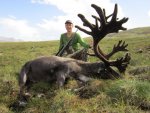
Here is a mountain caribou for you to look at I shot in the NWT 2 years ago. I did a lot of reading and research at the time and what you've read here is accurate. Caribou in the NWT see light hunting pressure from people and wolves compared to AK. Mountain caribou tend to have more points, more mass, and a narrower spread than barren ground.
Attachments
Nick Muche
WKR
What a bull, man that is nice! Congrats!

TEmbry
WKR
What a bull, man that is nice! Congrats!
Nice Bull but may need a bit more uptop... Lol
Amazing Animal!
Similar threads


Featured Video
Latest Articles
- TT#64 Josh Boyd Elk Hunting Strategies for Every Season
- Aaron Davidson of Gunwerks
- TT#63 Dirk Durham’s Art of Elk Calling
- BIG Buck Stories with the Dirty Giants Podcast
- TT#62 Brian Barney Hunting Bulls without Calling
- Hoyt Alpha AX-2 SD Review
- Kuiu Kenai vs Outdoor Vitals Vario Hooded Jacket Review
- Hoyt RX-9 Ultra Review
- Hunting Vampire Bucks & Building an Optics Kit
- Darton Sequel ST2 35 Review