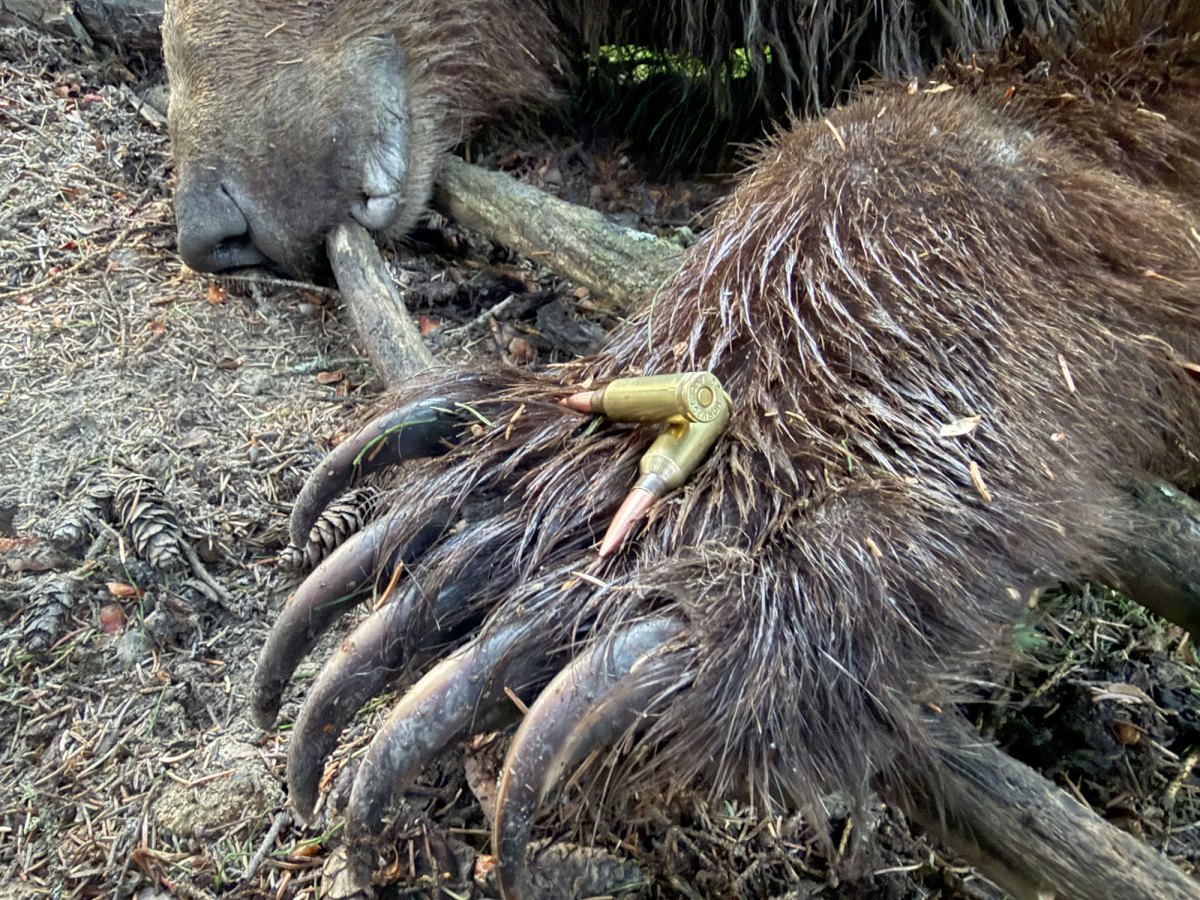
Tyler takes his 22 ARC moose hunting.

Follow along with the video below to see how to install our site as a web app on your home screen.
Note: This feature may not be available in some browsers.
You know that Tyler is a member here right?Tyler takes his 22 ARC moose hunting.
Which bullet in which cartridge at what impact velocity?Why would you want to when there's much better moose hunting cartridges around? (I've always wanted to instigate a 40 page thread.......)
Yep.You know that Tyler is a member here right?



You know that Tyler is a member here right?
What benefit does a “more powerful cartridge “ have?I think the vast majority of hunters would probably be better adopting a "most powerful cartridge" that the shooter can comfortably shoot accurately.
 www.outdoorlife.com
What benefit does a “more powerful cartridge “ have?
Does a larger cartridge automatically become better because it’s bigger? Or is it the bullet that matters?
Does a larger cartridge with a bonded or traditional mono bullet kill faster than the 88 ELD m that Tyler used? Or does it make a larger wound channel?
#2 isnt accurate standing on its own. An 88 224 will likely penetrate better than a 109gr 264 and way better than a 109gr 308. Sectional density matters when it comes to penetration. The 109 243 does have a slightly better sd than an 88 224.Let's say Hunter A is using a 109g Eldm in some sort of 6mm cartridge and Hunter B is using an 88g Eldm.
1) The 109g bullet has just under 24% more lead it can use to create a better wound channel
2) The 109g bullet starts with 24% more mass which means it will likely penetrate farther on a large animal.
If a hunter can shoot their 6/6.5mm cartridge accurately, it makes sense to take advantage of their larger/heavier projectiles. Using a larger, heavier bullet is not going to make them less lethal.
Instead of trying to find the lightest possible cartridge that will work on big game, we should be searching for the sweet spot - biggest cartridge that the shooter can shoot accurately.
#2 isnt accurate standing on its own. An 88 224 will likely penetrate better than a 109gr 264 and way better than a 109gr 308. Sectional density matters when it comes to penetration. The 109 243 does have a slightly better sd than an 88 224.

Why would you compare a 109 in .264 or .308? Lets compare the actual ELDM line. The 88 has a worse SD than any other weight ELDM.#2 isnt accurate standing on its own. An 88 224 will likely penetrate better than a 109gr 264 and way better than a 109gr 308. Sectional density matters when it comes to penetration. The 109 243 does have a slightly better sd than an 88 224.
What is our standard of accuracy in this situation? How much of a wound do we want? If a bullet is reaching sufficient penetration depth and upsetting enough for clean kills consistently what's the point in going larger? Does a shooter actually use the larger cartridge accurately enough to take advantage of the larger theoretical wounds? How do we determine our sweet spot?Let's say Hunter A is using a 109g Eldm in some sort of 6mm cartridge and Hunter B is using an 88g Eldm.
1) The 109g bullet has just under 24% more lead it can use to create a better wound channel
2) The 109g bullet starts with 24% more mass which means it will likely penetrate farther on a large animal.
If a hunter can shoot their 6/6.5mm cartridge accurately, it makes sense to take advantage of their larger/heavier projectiles. Using a larger, heavier bullet is not going to make them less lethal.
Instead of trying to find the lightest possible cartridge that will work on big game, we should be searching for the sweet spot - biggest cartridge that the shooter can shoot accurately.

What is our standard of accuracy in this situation? How much of a wound do we want? If a bullet is reaching sufficient penetration depth and upsetting enough for clean kills consistently what's the point in going larger? Does a shooter actually use the larger cartridge accurately enough to take advantage of the larger theoretical wounds? How do we determine our sweet spot?
The 22 cals collectively have over a thousand full pages on this forum showing that there's no point in going larger unless you need the extra terminal range.
Almost seems like "who can shoot the biggest round" became "who can kill one with the smallest". Same measuring contest, different criteria. "Plenty as long as x,y and z criteria are met" to me means "just enough to get it done" which is antithetical to assuring the quick ending of an animal life with the least amount suffering. I say choose the round that provides the most energy and makes the biggest hole in a firearm you can handle the recoil comfortably and shoot accurately and precisely. The goal should be bigger in my opinion. Not saying that someone who knows what they're doing is necessarily irresponsible for using something as small as a .22 ARC for something as large as a moose. I am willing to bet that the overwhelming majority of hunters that try will fail in one way or the other.
Because I was quoting what he said.Why would you compare a 109 in .264 or .308? Lets compare the actual ELDM line. The 88 has a worse SD than any other weight ELDM.
The only thing the cm buys over the arc is more range. If the arc gets the velocity you want to the range you need, the cm is unnecessary.You are probably correct on that point.
My only issue is really with the concept of using the least powerful cartridge possible on genuine game.
Going back to the original idea of using a 22 ARC, I would point to the 22 CM as the better option on big game for someone who wants to shoot a 22 caliber bullet.