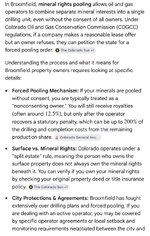
Mineral Rights

Looking at houses with property along the Front Range of Colorado, I keep coming across mineral rights and leases. They all seem to be similar, leased to an oil and gas company, that doesn’t have surface access, but has a setup 1-3 miles away where they dig down 9000-10000 feet and then come in horizontally to the property.

I have 2 questions. First is safety. I have talked to a couple of people that I trust and both felt that safety was a non issue living on the property.

Second, do I want to retain the rights? Assuming the owner wants to keep them or possibly doesn’t have the rights himself, is there any disadvantage other than potentially losing out on income that the lease might produce.

Hoping to find someone with actual experience vs the I heard fracking was terrible or drill baby drill people.

Ok one more question…. Assuming this forever home becomes a not forever home, what does it look like selling the property without having the mineral rights myself?

@Holski and @Mighty Mouse gave very sound advice on most of the issues. The disturbance stuff comes down to a person's opinion of what amount of activity they don't like. I have like 5 pads within 5 miles of my house and no one would have a clue they were there. If you lived next to the access road, that would be a different story.

If you are on public water, nothing to worry about with OG drilling in regard to water quality in your well.

Again people are giving good on the Mineral Rights thing. If you can get them reasonably priced, do it IMO. In my opinion, it does not need to be a deal breaker if the price of the property represents value for money without them. I am not sure how big the property is but you may want to look at what the existing lease on the property is. Its possible future access roads or other infrastructure could cut across the property depending on CO regs and what terms are in the lease. If its a small parcel like 3-5 acres, its probably doubtful you have to worry about it. The implications of not having the minerals rights increases as the property size grows, because the potential for mineral resource extraction or the disturbance associated with extraction on the property increases. What i mean by that is if its an area of houses on 40 acre lots there is a lot of space to fit a permitted facility in between all the buffers or areas excluded by regulation. If its a subdevelopment with house on lots less than 5 acres, those areas to perform extraction or fit a facility become much smaller.

I would heed @Mighty Mouse 's advice to check out CO's State webpage for Oil Gas and Carbon Management . They have a pretty robust regulatory program in CO and had a lot of uptodate and useful information there last time I looked. You can also find production records for wells in the state of CO. I doubt it will tell you how much royalty checks are going to be for but it might shed some light if the wells in your area are good producers or not, if you know what you are looking at.

interactive map: https://cogccmap.state.co.us/cogcc_gis_online/

production data: https://ecmc.colorado.gov/data-maps-reports/cogis-database/cogis-production-data-inquiry

Carbon Sequestration will be a thing in the near to medium term in most places. So that may be on the horizon in your area as well.
 
@Holski and @Mighty Mouse gave very sound advice on most of the issues. The disturbance stuff comes down to a person's opinion of what amount of activity they don't like. I have like 5 pads within 5 miles of my house and no one would have a clue they were there. If you lived next to the access road, that would be a different story.

If you are on public water, nothing to worry about with OG drilling in regard to water quality in your well.

Again people are giving good on the Mineral Rights thing. If you can get them reasonably priced, do it IMO. In my opinion, it does not need to be a deal breaker if the price of the property represents value for money without them. I am not sure how big the property is but you may want to look at what the existing lease on the property is. Its possible future access roads or other infrastructure could cut across the property depending on CO regs and what terms are in the lease. If its a small parcel like 3-5 acres, its probably doubtful you have to worry about it. The implications of not having the minerals rights increases as the property size grows, because the potential for mineral resource extraction or the disturbance associated with extraction on the property increases. What i mean by that is if its an area of houses on 40 acre lots there is a lot of space to fit a permitted facility in between all the buffers or areas excluded by regulation. If its a subdevelopment with house on lots less than 5 acres, those areas to perform extraction or fit a facility become much smaller.

I would heed @Mighty Mouse 's advice to check out CO's State webpage for Oil Gas and Carbon Management . They have a pretty robust regulatory program in CO and had a lot of uptodate and useful information there last time I looked. You can also find production records for wells in the state of CO. I doubt it will tell you how much royalty checks are going to be for but it might shed some light if the wells in your area are good producers or not, if you know what you are looking at.

interactive map: https://cogccmap.state.co.us/cogcc_gis_online/

production data: https://ecmc.colorado.gov/data-maps-reports/cogis-database/cogis-production-data-inquiry

Carbon Sequestration will be a thing in the near to medium term in most places. So that may be on the horizon in your area as well.
All the advice above, including this has been awesome. The lot is only 2 acres and it is in Broomfield, which requires pumps to be at least 2000 feet from residential areas. The vertical and horizontal pipes have already been installed so it doesn’t sound like there is any reason to believe there will be further disturbance. Surface activity is also prohibited per city ordinance.

I think at this point it’s a struggle to figure out the value with and without the mineral rights. The seller at this particular, Home is being very secretive and won’t give me much information past “it’s enough to fill up a tank or 2 of gas”
 
I think at this point it’s a struggle to figure out the value with and without the mineral rights. The seller at this particular, Home is being very secretive and won’t give me much information past “it’s enough to fill up a tank or 2 of gas”

I would personally look to see if any other homes in the area are for sale and if they include rights. I would personally discount the house without the mineral rights and tell the seller unless he is willing to disclose the value to find another buyer. I personally think the housing market is going to continue to get soft so there is no reason to rush.
 
All the advice above, including this has been awesome. The lot is only 2 acres and it is in Broomfield, which requires pumps to be at least 2000 feet from residential areas. The vertical and horizontal pipes have already been installed so it doesn’t sound like there is any reason to believe there will be further disturbance. Surface activity is also prohibited per city ordinance.

I think at this point it’s a struggle to figure out the value with and without the mineral rights. The seller at this particular, Home is being very secretive and won’t give me much information past “it’s enough to fill up a tank or 2 of gas”
on 2 acres of land I highly doubt royalties are anything remotely close to life changing. I would be astounded if they were more than something like 1500-2k$ a year. But I don't have really any experience in that basin. I would bet you are looking at less than 1,000$ a year esp as the wells age.
 
on 2 acres of land I highly doubt royalties are anything remotely close to life changing. I would be astounded if they were more than something like 1500-2k$ a year. But I don't have really any experience in that basin. I would bet you are looking at less than 1,000$ a year esp as the wells age.
His comment was “it’s enough for a tank of gas or 2.” Which makes me wonder wtf he’s hiding and not giving me a ton of confidence. Yes I can walk away but the location, house, yard, amenities, etc fit the family perfectly and it’s the best option we’ve found.

I offered to give him royalties for a set number of years while maintaining mineral rights. He balked but he couldn’t articulate why he didn’t like the idea because his reason for maintain the mineral rights is that “he was entering retirement and wanted the monthly income”.
 
His comment was “it’s enough for a tank of gas or 2.” Which makes me wonder wtf he’s hiding and not giving me a ton of confidence. Yes I can walk away but the location, house, yard, amenities, etc fit the family perfectly and it’s the best option we’ve found.

I offered to give him royalties for a set number of years while maintaining mineral rights. He balked but he couldn’t articulate why he didn’t like the idea because his reason for maintain the mineral rights is that “he was entering retirement and wanted the monthly income”.
Nobody wants to give up mineral rights when they have them. Who knows what formation will become relevent or what prices will be in 10 years. Might be great or might be nothing. And its passive income like hes claiming. Not sure why he just does not show you like 12 months worth.
 
The Home we’re looking at, the current owner owns mineral rights and wants to retain them. It has already been drilled, and they are receiving monthly payments out of a pool payment for the entire area.

I need to figure out if the other homes in the area, all sharing similar lot sizes, are being sold with or without the mineral rights being included in the sale. If mineral rights are being included the asking price should reflect him retaining mineral rights. If mineral rights are not being included in the sale price then it’s probably a non-issue other than the fact that it’s weird to think I own the land but not what’s underneath it.

They are all being sold without the mineral rights if the home price is roughly the same. In the front range if you buy a home with the mineral rights (probably not going to happen) that could potentially be an upside of hundreds of thousands to millions (dependant on acreage) over the years and no one is going to sell that at the same price as the house next door.
 
In the west, the homestead act separated massive blocks of land into private surface and federal subsurface. I worked in blocks of land in Oregon and some in California where the ownership was severed by distance and by commodities. Hence the state owned the first 200 ft and then a company everything below that. In another, one company owned the gold and another owned the lead-zinc.

In oil and gas, I don't know how you moniter that when they can access your property 20,000 ft below you from 2 miles away. Ownership will usually show up in a detailed title search but most title companies don't do that anymore.
 
My Dad bought some property in Imperial Valley in southern California in 1950 and got all the mineral rights with it. Many years later there was found to be a geothermal area. Dad leased the mineral rights for geothermal. 50 years later they came up with a viable way to the energy produced into electricity, Dad is gone and I own the rights now, even tho I don't own the land (Dad sold the land , but kept 100% of the mineral rights). I have a deed for these rights issued by Imperial County.

I get a nice check every month from selling the electricity to the city of Phoenix, Az.
 
In the west, the homestead act separated massive blocks of land into private surface and federal subsurface. I worked in blocks of land in Oregon and some in California where the ownership was severed by distance and by commodities. Hence the state owned the first 200 ft and then a company everything below that. In another, one company owned the gold and another owned the lead-zinc.

In oil and gas, I don't know how you moniter that when they can access your property 20,000 ft below you from 2 miles away. Ownership will usually show up in a detailed title search but most title companies don't do that anymore.
@Ucsdryder his last sentence is spot on, I would get an actual landman to do that end of it. Should be easy with their databases.
 
I think it’s not a lot of money in royalty checks. Here in PA in the wonderful world of Marcellus Shale, the checks really dropped off after several years due to the volume of gas produced dropping way off. Until Marcellus hit most of the state was fee simple ownership which means the surface owner owns the subsurface to the center of the earth. Close to Titusville were the whole industry started the more the subsurface and surface were separated. Oil and gas are separate rights with coal and other rocks being a separate estate.

The main water issues were stupid human tricks. Stuck water trucks emptying flow back water into ditches, truck wrecks, righty tightly, lefty loosely issues. Other big one was not properly cementing the well bore to keep the stuff put down well away from the ground water. I don’t know of any issues of the actual frack making to the surface and creating problems.

Biggest issues were truck traffic to and from the pads and the smell of whatever they are using on the pad to treat the gas to make the gas pipeline quality. Plus the noise from the compressors. Not in the industry just a dumb forester who had deal with over 100,000 acres of gas leases and surface only ownership and about 50 Marcellus pads.

I can say I now know what it’s like to live through an old fashioned gold rush. It was balls to wall for about 2.5 years and then it basically went to nothing for about 6 years and then changed again to slow and steady.

In answer to your question I don’t think you’ll even be aware of the well bore or gas production on the property. Plus you would be looking at a pretty small royalty check. Probably not worth buying the subsurface at this point in time, but the next big play could be a rock layer 200 ft below the current one. Better odds of going to the roulette wheel in Vegas and putting the money on red.
 
In the west, the homestead act separated massive blocks of land into private surface and federal subsurface. I worked in blocks of land in Oregon and some in California where the ownership was severed by distance and by commodities. Hence the state owned the first 200 ft and then a company everything below that. In another, one company owned the gold and another owned the lead-zinc.

In oil and gas, I don't know how you moniter that when they can access your property 20,000 ft below you from 2 miles away. Ownership will usually show up in a detailed title search but most title companies don't do that anymore.
We just bought in GA and atty said we’d have to do a total diff title search for mineral rights and then said he’d not heard of folks not owning them so we stopped chasing that unicorn and assume that we own them.
 
In oil and gas, I don't know how you moniter that when they can access your property 20,000 ft below you from 2 miles away.
State regulatory agencies require a survey of the wellbore to be filed for every well drilled to ensure the well is in the correct place and the oil company isn't extracting oil they don't have rights to. The location of the drill bit is continuously monitored in three dimensions to within a few feet of accuracy while the well is being drilled.
 
Looking at houses with property along the Front Range of Colorado, I keep coming across mineral rights and leases. They all seem to be similar, leased to an oil and gas company, that doesn’t have surface access, but has a setup 1-3 miles away where they dig down 9000-10000 feet and then come in horizontally to the property.

I have 2 questions. First is safety. I have talked to a couple of people that I trust and both felt that safety was a non issue living on the property.

Second, do I want to retain the rights? Assuming the owner wants to keep them or possibly doesn’t have the rights himself, is there any disadvantage other than potentially losing out on income that the lease might produce.

Hoping to find someone with actual experience vs the I heard fracking was terrible or drill baby drill people.

Ok one more question…. Assuming this forever home becomes a not forever home, what does it look like selling the property without having the mineral rights myself?
Just know CO taxes mineral rights even if not in production. Those taxes do go up if they are producing around you, even if you arent producing, as it raises the mineral value assessment

Fracking isn’t bad in general , but any sub surface extraction of anything can be bad if not done correctly, that’s including your water well.

I personally would not own land without mineral rights or control of those rights.
 
Just know CO taxes mineral rights even if not in production. Those taxes do go up if they are producing around you, even if you arent producing, as it raises the mineral value assessment

Fracking isn’t bad in general , but any sub surface extraction of anything can be bad if not done correctly, that’s including your water well.

I personally would not own land without mineral rights or control of those rights.
Not sure how much control you have regardless.

IMG_1710.jpeg
 
My Dad bought some property in Imperial Valley in southern California in 1950 and got all the mineral rights with it. Many years later there was found to be a geothermal area. Dad leased the mineral rights for geothermal. 50 years later they came up with a viable way to the energy produced into electricity, Dad is gone and I own the rights now, even tho I don't own the land (Dad sold the land , but kept 100% of the mineral rights). I have a deed for these rights issued by Imperial County.

I get a nice check every month from selling the electricity to the city of Phoenix, Az.
this is the perfect example why people don't want to sell. You might get lucky with something like this even if you don't make a lot of money in the short term on OG production. There are certainly no guarantees this scenario will happen for most people. I am assuming @Colorado Cowboy has more than 2 acres? There are people in OG areas with large farms or whatever that became extremely wealthy during the OG rush.
 
In western Canada most people don’t own mineral rights on their land . But some do and have done very well IF there is oil or gas. However land owners do own rights to gravel which can also be lucrative. I don’t know why gravel is different than other minerals. My brother and I own some mineral rights and have leased the rights for good money several times. But no wells were dug and it never went further.
 
Back
Top