MDT HNT26 Question

treillw

WKR
Joined
Mar 31, 2017
Messages
2,092
Location
MT
The only thing keeping me from buying an MDT HNT26 chassis for a 6 UM is the short length of the bottom of the stock rear, where it rides on a rear bag. It seems to be sloped comparably to other traditional stocks for shooting prone, but the slope length is about three times less than a traditional stock, restricting the up and down adjustment range of motion. I guess there is no way to mitigate this.

Another gun of mine was similar and minor vertical adjustments were a pain to get it right where you needed it to be. One more thing to worry about in the field where time is of the essence.

Ideas? Comparable alternatives?

Thanks!
 
OP, what you’re concerned about is not having enough of a slope, correct?

The bag rider mentioned above is the opposite of what you think you’re looking for, as it eliminates the slope.

What you actually need is no slope for precision shooting, like the design of the Rokstok. You can raise and lower the stock just fine with no slope. What the flat toe line does is keep the stock from dropping under recoil and tracking straight back. The HNT 26 does a decent job at this because of the way it’s designed. A bag rider would only further help it in that area.
 
You don’t want any slope on the toe of the stock, you want it to track straight with recoil. The bottom of the hnt 26 is kind of short, but usable with a rear bag and geometry is correct imo.

If you require slope on your stock for elevation you are relying too much on the bag and not enough on your body imo.

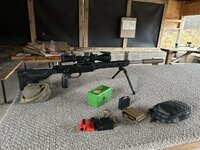
Below is an AG schmedium.

I have thought of a bag rider on there but imo it would just add a snag point.

As is I’m very happy with the hnt 26. Feels like my comp gun I shoot all year. If they made an ultra lite and short way to raise the butt stock it would be better, but as is I’m happy with it.
IMG_2073.jpeg
 
OP, what you’re concerned about is not having enough of a slope, correct?

The bag rider mentioned above is the opposite of what you think you’re looking for, as it eliminates the slope.

What you actually need is no slope for precision shooting, like the design of the Rokstok. You can raise and lower the stock just fine with no slope. What the flat toe line does is keep the stock from dropping under recoil and tracking straight back. The HNT 26 does a decent job at this because of the way it’s designed. A bag rider would only further help it in that area.
So if understand this correctly, the goal would be to have a “flat bottom” like the Rokstock. It looks like the above mentioned bag rider (jkl industries) offers both an angled and a flat bottom. The picture on the site shows an angled, I assume. Would the flat bottom be more like what is ideal? Gives a little more surface area and is flat. Or is this still not ideal?

The idea of snagging it on things is a whole other issue.
 
If you require slope on your stock for elevation you are relying too much on the bag and not enough on your body imo.
How do you use your body to adjust elevation?

IMO, ideally the rifle should be setup dead on target sitting on the bipid and rear bag without you ever touching it - come up behind it, support the recoil pad, pull the trigger. IMO, bipod preload should be the only force acting on the gun when you pull the trigger.

If photos are serving me well, the rokstock appears to have a reverse toe slope from traditional (higher in the back than front), which would drive the muzzle downward under recoil. I like the idea, but the thing is hideous IMO.

Almost all of the traditional prone position stocks (EH1, Manners LRH, McMIllan ELR hunter, etc) have a gentle toe slope from front to rear.

If there is no slope to the toe (i.e. perfectly level), the only ways you can adjust crosshair elevation is by adjusting bipod height (which is a royal pain to get perfect quickly on animals, under pressure, before they bust you, especially if you scratch it in), or squeeze your rear bag. Squeezing the rear bag is obviously easy and quick, but it doesn't give you a ton of range. I really didn't enjoy it on my rifle with a flat toe.

I'm open to changing my ways and further education!

Thanks!
 
How do you use your body to adjust elevation?

IMO, ideally the rifle should be setup dead on target sitting on the bipid and rear bag without you ever touching it - come up behind it, support the recoil pad, pull the trigger. IMO, bipod preload should be the only force acting on the gun when you pull the trigger.

If photos are serving me well, the rokstock appears to have a reverse toe slope from traditional (higher in the back than front), which would drive the muzzle downward under recoil. I like the idea, but the thing is hideous IMO.

Almost all of the traditional prone position stocks (EH1, Manners LRH, McMIllan ELR hunter, etc) have a gentle toe slope from front to rear.

If there is no slope to the toe (i.e. perfectly level), the only ways you can adjust crosshair elevation is by adjusting bipod height (which is a royal pain to get perfect quickly on animals, under pressure, before they bust you, especially if you scratch it in), or squeeze your rear bag. Squeezing the rear bag is obviously easy and quick, but it doesn't give you a ton of range. I really didn't enjoy it on my rifle with a flat toe.

I'm open to changing my ways and further education!

Thanks!

Hand on bag, rifle between thumb and finger, pinch to tweak elevation.
 
How do you use your body to adjust elevation?

IMO, ideally the rifle should be setup dead on target sitting on the bipid and rear bag without you ever touching it - come up behind it, support the recoil pad, pull the trigger. IMO, bipod preload should be the only force acting on the gun when you pull the trigger.

If photos are serving me well, the rokstock appears to have a reverse toe slope from traditional (higher in the back than front), which would drive the muzzle downward under recoil. I like the idea, but the thing is hideous IMO.

Almost all of the traditional prone position stocks (EH1, Manners LRH, McMIllan ELR hunter, etc) have a gentle toe slope from front to rear.

If there is no slope to the toe (i.e. perfectly level), the only ways you can adjust crosshair elevation is by adjusting bipod height (which is a royal pain to get perfect quickly on animals, under pressure, before they bust you, especially if you scratch it in), or squeeze your rear bag. Squeezing the rear bag is obviously easy and quick, but it doesn't give you a ton of range. I really didn't enjoy it on my rifle with a flat toe.

I'm open to changing my ways and further education!

Thanks!

I would call that too much reliance on a bag for field shooting. And bipod preload dosnt work well on varying terrain either, relying on either puts you in a bad spot when it comes to varying terrain. I’ll try to explain.

This falls apart imo on anything but perfect prone, or a bench. I want my body interfacing the rifle the same way prone, as I am in any other position. The bag is simply steadying the rear of the rifle, my body is supporting it just as it would be from a kneeling or standing position.The above bag I can use any ways, to adjust for elevation, and squeeze the bag to fine tune.

And yes your correct, perfect npa, I should be able to come off the rifle and have it sit naturally on target, but I wouldn’t consider the bag or support part of that equation. Field shooting requires lots of imperfect positions, being able to adjust your bag to that without interfering how your connected with the gun makes a big difference when your dealing with recoil.

On top of that if your only relying on your bag to manage any muzzle rise, the bag material and amount of recoil makes a big difference.

Others will probably better describe this, I’m not the best at it. I used to think the same way, I need my rifle to be supported by my bipod and rear bag and I just have to get behind it and touch it off. In reality this will work well on the bench or flat prone spot, but falls apart when field or positional shooting become involved. In PRS we could call this free recoil, or close to it. On a wobbly prop I can come off my 20lb dasher and just be touching the recoil pad and likely make a decent shot, though maybe not spot it. Doing that with a 10lb 6.5 creedmoor just dosnt work the same.
 
Ideally you want to have a rear bag that isn't too solid & doesn't have a dense fill material. That allows you to simply squeeze the bag for your elevation adjustments. If you have a fully flat toe, your recoil will come straight back into your shoulder. With a sloped toe, recoil will cause muzzle rise & you have to reposition yourself, your bag & your rifle for every shot. With a bag rider (and perfect form) all you need to do is push the rifle forwards slightly after the shot.

There's a reason that benchrest guns are built the way they are.
 
The only thing keeping me from buying an MDT HNT26 chassis for a 6 UM is the short length of the bottom of the stock rear, where it rides on a rear bag. It seems to be sloped comparably to other traditional stocks for shooting prone, but the slope length is about three times less than a traditional stock, restricting the up and down adjustment range of motion. I guess there is no way to mitigate this.

Another gun of mine was similar and minor vertical adjustments were a pain to get it right where you needed it to be. One more thing to worry about in the field where time is of the essence.

Ideas? Comparable alternatives?

Thanks!
I have not had any issues using a variety of rear bags with the HNT26.
 
Back
Top