
streamerfish
WKR
- Joined
- Dec 12, 2025
- Messages
- 334
I was asked by multiple people via messages and on a couple of threads to give some input on my Lee Pro 6000. The following is my initial thoughts after about 750 total 9mm rounds being reloaded on it.
For some quick background on the unit. The Pro 6000 is Lee's flagship progressive press that came out a couple years ago. On pistol shooting forums it has a pretty strong reputation as the best bang for your buck progressive press for moderate output. (insert Dillon or nothing people here.).
In kind of an interesting thought exercise, like alot of products well thought about on this forum. The Pro 6000 was thoroughly BETA tested by a couple of people on a prominent pistol reloading forum for over 1yr before it was released to the public, with public posts about findings, tweaks made, fixed discovered etc, etc. With Lee almost universally listening to feedback and making the changes before it went to market. And with a few changes after going to market also.
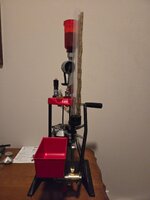
I purchased the press as a 9mm "kit". It came with the standard Lee 3 die set, the powder drop with die, and the 9mm inline case feeder. I mounted the press on an inline fabrication stand. I also added the inline fabrication roller handle, and purchased the Lee factory crimp die. My total price for everything in the picture below, including shipping (everything was ordered online and shipped) and taxes was less then $700.
Setup was pretty straight forward. Like almost anything else anymore, I largely pulled the machine apart, de greased screws, then set them to proper tension (whether its guns, tools etc, this seems to save alot of headaches down the road.) Alon with lubricating the joints recommended in the instructions.
I've seen alot of videos online of people operating this press, and having alot of press movement and flex during operation. This was somewhat concerning to me. However, with the inline Fabrication mount, I have zero movement that I see or feel at all, its completely solid.
Generally, with my experience running progressive presses, their are 3 area's that cause the most issues outside of user error.
1. The priming system
2. The powder drop system
3. The indexing system
Of the "big 3", I had to spend a little time getting the indexing system timing lined up correctly for operation. In my case, this ultimately involved tweaking the indexing rod as it wanted to over index out of the box. Any kind of misalignment of your indexing usually spells disaster for your priming system as well. They are more or less tied together.
Other then that, its been clear sailing.
Speaking of the priming system.
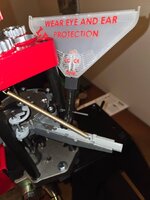
To be fair, it looks a little cheap, maybe even a bit hokie. However, sometimes, simple is just better. And IMHO, this is one of the best priming systems I've seen on a progressive from a pure functional standpoint.
The plastic triangle piece holds your primers, opens in half like a book, you simply dump a box or so of primers into it, then gently shake it back and forth, it has grooves inside it that flip over the primers, then you simply close it, set it to lock, slide it into the black receiver, click it to open. And primers are loaded. It takes about 10/15 seconds time total, from grabbing a box of primers to priming shells. Much easier and faster then tube systems.
From there its a pretty simplistic gravity feed, with the grey plastic bar feeding to the index plate. The tip of the bar that actually slides under the plate is metal, and it is removable, so you can switch back and forth between small and large primers.
The only thing that i have noticed that I need to keep an eye on, is sometimes the gravity feed needs a bit of help, If you look at the black piece that the primers run through to drop down to the priming plate area, there is a small metal pin that runs through it. This pin is designed to rub on the black frame piece to help "shake" the priming system, I may need to look at adjusting this a bit. But overall I am extremely happy with the priming system. It primes at the top of the stroke with the case arriving into station 2. Feel is very clear seating the primer, seating depth has been perfect every time.
The powder drop system is pretty standard and simple. The kit came with the Lee pro auto drum measure. It comes with a small and large capacity drum. Honestly this system is almost fool proof. It is a volume based measurement system, you can take out the drum, preset it to your load by simply filly the drum, then adjusting it to where its basically flush at the top. then insert the drum and run a couple of drops, usually that puts you within a couple tenths of a grain on pistol powders, you can then fine tune from there. The system runs through a M style casing flaring powder drop die. Much improved with the M style over Lee's older flair dies.
As I mentioned above I did need to adjust the indexing rod. Since the adjustment, operation has been flawless. One thing that I really appreciate about the indexing system. It ships with what they call a "slow" indexing rod. So, the speed of index is slower then most other progressive presses. Personally I prefer this, as the cases bounce around less, the bullets stay lined up better etc. But they actually have different rods for various speeds that you can order if you so choose.
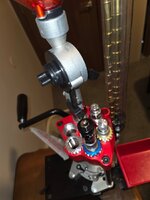
A view from the top shows what I would consider the most compelling reason to purchase this press besides price. A true 6 station press. As currently configured.
1. resize/decap
2. Powder drop/flair and prime
3. empty
4. empty
5. bullet seating
6. bullet crimp
Here is how it will be configured in another month or so.
1. Resize/decap
2. Powder drop/flair and prime
3. Powder check die
4. Inline bullet feeding die
5. Bullet seating
6. Bullet crimp
From a pistol reloading standpoint, my opinion is that 5 stations is ok, 6 is ideal, less then 5 is blah, more then 6 is cool but not really necessary.
Soo....who is this for.
To me this is the ideal press for what I would call a moderate capacity reloader. I would say this machine and accessories is really designed to run a couple hundred rounds a sitting, not say 1000 rounds a sitting (although you could). Although you can buy aftermarket electric case feeders and bullet feeders similar to what people run on say their dillon 750XL, It just feels like its kinda designed for the guys who is going to sit down and run out a couple hundred rounds in 45 minutes or so that he needs and move on with the day.
It is plenty fast, but it really isn't designed for the extreme top speed reloader that is running that handle as fast as you can. However, its very easy to run at a 10 rounds per minute pace, even manually setting the bullets in the case, until you run out of cases or primers and need to reset.
Please feel free to ask any questions you want. Hopefully this was helpful.
For some quick background on the unit. The Pro 6000 is Lee's flagship progressive press that came out a couple years ago. On pistol shooting forums it has a pretty strong reputation as the best bang for your buck progressive press for moderate output. (insert Dillon or nothing people here.).
In kind of an interesting thought exercise, like alot of products well thought about on this forum. The Pro 6000 was thoroughly BETA tested by a couple of people on a prominent pistol reloading forum for over 1yr before it was released to the public, with public posts about findings, tweaks made, fixed discovered etc, etc. With Lee almost universally listening to feedback and making the changes before it went to market. And with a few changes after going to market also.
I purchased the press as a 9mm "kit". It came with the standard Lee 3 die set, the powder drop with die, and the 9mm inline case feeder. I mounted the press on an inline fabrication stand. I also added the inline fabrication roller handle, and purchased the Lee factory crimp die. My total price for everything in the picture below, including shipping (everything was ordered online and shipped) and taxes was less then $700.
Setup was pretty straight forward. Like almost anything else anymore, I largely pulled the machine apart, de greased screws, then set them to proper tension (whether its guns, tools etc, this seems to save alot of headaches down the road.) Alon with lubricating the joints recommended in the instructions.
I've seen alot of videos online of people operating this press, and having alot of press movement and flex during operation. This was somewhat concerning to me. However, with the inline Fabrication mount, I have zero movement that I see or feel at all, its completely solid.
Generally, with my experience running progressive presses, their are 3 area's that cause the most issues outside of user error.
1. The priming system
2. The powder drop system
3. The indexing system
Of the "big 3", I had to spend a little time getting the indexing system timing lined up correctly for operation. In my case, this ultimately involved tweaking the indexing rod as it wanted to over index out of the box. Any kind of misalignment of your indexing usually spells disaster for your priming system as well. They are more or less tied together.
Other then that, its been clear sailing.
Speaking of the priming system.
To be fair, it looks a little cheap, maybe even a bit hokie. However, sometimes, simple is just better. And IMHO, this is one of the best priming systems I've seen on a progressive from a pure functional standpoint.
The plastic triangle piece holds your primers, opens in half like a book, you simply dump a box or so of primers into it, then gently shake it back and forth, it has grooves inside it that flip over the primers, then you simply close it, set it to lock, slide it into the black receiver, click it to open. And primers are loaded. It takes about 10/15 seconds time total, from grabbing a box of primers to priming shells. Much easier and faster then tube systems.
From there its a pretty simplistic gravity feed, with the grey plastic bar feeding to the index plate. The tip of the bar that actually slides under the plate is metal, and it is removable, so you can switch back and forth between small and large primers.
The only thing that i have noticed that I need to keep an eye on, is sometimes the gravity feed needs a bit of help, If you look at the black piece that the primers run through to drop down to the priming plate area, there is a small metal pin that runs through it. This pin is designed to rub on the black frame piece to help "shake" the priming system, I may need to look at adjusting this a bit. But overall I am extremely happy with the priming system. It primes at the top of the stroke with the case arriving into station 2. Feel is very clear seating the primer, seating depth has been perfect every time.
The powder drop system is pretty standard and simple. The kit came with the Lee pro auto drum measure. It comes with a small and large capacity drum. Honestly this system is almost fool proof. It is a volume based measurement system, you can take out the drum, preset it to your load by simply filly the drum, then adjusting it to where its basically flush at the top. then insert the drum and run a couple of drops, usually that puts you within a couple tenths of a grain on pistol powders, you can then fine tune from there. The system runs through a M style casing flaring powder drop die. Much improved with the M style over Lee's older flair dies.
As I mentioned above I did need to adjust the indexing rod. Since the adjustment, operation has been flawless. One thing that I really appreciate about the indexing system. It ships with what they call a "slow" indexing rod. So, the speed of index is slower then most other progressive presses. Personally I prefer this, as the cases bounce around less, the bullets stay lined up better etc. But they actually have different rods for various speeds that you can order if you so choose.
A view from the top shows what I would consider the most compelling reason to purchase this press besides price. A true 6 station press. As currently configured.
1. resize/decap
2. Powder drop/flair and prime
3. empty
4. empty
5. bullet seating
6. bullet crimp
Here is how it will be configured in another month or so.
1. Resize/decap
2. Powder drop/flair and prime
3. Powder check die
4. Inline bullet feeding die
5. Bullet seating
6. Bullet crimp
From a pistol reloading standpoint, my opinion is that 5 stations is ok, 6 is ideal, less then 5 is blah, more then 6 is cool but not really necessary.
Soo....who is this for.
To me this is the ideal press for what I would call a moderate capacity reloader. I would say this machine and accessories is really designed to run a couple hundred rounds a sitting, not say 1000 rounds a sitting (although you could). Although you can buy aftermarket electric case feeders and bullet feeders similar to what people run on say their dillon 750XL, It just feels like its kinda designed for the guys who is going to sit down and run out a couple hundred rounds in 45 minutes or so that he needs and move on with the day.
It is plenty fast, but it really isn't designed for the extreme top speed reloader that is running that handle as fast as you can. However, its very easy to run at a 10 rounds per minute pace, even manually setting the bullets in the case, until you run out of cases or primers and need to reset.
Please feel free to ask any questions you want. Hopefully this was helpful.


