Lack of Snowfall out West = Smaller Elk, Deer, and Moose Racks for 2026?

Last summer our tanks were dry until late September and early October, then it rained on and off for a couple of weeks right in the middle of the youth hunts and cow hunts. Filled the tanks some. The Elk had moved off the tanks in the early summer so hunting was a bit tough for those hunters who sit water. Had a few fires and one just 2 weeks ago. Hope it rains or snows soon. That said the Elk in my front yard are Fat. No stress at all.
 
If you look at the averages for snow pack, Idaho and Wyoming are almost at 100% in every region. It seems it just hasn’t snowed much in the lower elevations or melts almost immediately. Should be a great year on winter survival and hopefully fawn survival. A really wet spring would probably put this year on top for being one of the better years.
 
I'd argue that biologist is wrong regarding "needing snow"
Rain will do the trick just fine, especially when the frost is out,
not to mention that the mountains often
make their own weather and get afternoon rain showers when
the flats and foothills get nothing.
The mountain snow just runs down the creeks and rivers.
 
I'd argue that biologist is wrong regarding "needing snow"

The mountain snow just runs down the creeks and rivers.

Sorry, but this is a fundamental misunderstanding of the difference between rain and snow.

Rain is actually more immediate and flows to the drainages. Snow is more of a time released capsule that holds much of its water until spring, allowing the various damns and reservoirs to manage the flow. In terms of the higher elevation ecosysem, snowmelt is generally much more efficient at soaking into the ground than rain is.

Rain is like getting your entire yearly salary in cash on January 1st. If you aren't careful, you spend it all or lose it and once its gone, its gone. Snowpack is like getting a steady paycheck every two weeks throughout the year. It guarantees you have funds when you actually need to pay the bills in the summer.

Its almost as if the Rocky Mountain West has an entire ecosystem evolved heavily around Winter snow pack. Deprive those mountain of that snowpack and the ecosystem starts to unwind. This is not going to benefit the animals that rely on that very ecosystem, whether that's up high or down stream. You start stacking year upon year of low snowpack and the effects will be entirely negative.
 
Only way it would change my plans of applying is if I was looking to drop max or near max points on a specific unit. Even then, it would just be lots of phone calls and research being done to see if it will effect that unit to a level I wouldn’t want to drop the points.

It’s been warm in N. Utah with very little snow all winter. We have gotten rain though, just nothing in the form of snow. That can all change really quick up here though. A couple good storms can result in a foot plus a day in the mountains. It’s always helpful to get it up there, in quantities that it holds until end of May at least.

According to the weather, we are supposed to be socked in with snow in the mountains and rain/snow in the valley for the next week or so. Local ski resort got 7 inch’s last night and it’s still snowing up there.
Just to update this. Ski resort here is reporting 16 inches in the last 48 hours and it’s still a snowing. We have gotten about an inch down in the valley in 2 hours.

16 inches is about a 40% increase in their snow pack. Crazy how fast things can change.
 
Was in steamboat CO in early Jan and heard the same report on the snow. I've never heard drought was tied to antler growth, that's interesting. Maybe just doesn't get talked about in the east. Our deer seem to just move around when certain creeks dry up.
 
If you look at the averages for snow pack, Idaho and Wyoming are almost at 100% in every region. It seems it just hasn’t snowed much in the lower elevations or melts almost immediately. Should be a great year on winter survival and hopefully fawn survival. A really wet spring would probably put this year on top for being one of the better years.
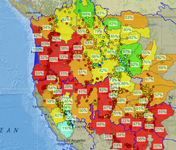
Wondering where you’re seeing that at? USDA has snow water equivalent maps updated and Boise and Payette systems are at 70%. Owyhees and eastern oregon are hurting bad (30%). Reservoirs are cooked out there with not much chance of filling. Will likely be a short irrigation season for irrigators in eastern oregon unless they are a water user of owyhee reservoir.
 
Wondering where you’re seeing that at? USDA has snow water equivalent maps updated and Boise and Payette systems are at 70%. Owyhees and eastern oregon are hurting bad (30%). Reservoirs are cooked out there with not much chance of filling. Will likely be a short irrigation season for irrigators in eastern oregon unless they are a water user of owyhee reservoir.

I'm not seeing that either. Not even close:


Kinda sounds as if someone read the RFK Jr report on the health of the Rocky Mtn Snowpack and took it as gospel. Next up, we'll get some fitness tips for elk hunting in a drought year brought to you by Kid Rock.
 
Gotta look at the big picture, aside from poor skiing conditions, this winter could likely be a net benefit for hunting (not agriculture or river rec):

Water can come in the form of May/June rain and create really high quality feed. We had plenty of precipitation in December...it just wasn't cold enough to be snow. If that continues...with these cold temps, look out. Wet start to the summer is also better for fire suppression than a heavy snow year.

We could also have a cold spring where the snow lingers up top, even though there isn't much of it.

The fact that we've had a mild winter will likely bode well for survival rates, and the does that are currently pregnant are getting a ton of extra feed this winter...which research indicates those buck fawns will likely experience some above average antler potential throughout their lifetime due to such favorable conditions in-utero.

Definitely not a simple black and white dynamic
 
Gotta look at the big picture, aside from poor skiing conditions, this winter could likely be a net benefit for hunting (not agriculture or river rec):

Water can come in the form of May/June rain and create really high quality feed. We had plenty of precipitation in December...it just wasn't cold enough to be snow. If that continues...with these cold temps, look out. Wet start to the summer is also better for fire suppression than a heavy snow year.

We could also have a cold spring where the snow lingers up top, even though there isn't much of it.

The fact that we've had a mild winter will likely bode well for survival rates, and the does that are currently pregnant are getting a ton of extra feed this winter...which research indicates thoae buck fawns will likely experience some above average antler potential throughout their lifetime due to such favorable conditions in-utero.

Definitely not a simple black and white dynamic
Snow in the hills is money in the bank. All that fawn survival won’t mean much if we lack the snowpack to prevent the mountains from drying out by June. Could be another fire season like it was two years ago when we had all the fires burning in central idaho closing access to many of the sawtooth units.
 
Snow in the hills is money in the bank. All that fawn survival won’t mean much if we lack the snowpack to prevent the mountains from drying out by June. Could be another fire season like it was two years ago when we had all the fires burning in central idaho closing access to many of the sawtooth units.
Or it could be like 4 years ago when we lost almost all our snowpack in a 2 week period in May with temps into the 90s, massive flooding, and then fires all summer.

Snowpack is only one factor among many...and its still WAAYYY to early to tell at this point.
 
Or it could be like 4 years ago when we lost almost all our snowpack in a 2 week period in May with temps into the 90s, massive flooding, and then fires all summer.

Snowpack is only one factor among many...and its still WAAYYY to early to tell at this point.
I dont like either of these could-be’s lol. Fingers crossed for a wet spring and people practicing fire safety when camping this summer so we can all get out and chase big bucks like the one you have in your photo.
 
Back
Top