Knot masters?

LostArra

WKR
Joined
May 9, 2013
Messages
4,313
Location
Oklahoma
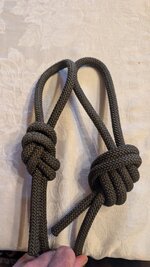
Is a double overhand knot loop (right) stronger or "better" than a single version (left)? Both seem secure under load and don't easily come untied.

PXL_20260517_132038653.jpg
 
Depends on how you are using it I suppose. If you are just using it for a loop end the bowline is a well tested knot. A figure 8 on a bight (left in your picture) is used to catch rapplers/climbers when they fall plus it can also be tied through an attachment point, that knot is known as a figure 8 follow through.

A little more info on what you are securing might help?
 
If you're trying to improve on the figure 8, look up the figure 8 double loop.

There's a point where the knots slip is no longer the issue and instead it's the shear on the rope in the knot. Some knots break the rope sooner than others.

What are you trying to do and with what kind of rope?
 
Thanks to all.
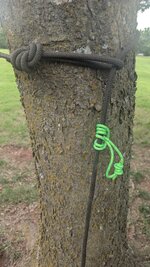
Random deer camp ropes used around trees to attach harnesses. In process of upgrading some prusiks.
The figure 8 does lay flatter against tree.
The bulky one might grab a little better but there are usually some small limbs present to prevent sliding.

PXL_20260517_174104417.jpg
 
Thanks to all.
Random deer camp ropes used around trees to attach harnesses. In process of upgrading some prusiks.
The figure 8 does lay flatter against tree.
The bulky one might grab a little better but there are usually some small limbs present to prevent sliding.

View attachment 1067531
Just about any knot you could come up with is gonna be super good enough for that application. But like has been said above a figure 8 is the most common knot used in climbing and guys take massive whippers on it regularly. If you feel like nerding out on ropes and knots and shit. There’s a guy on YouTube How not 2. Just about all he does is test knots and climbing/caving gear.
 
Just about any knot you could come up with is gonna be super good enough for that application. But like has been said above a figure 8 is the most common knot used in climbing and guys take massive whippers on it regularly. If you feel like nerding out on ropes and knots and shit. There’s a guy on YouTube How not 2. Just about all he does is test knots and climbing/caving gear.
Solid channel and lots of knot nerd info
 
While I have the attention of you knot guys: When I deconstructed the knot on the right it appeared to be a double overhand loop knot (surgeons loop) but did not finish properly. What's up ? Diameter of the rope is the problem?

 
Probably just the dressing. A fishing knot is great at its purpose.. to be strong NEVER come untied even if it’s slack. Problem is once it is pulled tight you will be using a knife to cut it out. Climbing knots are also designed to be strong, and never come untied if slack.. just tend to be easier to untie when needed. The knots and hitches I use daily for work are a little different they need to be strong, quick to tie, and easy enough to untie after they have been loaded. I use a bowline everyday and it’s a great knot but if the knot was going back and forth between slack and tight I would use something else because it could work its way out. Unless your fishing there isn’t much use case for the surgeons
 
Look up a figure 8 follow through. It’s generally what is used for tying into the rope for climbing and is strong while also being fairly easy to untie. The advantage here is it’s a little more tree friendly and you don’t have to pull the entire length of rope through bight.
 
Like others have said, either knot is solid for this. The length of tail (free end coming out of the knot) is important. 6”-8” is the use standard.
I always liked to tie an overhand knot in the tag end around the standing rope.
 
Use the figure 8 in that application. If you are using it for a tether or safety line then use a hard knot (ie does not slip) that is easy to look at and tell thats its tied correctly, doesnt easily untie when un-weighted, but is as easy as possible to untie after loading. The figure 8 on a bight shown is one of the best for that use. (Its the same knot as a figure 8 follow thru, just tied differently). If you’re leaving safety lines in place consider tying the figure 8 directly around the tree. If taking with you frequently then the girth hitch is a lot easier.

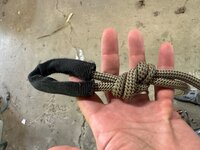
A tip: if using for a girth-hitched tether that is placed and removed frequently, there is a lot of wear concentrated at the apex of the loop when you hitch around the tree as shown above. Rope-on-rope cuts, so after a while it’ll weaken it. That rope is plenty strong and in this use there are advantages to girth hitching like that rather than tying around the tree, but a thinner rope or web may not have as much safety margin. Get $1 worth of 1” tubular webbing and slip the rope though the webbing so it sits just in the loop. Then all the wear is on the webbing, leaving the rope itself undamaged.
IMG_0652.jpeg
 
Back
Top