JF_Idaho
WKR


He didn't want to show that the 338 did not penetrate after hitting the knuckle either. Kinda blew his own theory.

Follow along with the video below to see how to install our site as a web app on your home screen.
Note: This feature may not be available in some browsers.

I think he owns a tape measure. But I believe it starts at 3” I wouldn’t mind borrowing that tape measure..I had the faintest hope that this video would actually be an unbiased test. Instead, he constructs a test to validate his bias.
He can't even be bothered to measure the penetration on the rib shot. Does he not own a tape measure? How about a muzzle velocity?
 he said there is 6” of muscle I don’t believe that for a second.
I refuse to give that video a view because the guy is rather questionable as a person. Unless I'm mistaken this is the guy who thinks leg shooting a deer at 700 yards is an ethical hunting practice.
I'm going to guess the conclusion is that it is not adequate. Somebody let me know if he has any good arguments.
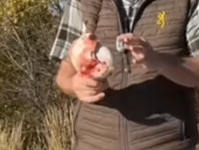
Ok, this got me to watch it.View attachment 956278
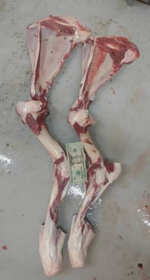
View attachment 956279
He didn't want to show that the 338 did not penetrate after hitting the knuckle either. Kinda blew his own theory.


In fairness the thread is full of dead animals including elk and video is just hide and bone edited with someone who's main point has always been bigger is better for elk.There seems to be just as many closed minded folks not wanting to watch a differing test than what they want to believe.
Seems quite hypocritical when someone naysays the effectiveness of the 77TMK, and the defenders always scream “did you read the thread”. Yet when someone shows a differing body of evidence they don’t even take the time to watch and see if there are biases OR if maybe there’s some validity to their testing.
Sent from my iPad using Tapatalk Pro

I think it’s probably because of the proven time and time again, very dishonest individual playing an online character, “presenting” it more than anything else.There seems to be just as many closed minded folks not wanting to watch a differing test than what they want to believe.
Seems quite hypocritical when someone naysays the effectiveness of the 77TMK, and the defenders always scream “did you read the thread”. Yet when someone shows a differing body of evidence they don’t even take the time to watch and see if there are biases OR if maybe there’s some validity to their testing.
Sent from my iPad using Tapatalk Pro



All that said, at the fundamental core of "how do you kill things with projectiles", two items are non-negotiable, and everything else is just nice to have. Shot Placement, and Penetration. As you go up and down the scale of bigger to smaller cartridges (and heavier and lighter arrows, and whatever else), the one thing that bigger buys you over smaller when all else is more/less equal (eg: .243 Accubonds vs 338 Accubonds or 243 ELD-X to 338 ELD-X) is more penetration. Since that's one of our two non-negotiables, that does have value and merit, if you happen to need more of that.

This is at best only partially-true, and at worst not-at-all-true (as presented here).
Caliber itself has nothing to do with penetration. Sectional Density, impact velocity, and bullet construction are the factors that determine the penetration characteristics of a projectile. This is why a .22 or .24 caliber can kill just as well as a .30 or bigger with the right bullets.
What's your deal with showing up in replies and saying I said things I did not, and wanting to nitpick on general statements like we were at a university debate?
so therefore, a substantially heavier weight bullet of identical or even somewhat less sectional density, will out-penetrate the lighter one 100% of the time, because with the heavier one, there is still enough retained mass to continue penetrating as it fragments when compared to the much lighter bullets in this current topic.