About 51:30 into this podcast, the guys are discussing zero range vs zero angle.
He claims that with most ballistic calculators, you enter a zero distance and given set of atmosphere conditions. (He uses an example of 1000 yards with cold temps, sea level, to purposely exaggerate the effect) He says that if you then change the atmospherics to something different(higher temp and high elevation), your zero range will still have a correction of 0,0. He claims using zero angle would have been better or given an actual correction. Says that with most calculators, even though the conditions changed it has to give you a 0,0 because the zero range is the baseline it has to go off.
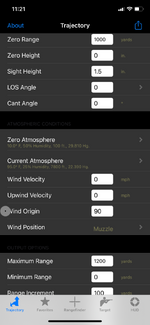
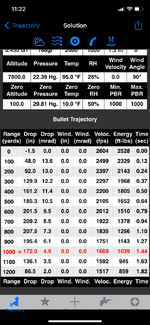
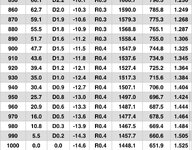
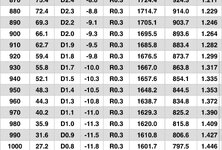
When I try what he says, using Ballistic AE, I get corrections to my dope, even at my zero distance, as long as the atmosphere has changed from the atmosphere I entered at the time of zeroing. For example if I put in a 1000 yard zero, at sea level and cold temps, and then change the atmosphere to get updated data for a different set of conditions, I get about a 3 mil correction even at my zero distance of 1000 yards.
What am I missing? Did he misspeak or is there something I’m missing?
Obviously no one is zeroing at 1000 yards, but I’m always trying to learn more and listening to this just made me really question why they would make that claim when it seems to not be a real issue at all? Any basic calculator should correct data when the atmosphere changes, even for the zero range, right?
He claims that with most ballistic calculators, you enter a zero distance and given set of atmosphere conditions. (He uses an example of 1000 yards with cold temps, sea level, to purposely exaggerate the effect) He says that if you then change the atmospherics to something different(higher temp and high elevation), your zero range will still have a correction of 0,0. He claims using zero angle would have been better or given an actual correction. Says that with most calculators, even though the conditions changed it has to give you a 0,0 because the zero range is the baseline it has to go off.
When I try what he says, using Ballistic AE, I get corrections to my dope, even at my zero distance, as long as the atmosphere has changed from the atmosphere I entered at the time of zeroing. For example if I put in a 1000 yard zero, at sea level and cold temps, and then change the atmosphere to get updated data for a different set of conditions, I get about a 3 mil correction even at my zero distance of 1000 yards.
What am I missing? Did he misspeak or is there something I’m missing?
Obviously no one is zeroing at 1000 yards, but I’m always trying to learn more and listening to this just made me really question why they would make that claim when it seems to not be a real issue at all? Any basic calculator should correct data when the atmosphere changes, even for the zero range, right?