I am new to reloading (and honestly shooting) and am working on my first load development project.
I ordered a new 280 AI that will be my primary focus, but for now I am working on my current rifle which is a 6.5 creedmoor, Savage 110 Trail Hunter with an 18” barrel. Speed really isn’t my concern here but for comparison it shoots factory 143 ELDX at an average of 2553 fps.
The rounds below were loaded with once fired hornaday brass since I have a ton of it, Winchester large rifle primers, 143gr ELDX, and IMR 4350.
My questions revolve around interpreting data collected and next steps, realizing there are many variables, many of which are human related and hard to quantify such as:
- All powder charges weighed individually on a balance beam scale.
- I never touched a rifle before until July 2025 so my skill level is not extremely high.
- These strings were shot outdoors off a bipod, in freezing temps and 15+ mph winds.
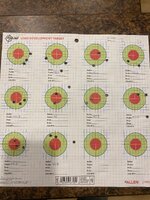
- The highest accuracy loads were on one side of the target in a vertical line so I’m not sure if even placement on the target sheet played a role.
- Lower quality chronograph.
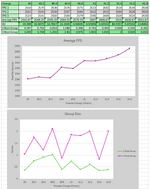
Rounds were fired in five shot groups going from lowest to highest charge and repeating to try to eliminate some charges being fired after more practice rounds essentially. Most groups seemed to have a flier that was almost certainly shooter error. So just for visualization I graphed the 3 shot group but also the closest two shots in the group.
My thoughts are to shoot several 5 round groups with 40gr, 40.8, and 41.2 as a better accuracy comparison. But I am curious to see what more experienced reloaders and shooters would suggest.
I ordered a new 280 AI that will be my primary focus, but for now I am working on my current rifle which is a 6.5 creedmoor, Savage 110 Trail Hunter with an 18” barrel. Speed really isn’t my concern here but for comparison it shoots factory 143 ELDX at an average of 2553 fps.
The rounds below were loaded with once fired hornaday brass since I have a ton of it, Winchester large rifle primers, 143gr ELDX, and IMR 4350.
My questions revolve around interpreting data collected and next steps, realizing there are many variables, many of which are human related and hard to quantify such as:
- All powder charges weighed individually on a balance beam scale.
- I never touched a rifle before until July 2025 so my skill level is not extremely high.
- These strings were shot outdoors off a bipod, in freezing temps and 15+ mph winds.
- The highest accuracy loads were on one side of the target in a vertical line so I’m not sure if even placement on the target sheet played a role.
- Lower quality chronograph.
Rounds were fired in five shot groups going from lowest to highest charge and repeating to try to eliminate some charges being fired after more practice rounds essentially. Most groups seemed to have a flier that was almost certainly shooter error. So just for visualization I graphed the 3 shot group but also the closest two shots in the group.
My thoughts are to shoot several 5 round groups with 40gr, 40.8, and 41.2 as a better accuracy comparison. But I am curious to see what more experienced reloaders and shooters would suggest.