I think "Wallop" is a thing

Are we using "Whollup" in place of mechanical kinetic energy transfer? If so ya its real and exists AKA physics... But it still does not tell you how a bullet will perform or correlate to wound channel. I cant remember off the top of my head but I believe it was Dr. Fackler that did research on this using metal or lead disks.. Also there is a paper in the link provided. The fact that "whollup" is "knockin em off their feet" just isn't true...
I don't consider whollup to be compared to knocking an animal down necessarily. Adequate whollup means a wide wound channel, easily breaking all bones it it's way and leaving a 1 1/2" to 3" exit hole that sucks innards and blood out the other side.
 
I don't consider whollup to be compared to knocking an animal down necessarily. Adequate whollup means a wide wound channel, easily breaking all bones it it's way and leaving a 1 1/2" to 3" exit hole that sucks innards and blood out the other side.
Again this is bullet dependant. For EXTREME example only lets say we have a .224 and .50 cal BMG both constructed like a heavy for caliber thin jacketed cup and core bullet IE TMK. both impacting at the same velocity in identical tissue/matter/animal. Yes by nature the 50 cal has more jacket to fragment and more lead core do drive the projectile deeper. But why? The .224 will most likely be caught and fully fragmented or "done" by the time it hits the off side of say a mule deer.. The 50 will still be going for say 10 mule deer deep. (I really don't know how many deer a 50 will penetrate) But what is the advantage? So you put a football size permanent wound channel in 1 deer vs a buick sized wound channel in 1 deer plus how ever many more. Furthermore the .224 will have realized its full potential inside 1 deer but the .50 will have never realized its full potential and at said hypothetical velocity may not have even began to fragment in the first 3/4 of the deers body. So I agree the heavy for caliber fragmenting bullets are way way more destructive than their lighter counterparts. But it begs the questions how much is too much? What am I gaining? Do I want the permanent wound channel to be fully inside the animal or just blow the back half out? So we find the happy medium. I want the Nalgene sized wound channel fully contained inside the animal, delivered from the lightest recoiling rifle it can, and effective out to what I deem MY range is.. I also have seen a photo from a big 30 that was using a heavy for caliber fragmenting match bullet on a deer. It was almost literally blown in half. A little hide below the spine and some belly is all that was left. Thoughts?

EDIT. Now if we are comparing a solid copper mono to a solid copper mono that is just a matter of do you want a knitting needle sized hole or #2 pencil sized hole...
 
Yes, this is what was lost in the "kill everything with a .223" (i got one by the way) convo. I like my bullets to exit. I just do. I think it makes for better blood trails, and I think that matters. that doesn't make the .223 less deadly, it just means it will often not meet a criteria that I HAVE. Medium construction bullets that expand and still fully penetrate do a lot of both. I prefer that. I like a good .243 interlock in 100 gr.
However, man do larger calibers destroy a lot of meat on a deer. It can be gruesome. This last year I swore I was done hitting whitetails with a 3006.
I really don't see any difference at all between my 6.5 Creedmoor and the .338 Win Mag I owned for two decades in terms of exits. Both seem to exit just fine.

However, it often felt as if the butt of that .338 Win Mag often exited my shoulder after pulling the trigger.
 
I really don't see any difference at all between my 6.5 Creedmoor and the .338 Win Mag I owned for two decades in terms of exits. Both seem to exit just fine.

However, it often felt as if the butt of that .338 Win Mag often exited my shoulder after pulling the trigger.
The problem with exit wounds - and I say this as someone who has preferred them for decades - is that quite often the heavier bullets that hedge your bets towards getting an exit, also push you towards *small* exits.

In 2001 I lost a deer on a quartering away shot. I second guessed myself for two months, then we found the buck's head maybe 100 yards from where I'd shot him. He'd just went into a nasty pine thicket and without a blood trail (because I had no exit wound on the steep quartering away shot) there was no way to find him. We just chanced across his head on a rabbit hunt that winter. We'd repeatedly walked within a few feet of him the night I shot him - but in a thicket where 30' might as well have been half a mile.

(To be clear, that was a 30-06 on a 175 pound whitetail - plenty of 'wallop')

That pushed me to heavier bullets, for a number of years. But I began to notice that a lot of those still didn't exit on steep shots, and even when they exited, the wounds weren't always very big.

Probably the last straw in this regard, for me, was the elk I shot a couple years ago:

This is what a 0.284" 160 grain Nosler Accubond looks like when you make a pinwheel-perfect textbook shot on an elk at an impact speed of right at 2300'.

Entrance:

b4b8f127-cf26-4eaa-b72b-24c51b04074b.jpg

And the exit. It's the little red sideways 'v' spot on its hide:

bbf7549e-ebf1-4456-bc75-3ca94e303d36.jpg

That's about as perfect as shot placement gets. (451 yards, no wind). There was good internal damage to both lungs and the plumbing at the top of the heart was severely damaged. He ran maybe 75 yards. But what good was the exit wound? That sort of exit won't bleed enough to enable trailing an elk.

You could argue that the same bullet at 2500' or 2700' impact speed, might have left a larger exit. Or maybe a shoulder exit with some bone fragments might have left a better exit. But so what? Most critters with shoulder exits aren't going more than a few yards.
I also have seen a photo from a big 30 that was using a heavy for caliber fragmenting match bullet on a deer. It was almost literally blown in half. A little hide below the spine and some belly is all that was left. Thoughts?
I shoot a lot of deer with smokeless muzzleloaders. Could have shot more than one, yesterday. But I generally use light to moderate loads, by smokeless standards. My 'heavy' load is a .40/225 at 2550'ish. Which is practically a freight train in terms of what it does to deer.

But I have seen videos of guys killing deer with .45 caliber 300+ grain projectiles at 2700' to 3000' and it honestly sort of bothers me to even watch. Exit wounds the size of small watermelons, at time. There's just no point in that, IMO.
 
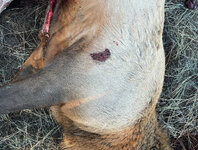
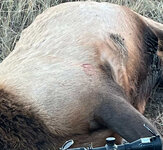
A friend and i had this conversation after loading his cow elk he’d killed with his 6 creed. I got it on video through the spotter, and we were watching it over and over trying to see exactly where it had hit her. There was next to no indication that she had been hit all all short of the thwack and the fact she tipped over dead.

She made it all of 10 yards before expiring, textbook double lung quartering away shot, 336 yards, leaving what was rest of the slug at the joint of the scapula to the leg bone. Hard to make one any more dead. But you can definitely tell that the “wallop” everyone talks about was less than videos you see of the super duper loudenboomer magnums. The consensus we came to, is that using a similarly constructed bullet from a 300 PRC would absolutely deliver more energy into the animal, but to what end? Short of shocking the CNS into a bang flop, anything beyond what was done to this cow is unnecessary in my eyes IMG_4567.jpegIMG_4570.jpeg
 
A friend and i had this conversation after loading his cow elk he’d killed with his 6 creed. I got it on video through the spotter, and we were watching it over and over trying to see exactly where it had hit her. There was next to no indication that she had been hit all all short of the thwack and the fact she tipped over dead.

She made it all of 10 yards before expiring, textbook double lung quartering away shot, 336 yards, leaving what was rest of the slug at the joint of the scapula to the leg bone. Hard to make one any more dead. But you can definitely tell that the “wallop” everyone talks about was less than videos you see of the super duper loudenboomer magnums. The consensus we came to, is that using a similarly constructed bullet from a 300 PRC would absolutely deliver more energy into the animal, but to what end? Short of shocking the CNS into a bang flop, anything beyond what was done to this cow is unnecessary in my eyes View attachment 975673View attachment 975674
Hard to beat a 215 grain Berger!!!
I took a spotting scope video of a buck being center punched with a 215 Berger out of a 300 RUM just 2 weeks ago, after a follow up shot to the brisket the buck still made a 300 yard death run before tumbling to the bottom of a draw. Another buddy of mine has shot 15-20 deer/elk with his 6.5 PRC and 147 ELD-M's, and hasn't had one go further than 50 yards post impact.
 
If I swing a hammer that’s 2 pounds vs 3 or even 5 pounds. (Larger and heavier) Or stab with a sword that’s 2,3 and 5 pounds. The speed may be the same but the weight and power transfer will be more effective. Not only is a larger caliber bigger in diameter than a smaller caliber but there is a compounded larger space the mushroom is expanding into. So in theory getting hit by a 5 pound hammer will carry more results then that 2-3 pounder. So if I shoot that bigger bullet in theory yes it will do much more damage and energy transfer will be more. So therefore you can take worse placed shots on game and still have forgiveness. Redneck science I guess? That’s just my theory. With the heavier sword(bullet) even though it’s going at the same speed I’m able to penetrate more with a similar strength bullet and thus with that far greater energy have far greater expansion and area of energy transfer. So yeah wallup is a thing just not as much as we think. It does matter though. And is still visible and is compounded even greater the larger you go.
None the less I can kill elk with a 6.5 all day with the right bullet..so I’ll use both personally. I pick the rifle and caliber based on the country and game I am hunting.
 
If I swing a hammer that’s 2 pounds vs 3 or even 5 pounds. (Larger and heavier) Or stab with a sword that’s 2,3 and 5 pounds. The speed may be the same but the weight and power transfer will be more effective. Not only is a larger caliber bigger in diameter than a smaller caliber but there is a compounded larger space the mushroom is expanding into. So in theory getting hit by a 5 pound hammer will carry more results then that 2-3 pounder. So if I shoot that bigger bullet in theory yes it will do much more damage and energy transfer will be more. So therefore you can take worse placed shots on game and still have forgiveness. Redneck science I guess? That’s just my theory. With the heavier sword(bullet) even though it’s going at the same speed I’m able to penetrate more with a similar strength bullet and thus with that far greater energy have far greater expansion and area of energy transfer. So yeah wallup is a thing just not as much as we think. It does matter though. And is still visible and is compounded even greater the larger you go.
None the less I can kill elk with a 6.5 all day with the right bullet..so I’ll use both personally. I pick the rifle and caliber based on the country and game I am hunting.
I don’t think anyone ever said that a larger caliber doesn’t have the potential to do more damage. It does. But most people don’t use eldm or tmk style bullets in the larger calibers, they use solids or controlled expansion because the eldm’s do too much damage. Then wound channels are similar when dissimilar bullets are used and recoil is far less with the small calibers. So the hypothesis is a smaller caliber with the right bullet can duplicate the big caliber wounds with less recoil, thus deliver more accuracy.
 
If I swing a hammer that’s 2 pounds vs 3 or even 5 pounds. (Larger and heavier) Or stab with a sword that’s 2,3 and 5 pounds. The speed may be the same but the weight and power transfer will be more effective. Not only is a larger caliber bigger in diameter than a smaller caliber but there is a compounded larger space the mushroom is expanding into. So in theory getting hit by a 5 pound hammer will carry more results then that 2-3 pounder. So if I shoot that bigger bullet in theory yes it will do much more damage and energy transfer will be more. So therefore you can take worse placed shots on game and still have forgiveness. Redneck science I guess? That’s just my theory. With the heavier sword(bullet) even though it’s going at the same speed I’m able to penetrate more with a similar strength bullet and thus with that far greater energy have far greater expansion and area of energy transfer. So yeah wallup is a thing just not as much as we think. It does matter though. And is still visible and is compounded even greater the larger you go.
None the less I can kill elk with a 6.5 all day with the right bullet..so I’ll use both personally. I pick the rifle and caliber based on the country and game I am hunting.

Bullets aren't hammers or swords though....Type of bullet has a much greater impact on what happens then size of bullet.

Its not really about how much energy or potential energy transfer is being carried. Its about what the bullet actually does.

I think that if your shooting the same bullet, then sure, you can make a reasonable argument that bigger is better, (not sure how much better, but at least a bit better). If your shooting say Accubonds as a popular example, I am willing to bet that a 225gr accubond shot from a 35 whelen is going to make a bigger wound channel then a 90gr accubond shot from a 6mm creed.

But, we aren't living in a like for like reality. A 116gr TMK shot out of that 6mm creed is going to have a bigger wound channel then a 225gr Accubond from that 35 Whelen. Maybe not as long, but much bigger where it counts for killing the animal. Now, both are gonna do the job just fine if shot placement is good clearly.

And likewise, I would expect say a .30 cal TMK to do more damage then a 6mm TMK.

We are balancing multiple things when hunting and harvesting and animal (in my mind), we want to cleanly harvest the animal, generally have it expire as quickly as reasonably possible, but also for most people (including me), we want as much meat as we can get, so maybe we don't want the mass destruction bullet because of the higher potential for meat loss. We also have caliber selection mixed in there. Where we hunt can matter from a tracking standpoint, property lines etc. different sizes of game.

The reality is, if I want to kill an animal quickly as the first priority, I am going to choose a bullet type that is gonna cause mass destruction, that is on average going to give me the quickest kill, and the most margin of error in shot placement. Bullet type by far outweighing bullet size.

But, personally, harvesting a deer, which where I hunt are mostly blacktail or "benchleg" deer that aren't particularly big, I may purposely choose a bullet type that causes less damage, to mitigate potential meat loss, while understanding that it may not expire as quickly (on average). It's mostly pretty open country, having a deer run 100yards isn't a big deal from a recovery standpoint, and I don't want to blow up both shoulders completely. Maybe a shoot Accubonds, or some other kind of bonded bullet, or even a mono like say a LRX to still harvest the animal but try to lesson the probability of meat loss.

On the flip side, elk hunting on public land in thicker timber with other hunters in the area....I am going to lean more heavily towards bigger wound channels, more tissue damage, and trying to put that elk down quickly. Maybe its now a partition, or maybe a ballistic tip, or a berger, eldm, tmk, type, something that's gonna do more damage, damage more lung/heart tissue, will give me a bit more margin of error, I can go tight or on the shoulder and know its going to impart heavy damage, that elk isn't going far most likely. I may loose more meat, but i have more meat to work with (in my mind).

As to the whole wallup thing....frankly, the greatest impact wallup has on shooting big game, is the negative effect it has on my shoulder when I pull the trigger. Less accurate, less practice because of recoil etc.

 
I don’t think anyone ever said that a larger caliber doesn’t have the potential to do more damage. It does. But most people don’t use eldm or tmk style bullets in the larger calibers, they use solids or controlled expansion because they do too much damage. Then wound channels are similar when dissimilar bullets are used and recoil is far less with the small calibers. So the hypothesis is a smaller caliber with the right bullet can duplicate the big caliber wounds with less recoil, thus deliver more accuracy.
I completely agree with you I was just stating the redneck science behind my theory.
Bullets aren't hammers or swords though....Type of bullet has a much greater impact on what happens then size of bullet.

Its not really about how much energy or potential energy transfer is being carried. Its about what the bullet actually does.

I think that if your shooting the same bullet, then sure, you can make a reasonable argument that bigger is better, (not sure how much better, but at least a bit better). If your shooting say Accubonds as a popular example, I am willing to bet that a 225gr accubond shot from a 35 whelen is going to make a bigger wound channel then a 90gr accubond shot from a 6mm creed.

But, we aren't living in a like for like reality. A 116gr TMK shot out of that 6mm creed is going to have a bigger wound channel then a 225gr Accubond from that 35 Whelen. Maybe not as long, but much bigger where it counts for killing the animal. Now, both are gonna do the job just fine if shot placement is good clearly.

And likewise, I would expect say a .30 cal TMK to do more damage then a 6mm TMK.

We are balancing multiple things when hunting and harvesting and animal (in my mind), we want to cleanly harvest the animal, generally have it expire as quickly as reasonably possible, but also for most people (including me), we want as much meat as we can get, so maybe we don't want the mass destruction bullet because of the higher potential for meat loss. We also have caliber selection mixed in there. Where we hunt can matter from a tracking standpoint, property lines etc. different sizes of game.

The reality is, if I want to kill an animal quickly as the first priority, I am going to choose a bullet type that is gonna cause mass destruction, that is on average going to give me the quickest kill, and the most margin of error in shot placement. Bullet type by far outweighing bullet size.

But, personally, harvesting a deer, which where I hunt are mostly blacktail or "benchleg" deer that aren't particularly big, I may purposely choose a bullet type that causes less damage, to mitigate potential meat loss, while understanding that it may not expire as quickly (on average). It's mostly pretty open country, having a deer run 100yards isn't a big deal from a recovery standpoint, and I don't want to blow up both shoulders completely. Maybe a shoot Accubonds, or some other kind of bonded bullet, or even a mono like say a LRX to still harvest the animal but try to lesson the probability of meat loss.

On the flip side, elk hunting on public land in thicker timber with other hunters in the area....I am going to lean more heavily towards bigger wound channels, more tissue damage, and trying to put that elk down quickly. Maybe its now a partition, or maybe a ballistic tip, or a berger, eldm, tmk, type, something that's gonna do more damage, damage more lung/heart tissue, will give me a bit more margin of error, I can go tight or on the shoulder and know its going to impart heavy damage, that elk isn't going far most likely. I may loose more meat, but i have more meat to work with (in my mind).

As to the whole wallup thing....frankly, the greatest impact wallup has on shooting big game, is the negative effect it has on my shoulder when I pull the trigger. Less accurate, less practice because of recoil etc.
oh I absolutely agree I was just stating the redneck science on how in theory yes it’s a thing but regardless of data and facts that the diminishing returns of that bigger caliber doesn’t justify the added efficiency. I wrote that I still just run a 6.5 for what I’m doing.
 
I don’t think anyone ever said that a larger caliber doesn’t have the potential to do more damage. It does. But most people don’t use eldm or tmk style bullets in the larger calibers, they use solids or controlled expansion because the eldm’s do too much damage. Then wound channels are similar when dissimilar bullets are used and recoil is far less with the small calibers. So the hypothesis is a smaller caliber with the right bullet can duplicate the big caliber wounds with less recoil, thus deliver more accuracy.
I agree with you and my whole comment does state I still run a 6.5 caliber. I do think there is a big enough change though with that bigger bullet regardless of caliber. I’ve seen 110 monos ruin elk but then I’ve also seen 208 size monos have even greater damage. Is it enough for me to justify running the 30 no. I’ll stick to the smaller caliber with right bullet. I use the bullet and round that best suits the country I’m hunting. I 100% am behind with a smaller caliber shot placement and accuracy is the cats meow and I also believe that with wind drift you can get away with a bigger bullet rather then the gains you get with smaller caliber on accuracy. Still more accurate with that smaller caliber but that bullet at father distances in my experience can be harder to judge wind than the bigger boys. Needless to say but I still run a 6.5. Really I run a 257 cal most days. But I’ll hunt with all the prc rounds depending on the country I am hunting. To me I think you can get away with a lot more than people say with bullet size. As long as you have the right projectile and the right impact velocity your good.
 
Back
Top