First time reloading in ages, 300wm

fracguy

FNG
Joined
Jul 18, 2025
Messages
84
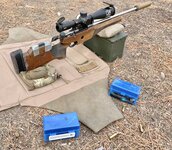
Got a press and dies a while ago and had other things that came up so never got to press out any ammo. I have learned that just about everything I did a long time ago was wrong so been doing a bunch of reading, had head separation with my 300 wm years ago, thought it was just the way it was, would only get 4 reloads out of my brass and all developed a crack, learned that was due to headspace issues. So I don't have the competition shell holders or any of that fancy stuff so I messed around with my dies and a cigarette lighter. I set my dies and used a lighter to blacken the shoulder, if there was any resistance or markings on shoulder I turned die down by about 1/16 of a turn until I got just the lightest of marks and barley any resistance when closing bolt. Turned die down about 1/32 so just barely moved and got no marks on shoulder and bolt will just about fall closed. Got a box of 215 berger hybrids, and man oh man are they LONGGG 😳😳. I am limited to length by my magazine, I did a very rough measurement with a piece of brass that sizes and used a punch to open back up so the bullet was a firm fit but movable. Bolt out (I don't have a coal gauge) I put round in and pushed it ahead until it stopped and used my cleaning rod to push it back out. Very crude I know but I can't make anything longer than 3.518 due to magazine anyways but curious, overall length was 3.696. My question is am I good to start my loads at 3.518 and get some nodes? I'm using r4831sc as it's mostly what I can get my hands on and seems to be the most temperature stable powder. Max load is 68.7gr with starting at 65. Start at like 66.7 and go up .5gr increments? I'm up for suggestions and tips. Using this on elk, not a target rifle. It's a weather by vanguard 300wm. Thanks in advance
 
So to clarify, you slammed the bolt closed on a round with minimal neck tension and got a measurement of 3.696” COAL? If so, I’d suggest doing again at .030” (3.548” COAL) longer than you mag length to confirm your not contacting the lands at that length at all. You likely won’t be but I’ve seen some weird leades and carbon buildup in throats that have done some funky things. If there is zero sign of land contact on the bullet with a 3.548” COAL, you should be okay to safely begin working at your max mag length of 3.518” without any suprises but will likely have a jump well in excess of .100”.

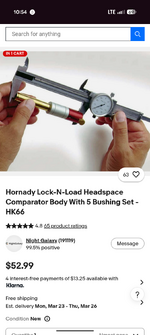
Regarding shoulder bump I’d highly recommend getting a comparator and calipers. Since they headspace off the belt, belted mag chambers can have some crazy variation in shoulder location (much more so with older rifles) and it’s worth knowing exactly where yours is in the chamber. I full length size and try to bump the shoulder .0015-.002 shorter than fired cases.
 
  • Like
Reactions: RME
So I would measure a fired case and then basically do the same that I did with the die until I have .002 difference in shoulder correct? I watched a video yesterday and a guy was using redding competition shell holders. Would those be worth buying? In my simplistic mind I did same thing by turning die out a tiny bit at a time. This is where I get super confused because I've read multiple different things.
 
You're doing some crazy stuff right now. Take a breath, read this, and start fresh.

 
You're doing some crazy stuff right now. Take a breath, read this, and start fresh.

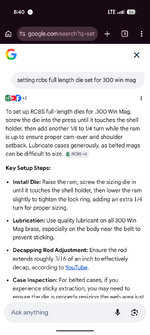
I've read some of it, time permitting at work. I'm getting lost with the setting my sizing die I guess. I remember years ago, I set it to what rcbs says by this and it worked fine, no issues with cases fitting but did have case head separation after about 4 firings so tossed brass after 3. Trying to eliminate that and gain some accuracy. My loads I used to shoot were most out to 600 which I always thought was decent for a hunting rifle, I shot 180gr Sierra boat tails with like 71gr imr4831 if I remember right. Probably over complicating a wet dream with this is probably what I'm doing. Do I need to invest in different dies to do what I'm trying to do? Thanks for the reply, that's been an interesting read so far. Also always went by the bullet length in the book and trimmed cases to match the book. So I was basically making fancy factory rounds. I never got too horribly involved in measuring coal or any of that.
 

Attachments

  • Screenshot_20260317-084005.png
    Screenshot_20260317-084005.png
    259.5 KB · Views: 2
I load for several belted mags. Also running Berger 215's in a 300 WM. I'm running mine over H1000.

Some good advice out there already. If I were in your shoes and I didn't want limited loadings per case due head seperation, I'd at least pick up a set of competition shell holders. Basic process I use for belted cartridges is that I let the cases expand till I get positive head space and then headspace off the shoulder like a standard cartridge; I bump .002-03 from full chamber length; keeps the brass working to a minimum, which decreases head seperations. Another plus with the different thickness shell holders is that you get full contact with the die bottom, which takes any slop out of your press. Certainly other ways to measure and control headspace, but the competition shell holders make it pretty simple.

Load to max functional mag length, so long as you're not into the lands too far to cause problems, and see what you get for accuracy. The 215's are generally eager to please and I'd be surprised if you don't quickly find a load you like. Through the years I ran several belted cartridges at standard 3.34 due mag length and never had one that I couldn't get an accurate load for with minimal fuss.

As far as starting powder charges, Hodgen's load data is a good place to start. I generally go .5 incriments. I don't chase max velocity; I chase accuracy and cycling functionality. I don't mess around too long with a powder in a given cartridge if its not producing. I don't care for finicky rifles or loads; some powders have big accuracy nodes in certain cartridges, which makes things quick and easy.
 
I'll add that traditionally Weatherby chambers with a long throat, even on non Wby cartridges. I have MkV's in 300 wm and 7mm RM, and they are long, as are, of course, the wby cartridges I've had. Granted, those rifles are both 25+ years old and they are MkV not Howas. Haven't worked with a new Wby in 10 years or more, so can't comment on how they're doing things in Wyoming.
 
Case head separation with belted mags is normally because you are oversizing brass and head spacing off the belt, not the shoulder. You'll need a way to measure shoulder bump, not guess it, to reduce how much youre working the brass
 
I've read some of it, time permitting at work. I'm getting lost with the setting my sizing die I guess. I remember years ago, I set it to what rcbs says by this and it worked fine, no issues with cases fitting but did have case head separation after about 4 firings so tossed brass after 3. Trying to eliminate that and gain some accuracy. My loads I used to shoot were most out to 600 which I always thought was decent for a hunting rifle, I shot 180gr Sierra boat tails with like 71gr imr4831 if I remember right. Probably over complicating a wet dream with this is probably what I'm doing. Do I need to invest in different dies to do what I'm trying to do? Thanks for the reply, that's been an interesting read so far. Also always went by the bullet length in the book and trimmed cases to match the book. So I was basically making fancy factory rounds. I never got too horribly involved in measuring coal or any of that.
Its common for belted cases to only last 3-4 loadings if you are resizing all the way to starting length. They can have a lot of headspace, so its a lot of stretch at every shot. Also, depending on the die/press combo, you can get pretty inconsistance sizing, so to maintain functionality, loaders will size every case even further than needed, which only makes the issue worse.
 
I load for several belted mags. Also running Berger 215's in a 300 WM. I'm running mine over H1000.

Some good advice out there already. If I were in your shoes and I didn't want limited loadings per case due head seperation, I'd at least pick up a set of competition shell holders. Basic process I use for belted cartridges is that I let the cases expand till I get positive head space and then headspace off the shoulder, which I bump .002-03 from full chamber length; keeps the brass working to a minimum, which decreases head seperations. Another plus with the different thickness shell holders is that you get full contact with the die bottom, which takes any slop out of your press. Certainly other ways to measure and control headspace, but the competition shell holders make it pretty simple.

Load to max functional mag length, so long as you're not into the lands too far, and see what you get for accuracy. The 215's are generally eager to please and I'd be surprised if you don't quickly find a load you like. Through the years I ran several belted cartridges at standard 3.34 due mag length and never had one that I couldn't get an accurate load for with minimal fuss.

As far as starting powder charges, Hodgen's load data is a good place to start. I generally go .5 incriments. I don't chase max velocity; I chase accuracy and cycling functionality.
Thanks, I think I'll order a set of the competition shell holders. So when I was messing around with all that last night, the shell holder was still touching the die and getting a cam over, not as much as what rcbs setting gets but was a solid cam over. With the die screwed in just touching it, the case still wouldn't chamber up, that's when I started making small adjustments to the die, screwing it in a c hair at a time. Also I don't have a chrony yet lol, just accuracy and cycling like you stated.
Case head separation with belted mags is normally because you are oversizing brass and head spacing off the belt, not the shoulder. You'll need a way to measure shoulder bump, not guess it, to reduce how much youre working the brass
That makes sense, I basically guessing at it. So you want a .002 head space to allow for expansion? Without that space can lead to pressure issues if I'm understanding why the .002 head space. Vs the resize all the way to starting length which has more head space which ais way over working the brass
 
Adequate shoulder bump is more about getting the cartridge to feed properly, not controlling pressure. .003 is kind of a standard number to aim for
 
Ok so that makes sense...
Was kinda what I did but I didnt have a comparator, think I may run up and grab one at lunch time.
I appreciate the info and taking time to teach my dummy o azz lol
 
Once fully expanded, I also use a comparator to measure my cases and make a note of whatever it is. Its most useful for checking spring back and size after each step of your process. If you are running a standard die with an expander ball, your sizing process might actually be lengthening the case by varying amounts, depending on how much force you apply, how consistently it is applied, and how evenly the lube is distributed.

It happens from time to time that folks measure and/or function check their cases post resizing with an expander ball, only to find that, despite resizing, their cases are too long; they then set the die/shell holder to push the shoulder back even further so that the cases remain the right length even after getting stretched by the expander ball. Of course, this works the brass even more than what is minimally required, leading to earlier case head seperations. To a much lesser extent, the process of pulling a case out of a resizing die can also result in some stretch. Predictably, this is even more prevalent in long cases, such as the 300 WM. Best is to remove the expander ball and measure the shoulder after sizing, then measure again after pulling the ball through. If you find that your cases are growing, it might be worthwhile to look into neck sizing with a mandrel, which sizes the neck by pushing down from the top instead of pulling up from the bottom.
 
Once fully expanded, I also use a comparator to measure my cases and make a note of whatever it is. Its most useful for checking spring back and size after each step of your process. If you are running a standard die with an expander ball, your sizing process might actually be lengthening the case by varying amounts, depending on how much force you apply, how consistently it is applied, and how evenly the lube is distributed.

It happens from time to time that folks measure and/or function check their cases post resizing with an expander ball, only to find that, despite resizing, their cases are too long; they then set the die/shell holder to push the shoulder back even further so that the cases remain the right length even after getting stretched by the expander ball. Of course, this works the brass even more than what is minimally required, leading to earlier case head seperations. To a much lesser extent, the process of pulling a case out of a resizing die can also result in some stretch. Predictably, this is even more prevalent in long cases, such as the 300 WM. Best is to remove the expander ball and measure the shoulder after sizing, then measure again after pulling the ball through. If you find that your cases are growing, it might be worthwhile to look into neck sizing with a mandrel, which sizes the neck by pushing down from the top instead of pulling up from the bottom.
That makes quite a bit of sense, pushing shoulder back just to have the expander ball pull the case back out. Did read on I think it was long range forum it's important to keep everything the same with the pressure when resizing. Eventually I want to get the Peterson long brass, right now I'm using federal brass. I guess I'll have to wait on a comparator, nobody has one in town.
 
Back
Top