First Aid

Joined
Dec 19, 2025
Messages
6
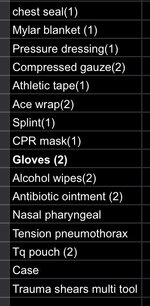
What sort of first aid kit does everyone carry in the back country? The more medical classes I take, the bigger my kit gets. I have a buddy that is a Dr with WEMT training brings only tape-everything else he figures he can improvise in the field.
 
Mine is pretty minimal. If I can’t fit it in my pocket, it’s too much. I have a pocket size kit that has a tourniquet and gauze. A few assorted bandaids. Not much else is needed.

I quit trying to pack for contingencies, that gets heavy.
 
In my mind, it depends 100% on the scenario.

Hunt with old guys? Bring Aspirin for chest pain.
Hunt with someone with a bee allergy? Bring epi pen.
Are guns or broadheads involved? Then a TQ is needed. That goes for off season practice too.

Skills trump equipment 100% of the time (may or may not apply to you).
Do you know how to use a chest seal or SAM splint? If not, why bother carrying one?
And skills decay rapidly. They need to be practiced in order to stay relevant.

Finally:
The one thing that always comes with me 100% of the time is an Inreach plb.
 
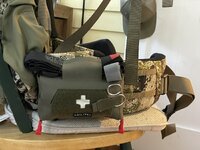
I’m was a paramedic for years and I’m big on tac-med for work. I’ve essentially cannibalized stuff I have for a backcountry kit. My setup is , single tourniquet on my pack shoulder strap or bino harness for easy access. Then I have the option of a dangle med pouch that velcros to my bino harness or a rip-away molle pouch on my pack waistband. Inside that- another TQ, trauma shears, pressure/israeli dressing, quikclot, some packing gauze, regular 4x4s, compression wrap, sam splint and an EpiPen . Then I have a small first aid kit inside my pack that has some OTC meds and bandaids. I hope this helps!
 
I’m was a paramedic for years and I’m big on tac-med for work. I’ve essentially cannibalized stuff I have for a backcountry kit. My setup is , single tourniquet on my pack shoulder strap or bino harness for easy access. Then I have the option of a dangle med pouch that velcros to my bino harness or a rip-away molle pouch on my pack waistband. Inside that- another TQ, trauma shears, pressure/israeli dressing, quikclot, some packing gauze, regular 4x4s, compression wrap, sam splint and an EpiPen . Then I have a small first aid kit inside my pack that has some OTC meds and bandaids. I hope this helps!
This!

And a marker. T Time & Date. Always.
 
lol totally forgot a marker! Thanks! I just went and added one to the pack, and when I was looking in it- I had a heavy duty penlight and a chest seal also.
Ask 100 guys how to put on, and where to put on, a TQ. 50% may do it correctly. How many keep track of time? Way too close to 0%

Saving a life is one thing. Preventing permanent nerve damage to salvageable life or limb is another. Steps. Knowledge. T Time & Date. Always. Especially in the back country where exfil is not minutes, but sometimes hours.
 
I read years ago in some magazine---field and stream/Outdoor Life -- back when they had real writers and not this junk from today ---- create your own first aid kit cheaper --- found this out later in life away from this country, forget a marketing first aid kit - or an issued one -- make your own, put them where they can be accessed quickly.

Not in any particular order
Quick Clot Z--small scissors (don't overlook these when hands are numb from cold, falling in water, etc, easier to use than a knife)--duct tape, benadryl, space blanket, regular gauze and bandages (Israeli compression), and butterflys --CAT tourniquet and use timer on watch/phone--nitrile gloves (hands get dirty, can't wash them, you may need these), moleskin, I have antiseptic wipes and a small bottle of alcohol, anitbiotics, chest seal, marker, c card.

As others have stated, the stuff that is most life saving, goes in outer pockets for easy access, everything doesn't have to be in one bag, just know where it is ---
 
CAT6 tourniquet, 2 packs of bleedstop, some goss, super glue, SAAMI splint (amazing for the weight), few bandages, small bottle of advil with cottonballs stuffed inside the extra space, trauma scissors, and the Garmin Inreach if you count that.
Call me paranoid, but once you see something real nasty or scary happen in person, you start to think about it.
 
Two tourniquets is better than one: you can add another if first is not tight enough or breaks and you can daisy chain them to make a pelvic splint.
 
Back
Top