Tourniquets are probably one of the simplest devices, yet most people don't actually know how to use them correctly. What follows is just general information for everyone.
The commercial ones are uniformly better than an improvised, even with training. My only reason for an improvised tourniquet in the backcountry is weight reduction and insuring I don't have a kit that ends up being left behind as it is unlikely I will need it. If going into a combat type situation, I would carry two C.A.T.s or S.O.F.T.T.s in first line or second line gear (not in a pack).
Extremity injuries, which accounts for 20% of all battlefield injuries, result in 7-9% of deaths during military activity. Silicone tourniquets were used, by the Israeli Defense Force (IDF) soldiers, for upper extremity and calf injuries, while ...

www.ncbi.nlm.nih.gov
The methods of application between a commercial windlass tourniquet (such as the C.A.T.), a commercial elastic tourniquet (such as the R.A.T.S.), and an improvised tourniquet are all different. Just because you can apply one correctly does not mean you will be able to use the others correctly.
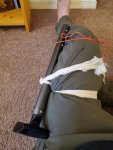
Here is an improvised tourniquet during practice. This one is actually obliterating distal pulses, notice how the amount of compression required to actually occlude the femoral artery. It is a little uncomfortable, and hurts if you try to use the muscles that are being compressed.
View attachment 220553
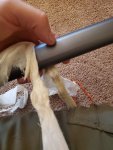
Don't assume you can take a tourniquet off and reapply (this applies to commercial tourniquets as well). When I started there was only enough slack to get the shovel handle under the triangular bandage, notice how much it stretched and the frayed material. I attempted to apply it a second time and it broke before pulses where obliterated.
View attachment 220554
I have also broken a C.A.T. Gen 7 that had been used previously in training.
If you are going to practice, practice on a thigh. Arms are easy, but the muscle mass on the thigh makes it a challenge to get adequate compression. If you fail to get adequate compression with the first tourniquet you apply, leave it in place and apply a second tourniquet 2 inches above it, if possible.