Field processing myths

Joined
Jun 5, 2023
Messages
41
Location
Alaska
This year I spent a lot of time working on improving my field care and processing. I read most threads that I could on rockslide on the topic and talked to as many old hunters as I could about which means I mostly spent my time encountering Fudd-lore about meat.

Below are the things I heard that gave me pause. As the thread fills out I'll update the main body of this post with more myths, explanations, or data if people post it.

Livers/organs

Don’t eat livers during the rut - if the liver looks white and has spiderweb like veins running over it you should throw it away.

Liver needs to be kept separate from all other meats - the people that say this have either put the meat immediately in a ziplock where it can’t breathe, or they’ve put it in the “hamburger” game bag.

Liver spoils and you should only take it if you can get it cold and out of the field in a day - I’ve heard these same people say that they throw the liver into their grind pile

General meat care

The more rutted out the bull the longer you let it hang - This person claimed that the standard time to hang a carcass is a few days, but if the meat smells off or rutted out you should have for 1-2 weeks.

One hair can spoil the grind pile - coming from people who don’t clean hair off of their meat in the field

Never get your meat wet - I haven’t met any Alaskans who will claim to have had meat spoil. I’ve talked to a number of people who are happy to put their meat directly on snow to cool it off. At least up here the preference has been cold > dry.

Don’t get any silver skin in the grind pile - One friend claims to have ground a muscle with all tendons/silverskin attached, done a taste test vs clean meat, and not been able to tell a difference in taste or texture. There’s whole threads on this that I won’t like here, If anyone has done a side by side comparison of the same muscle from the same animal I’d like to hear it.

Bones

Bones hold in a lot of heat, and if you want to cool the meat you need to debone the meat - is this not just an issue of meat thickness and surface area to cool?

Bone marrow is delicious - Coming from the same people that say that all fat needs to be trimmed from the animal. One time I heated up some moose bone marrow and it made my whole house smell like bad moose fat. When the marrow was cold the taste was unnoticeable.

Deboning in the field - I won’t even try to compile all of the opinions on this. I’ll just state my opinion and let people tell me im wrong. You should leave meat on the bone for the first night and let it go into rigor. If it’s going into the grind pile it’s acceptable to debone in the field after it’s been in rigor, but only if you need to save weight. This opinion is based on feelings, not facts.

Useful things learned this year

Having a pre-process sit-down is useful. After finding the animal and confirming its death i would take 5 minutes to tape my barrel, eat a snack, drink some water, and throw on rain pants. This gave me some time to let the adrenaline spike go down, and saved me from feeling completely spent when the animal was in my backpack.

Having an agreement about how the animal is going to be consumed before beginning field processing made life significantly easier. On a recent hunt we agreed that we were only taking roasts from the neck, and hind quarters. The entire shoulder and rib area was destined for the grind pile. This made it significantly faster and easier to field process animals as a team.

Use the game bag to cover meat as you skin it. The way this works is you first cut off the hock, and cover the shank with a game bag (putting the quarter in “upside down”). As you work the hide down, work the game bag down with it. Doing this resulted in significantly less cleaning of the quarters during butchery. On the shoulders you can use the game bag to “punch down” in the hide, and the meat never has a chance to get contaminants on it.

Taking the hind quarters off as a pair, attached to the pelvis, made for cleaner roasts and less waste. This is viable on smaller animals but It makes for an awkward pack-out.
 
I'll weigh in with another opinion on deboning:

If you're not chasing every bit of weight savings leg bones can provide some useful structure for handling the meat. I find it just a little easer to get into bags and on and off of packs and hung with the bones in than out.

If you de-bone you expose a little more meat to oxidation which can be a downside as many folks trim that oxidation off whilst butchering so more oxidized meat means a bit more meat tossed and a bit more time butchering. In my opinion less of a right or wrong and more of a pro/con.

I personally would have no qualms de-boning right away in the field if I were going to do it. I'm not familiar with what the benefit or cost of waiting for rigor would be in that scenario? But every one of my packouts have been short enough (<4mi) that it wasn't worth the extra field butchering time for the minor weight savings of removing leg bones.

re: bones and heat. I feel as if I've heard anecdotally that if you get spoiling due to heat it will start or be most severe at/near the bone but I don't know if that's correlation or causation. I've always viewed that the solution was to cool the meat moreso than to remove the bones but I am likely to need education er.
 
Interesting thread. With whitetails, our process has always been simple.

1. Get a good clean shot.
2. Gut it immediately.
2a. Organs - If deer is young, we always keep the heart and liver. My dad reports that older deer have a stronger flavor in the liver (they have processed more acorns). This could be fudd lore. I have started blind testing this by keeping them all (unless hit by bullet or bone fragments) and not telling him the deer’s age. I carry a couple of ziplock bags for this in my kill kit. I get them into cold salt water as soon as possible. Soak for 12 hours, changing water as desired. Freeze.
3. Drag it out of the field and skin it immediately. Then cut it into seven major pieces (two thighs, two rib cages, two shoulders, neck). Then cut off four shanks.
4. If time permits, immediately cut into steaks, roasts, etc. We usually turn shoulders, rib meat, neck, and shanks into burger, but I do like to keep shoulder roasts and shanks if space permits. It also depends on where the animal was hit. A nice clean double lung shot through the ribs doesn’t ruin much meat. A shoulder shot, even with a tougher bullet, usually ruins a fair amount. Then freeze it immediately.
5. If time doesn’t permit, put meat into contractor bags and immediately freeze. Thaw and process when able.
6. Cut off anything blood shot. Remove as much fat as practicable, especially any large chunks of white fat. Remove silver skin wherever practicable, especially any that is blood shot. There will often be good meat on either side of blood shot interstitial tissue.
 
I'll weigh in with another opinion on deboning:

If you're not chasing every bit of weight savings leg bones can provide some useful structure for handling the meat. I find it just a little easer to get into bags and on and off of packs and hung with the bones in than out.

If you de-bone you expose a little more meat to oxidation which can be a downside as many folks trim that oxidation off whilst butchering so more oxidized meat means a bit more meat tossed and a bit more time butchering. In my opinion less of a right or wrong and more of a pro/con.

I personally would have no qualms de-boning right away in the field if I were going to do it. I'm not familiar with what the benefit or cost of waiting for rigor would be in that scenario? But every one of my packouts have been short enough (<4mi) that it wasn't worth the extra field butchering time for the minor weight savings of removing leg bones.

re: bones and heat. I feel as if I've heard anecdotally that if you get spoiling due to heat it will start or be most severe at/near the bone but I don't know if that's correlation or causation. I've always viewed that the solution was to cool the meat moreso than to remove the bones but I am likely to need education er.
Going down the rabbit hole of pros/cons of deboning in the field probably isn’t a good use of this thread. There’s a million threads and opinions about it already. I included it in the main post because it’s one of those things would be frustrating to try to learn about as a new hunter.

Most of my hunting that I care about is sheep, goat, and bear hunting where the packout is a significant part of the trip. That informs my opinions on deboning.

If anyone has experience with meat spoilage from not deboning I’d be interested to hear about it, or if someone has weighed the loss of meat due to oxidation from deboning id like to see the numbers.
 
Interesting thread. With whitetails, our process has always been simple.

1. Get a good clean shot.
2. Gut it immediately.
2a. Organs - If deer is young, we always keep the heart and liver. My dad reports that older deer have a stronger flavor in the liver (they have processed more acorns). This could be fudd lore. I have started blind testing this by keeping them all (unless hit by bullet or bone fragments) and not telling him the deer’s age. I carry a couple of ziplock bags for this in my kill kit. I get them into cold salt water as soon as possible. Soak for 12 hours, changing water as desired. Freeze.
3. Drag it out of the field and skin it immediately. Then cut it into seven major pieces (two thighs, two rib cages, two shoulders, neck). Then cut off four shanks.
4. If time permits, immediately cut into steaks, roasts, etc. We usually turn shoulders, rib meat, neck, and shanks into burger, but I do like to keep shoulder roasts and shanks if space permits, Then freeze it immediately.
5. If time doesn’t permit, put meat into contractor bags and immediately freeze. Thaw and process when able.
6. Cut off anything blood shot. Remove as much fat as practicable, especially any large chunks of white fat. Remove silver skin wherever practicable, especially any that is blood shot. There will often be good meat on either side of blood shot interstitial tissue.
What have you learned from your liver experiments?

I pulled a liver off a fork moose this fall in late October, it was immediately on snow, and eaten/processed the next day. By all accounts I did everything correctly to get a good tasting liver but the flavor of that liver was still too intense for me. Maybe moose liver is just be too intense for me.

I’m curious how many of the myths that lead to intense tasting livers are from guys who don’t actually like liver in the first place.
 
What have you learned from your liver experiments?

I pulled a liver off a fork moose this fall in late October, it was immediately on snow, and eaten/processed the next day. By all accounts I did everything correctly to get a good tasting liver but the flavor of that liver was still too intense for me. Maybe moose liver is just be too intense for me.

I’m curious how many of the myths that lead to intense tasting livers are from guys who don’t actually like liver in the first place.

I’ll let you know after dinner this evening…
 
What have you learned from your liver experiments?

I pulled a liver off a fork moose this fall in late October, it was immediately on snow, and eaten/processed the next day. By all accounts I did everything correctly to get a good tasting liver but the flavor of that liver was still too intense for me. Maybe moose liver is just be too intense for me.

I’m curious how many of the myths that lead to intense tasting livers are from guys who don’t actually like liver in the first place.

If anyone had been around while I was boiling the liver and heart, they wouldn’t have fed it to a dog. I was almost retching from the steam. I ended up pouring off the water and boiling it again. And once I got it into the food processor and started adding the spices (black pepper, nutmeg, ginger), milk, and cognac, it got very delectable.
 
Use the game bag to cover meat as you skin it. The way this works is by first cutting off the hock, and covering the shank with a game bag (putting the quarter in “upside down”). As you work the hide down, work the game bag down with it. Doing this resulted in significantly less cleaning off the quarters. On the shoulders you can use the game bag to “punch down” in the hide, and the meat never has a chance to get contaminants on it.
🤦
Wtf, that's so brilliantly simple I feel dumb not having seen it done or thought of it.
 
According to the fudd lore I was given in my younger years I was told to let the meat hang at least 5 days. Skin on. Nowadays I skin it immediately if I can. Quarter it up and stick it in a cooler. Usually for about 3 days. I have a little grate system I keep the meat out of the blood that is pushed out of the muscle. Never had an issue with gamey tasting meat. Even super rutted bucks I've killed.
 
I committed the cardinal sin of meat care. My first two antelope were shot on a hot day at the same time, skinned, quartered and in the cooler within an hour. I didn't think my ice would melt so fast but by the time I got them home, they were floating in cold bloody water. By not supporting the meat in the cooler and not draining/replacing ice I had broke the rule. I'll just cut to the chase and say my light pink meat was delicious and still had good texture. Nobody could believe it was antelope. Now, I'll lightly brine duck breasts, antelope steak and other blood rich meat without much thought. So much for that rule.
 
I've never had an issue with deer in a cooler soaking in ice and cold water pulling the blood out for a few days. The blood is coming out of the meat to start with so if marinating in bloody water gave it a bad taste wouldn't it taste worse if all the blood was left in the meat by not soaking it?
 
Freezing Folgers coffee cans makes great block ice and meat only gets condensation unlike melted cubes
I have a small freezer in my garage just for freezing 2 liter bottles. When I kill an animal I put a layer of frozen bottles on the bottom of the cooler and put the meat in then I stuff more bottles in and around the meat where I can.

The tip of using a game bag to cover the skinned area is great. I have never even thought of that.
 
Very little blood comes out of the meat. After half an hour no blood comes out. It has all coagulated. The red color is myoglobin leaching out of the muscle, not blood.

Sent from my moto g power - 2025 using Tapatalk
 
Very little blood comes out of the meat. After half an hour no blood comes out. It has all coagulated. The red color is myoglobin leaching out of the muscle, not blood.

Sent from my moto g power - 2025 using Tapatalk
I always notice a big myoglobin dump from first freeze to first thaw on muscles.

It always makes me wonder how imporant it is for the meat to be dry and have a pellicle and other stuff you hear folks insist upon.

Our local processor does not age meat. He is brought dead animals with guts and has them cryovaced and assistants blowing you up to come get it ASAP. The meat is good. He gets lots of questions about aging and won't consider it.
 
I hunt a lot next to the ocean. I don’t remember the last time I didn’t wash out the cavity with sea water. A friend of mine has time to hunt earlier in the season and will tow his behind the boat for a bit to wash it out. This is before skinning. He has given me processed cuts and they are the best I’ve ever had. Also, we leave the fat on and bone in. It’s not nasty like other deer.
 
Taking the hind quarters off as a pair, attached to the pelvis, made for cleaner roasts and less waste. This is viable on smaller animals but It makes for an awkward pack-out.
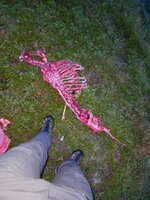
If you cut the quarter off such that the pelvis is bare bone, I'm not sure how this changes anything. Nothing was trimmed from the pelvis of this dink goat after the rear quarters were removed.
20240817_222238.jpg
Never get your meat wet - I haven’t met any Alaskans who will claim to have had meat spoil. I’ve talked to a number of people who are happy to put their meat directly on snow to cool it off. At least up here the preference has been cold > dry.
Yep, most all of my meat has been rained on for days and it is fine. I've also buried it in snow.

I would not place it in water to sit (such as a stream) unless in a plastic bag. Primary concern is potential contamination from the water, not the water itself.
 
I committed the cardinal sin of meat care. My first two antelope were shot on a hot day at the same time, skinned, quartered and in the cooler within an hour. I didn't think my ice would melt so fast but by the time I got them home, they were floating in cold bloody water. By not supporting the meat in the cooler and not draining/replacing ice I had broke the rule. I'll just cut to the chase and say my light pink meat was delicious and still had good texture. Nobody could believe it was antelope. Now, I'll lightly brine duck breasts, antelope steak and other blood rich meat without much thought. So much for that rule.
Did the exact same thing. Meat was fine
 
Aside from meat care, agree on any meat split prior. Shot a deer this year while hunting at my cabin. Two buddies were also up hunting from my cabin. One guy was with me when I shot it the other was off on his own. I was the only guy who shot one. Guy who was not even with us was texting me the other day asking when he "could come get his half."

Last year we did have one that we both put bullets in that we split but I was quite surprised to see this request. Especially "his half" if we were splitting meat between all hunters it would be 1/3.

Not something I am going to loose sleep over in this case but could see how this could turn into an issue.

As for general care from a purely logistical stand point mostly hunting white tails at my cabin or home I will hang a deer and skin, quarter etc either same day or next day depending on if it was shot morning or evening. Meat bags then hang in the barn until packed into the cooler to go home. Trimmed and processed at home usually a couple days later. I rarely have time to mess with aging etc at this stage in my life.
 
I stopped saving roasts on game that gets packed out. Everything I’d want to grind is carefully trimmed and into new cotton pillowcases to hang and pack out. In town the meat is grinder ready I don’t even have to look at it again, just cut the pillow case open, dump it in a meat tub, toss the pillow case, go have a hamburger at the local sports bar. Easy peazy.
 
Back
Top