
Failure of Navigation aides

BigNate

WKR
Joined
Dec 24, 2020
Messages
556
Location
Athol, Id. USA
Recently was putting together my stuff as rifle season was about to start, and having damaged my shoulder I wasn't able to hunt with my bow this year.

So I've carried a pocket compass when hunting for about 50 years at this point. When I was setting my stuff out I noticed this. 20251007_144638.jpg
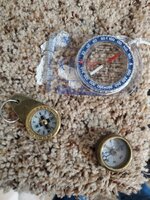
Now I've had a Garmin Oregon fail to work until it was no longer needed, onX was off by miles, phone compass confused. but never an old-school compass fail. I'd been using the Tru-Nord as it glows. My antique one has been in service the last couple days.

At this point I download a map of my area on onX, but always carry a compass.
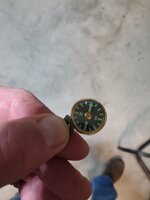
 
I had a silva forester die on me after 20 years in my pack and pocket. It rusted the needle and locked up.

I'm a big proponent of learning how to keep range and azimuth when operating in unfamiliar terrain
 
Recently was putting together my stuff as rifle season was about to start, and having damaged my shoulder I wasn't able to hunt with my bow this year.

So I've carried a pocket compass when hunting for about 50 years at this point. When I was setting my stuff out I noticed this. View attachment 949153
Now I've had a Garmin Oregon fail to work until it was no longer needed, onX was off by miles, phone compass confused. but never an old-school compass fail. I'd been using the Tru-Nord as it glows. My antique one has been in service the last couple days.

At this point I download a map of my area on onX, but always carry a compass.
Does the Silva indicator move, or is it stuck?
 
I had a good compass go wonky - so a second small one was added as a double check, and now I look at the main compass before heading out.

Strong magnets are used everywhere nowadays wrecking compasses they get near and I bet there are tens of thousands of bad compasses in packs that just never get used. I’m pretty sure my compass was goofed up when stuffed in a car trunk with rear stereo speakers hanging down, but it also could have been the magnetic connector in a fly fishing net that holds it to the vest.
 
I was caribou hunting on the tundra this fall and for much of the trip it was socked in with fog and snow with visibility under 50 yards in obviously unfamiliar territory with zero recognizable landmarks. I had my onX and my Inreach as backup but it gave me a bit of the willies relying solely on electronics. I’m going to order one of those and it’s going to live in my pack. Thanks for the reminder.
 
Three magnetic compasses close together... yea it's easy to believe that they affect each other, just like steel engine block would affect each of them separately. Spread them out a bit (6+ feet) and see if that one is still flipped.

I keep a Silva in the pack too, but it rarely gets used b/c I'm not in the Barren Grounds or KS prairies.
 
It was out by itself when I noticed it facing the wrong direction. The other compasses are affected by each other but very little, not 180°.

I'm in steep mountains and rarely need a compass or onX but when the clouds settle around you taking the wrong ridge could land you many miles in the wrong direction.
 
It was out by itself when I noticed it facing the wrong direction. The other compasses are affected by each other but very little, not 180°.

I'm in steep mountains and rarely need a compass or onX but when the clouds settle around you taking the wrong ridge could land you many miles in the wrong direction.
It sure makes you question what the heck happened! lol

Reading this post brought back the memory of seeing the compass read off at a weird angle that was obviously not right. It’s not talked about much, if ever, and it completely caught me off guard.
 
It's likely that your compass came close to something with a strong magnetic field which reversed the needle's polarity. Obviously, the needle does not know that it's pointing 'north,' only that it's aligned with whatever magnetic field is strongest. Away from other magnetic sources, that is the Earth's magnetic field, which happens to point roughly north. The waviness/variations in that field is why declination is printed on every useful map. However, we've all seen the compass point towards a pocket knife. It is susceptible to the strongest field nearby.

It orients itself along the strongest field because the needle's own field is perfectly aligned. If away other magnetic fields, it will point cleanly north-south. But true magnets, even the magnet in your phone speaker, magnetized driver bit, etc., can disrupt the needle's perfect internal alignment. The less aligned it is, the less accurate it will be and further from magnetic north it will point. In some cases, you may end up 'reversing' the polarity (roughly speaking, "subtracting" enough to make the needle point the other way).

The result is a needle which points roughly south, rather than north. Please note that it is very unlikely to point 'exactly' south, so I wouldn't recommend using the compass at this point. You can remagnetize the needle if you'd like, or keep it as is for the novelty.

This article also discusses this topic if you'd like to read more: https://rin.org.uk/blogpost/1706945/304954/Reverse-Polarity-in-Compasses#

Hope that this helps!
 
After years of surveying using a high grade compass, I can vouch for things that happen. It is very common to have a 15-20 degree variance in compass readings due to localized magnetite deposits, iron collections and or other influences. Magnetic fields move and aren't as dependable as you would think.

A common way of seeing this is through foresights and backsights. I utilize a gps, a compass and a topographic map. I don't trust any of these alone and I have doing cross country navigation since the late 60s professionally.

Most of the time its just backup for verification. But every once in a while, its critical. The worst I remember was exploration of a swampy flat behind a ridge. Fog settled in and left me with no reference points. Scattered through the flat were non-descript outcrops 20-30 ft high. The only access from the west was an elk trail through a non-descript cleft in a cliff. I think it took me three tries to find the trail with all the tools I had.
 
I carry two compasses at all times, a habit I acquired as a SAR dog handler the night I started into a brushy area and realized I had left my sole compass in my vehicle.

Navigation charts for Lake Superior include information about magnetic anomalies in northeastern Minnesota from iron deposits.

My all-time favorite compass ”deviation” anecdote was told to me by an observer. A bunch of handlers in my former unit in WA had been called back to a search base in the North Cascades when the missing subject was found. Everyone made it back except a guy whose radio transmissions were getting fainter and fainter. (In those days it was common for us to work alone, a practice that has virtually disappeared these days.)

A helicopter was sent to fetch him. He was on his way to BC when they found him. He had been holding his compass with the direction of travel arrow pointed at his navel, not away from him as he should have.

That story is why I attach a bright cord to the baseplate at the hole provided. If I fall prey to this error, the cord ”might” draw attention to that fact.
 
Back
Top