
Thats funny, you took the words out of my mouth before I deleted it.. They see the worse of the worse in hunters/ shooters. But dang they can find animals when the rest cant!!!“Guides” are probably some of the least informed and closed minded folks in all of the shooting and hunting world. Ask me how I know, I used to guide folks. I understand their position because people SUCK at shooting and their unfortunate answer is always the same. Bigger, tougher, faster, blah.
They are incredible outdoorsmans who know a ton about finding animals and are top notch in their specific regions. They are not incredible at knowing what kills effectively.

Navigation
Install the app
How to install the app on iOS
Follow along with the video below to see how to install our site as a web app on your home screen.
Note: This feature may not be available in some browsers.
More options
Style variation
You are using an out of date browser. It may not display this or other websites correctly.
You should upgrade or use an alternative browser.
You should upgrade or use an alternative browser.
ELD-X issues
- Thread starter Blcktail56
- Start date

- Joined
- Oct 22, 2014
- Messages
- 15,236
Seen SGK break off tip and not upset, shot a doe last year and it penciled through, doe ran off into heavy brush and cactus ( didn’t send in the dog ) next day saw a Mexican eagle sitting in a tree @ the spot, waded into the mess and
Found the doe , opened her up and very very quickly saw only deflated lungs
Should have been mush & large exit wound? Imo very rare failure
But tips do break off sometimes in a ammunition belt after a while of carrying
Never thought about plugging and failure
Sierra Gameking- or Tipped Gameking?
- Joined
- Oct 22, 2014
- Messages
- 15,236
Really appreciate the reply and info Form, with that 130 gr TMK is there a distance we need to stay away from?
No. They produce excellent wounds from at least 1,800fps to as fast as you can launch them.
- Joined
- Oct 22, 2014
- Messages
- 15,236
No offense to anyone, but I really really want to slow you down on this path towards match bullets for big game hunting. There is a reason that as an elk guide I would not allow match bullets to be shot at animals.
I think we need to back up to find the culprit here. What you experienced is one of those relatively rare “that doesn’t make any sense” moments with a certified big game bullet. These do happen, but they are rare. My godfather was professional hunter in Africa for 50 years. Saw thousands of animals taken in person. He noted that from time to time, a well made, properly calibrated bullet will hit an animal in the right place at the correct angle, and fail to adequately kill the animal for unknown reasons. This is the nature of high velocity projectiles made by imperfect humans. Things will sometimes go wrong and it’s not your fault. It’s not really the bullet’s fault either (well, probably not).
However, a match bullet would do what your bullet did more often. Match bullets are not a great choice on big game because the core is not well bonded to a thinner jacket, meaning when they hit tissue, they often violently expand, and lack penetration. You may here this referenced as uncontrolled expansion (more or less what happened with your bullet; total fragmentation). What some folks are getting wrong in this chat is exactly this: Uncontrolled expansion does often lead to a pretty devastating wound on the animals, and often kills them. Especially when that shot is well placed and especially on weak game like whitetail deer. However when you run the math, it’s a much better idea to have a thick jacketed bullet designed for hunting that has some expansion and is designed to penetrate as far as possible into the animal to reach the vital organs needed to kill it. Those guys who are killing elk with match bullets, I’m not doubting you’re telling the truth. You maybe shot 10 elk is the last 8 years if you’re good at what you do. That’s great! But your sample size is too small to know that those bullets are actually effective over the long run at killing elk. You don’t want to find that out when your match bullet fragments on the shoulder blade of a giant Arizona elk quartering away and basically bounces off of it.
The gentleman above, that notes that he killed a cow elk with a front shot with a .223 and match bullet, I can appreciate a good shot that worked out for you, but to put that on the internet and recommend it to random folks is not a good idea. You and I know that yes, an elk could be killed cleanly with a 223 but no, it’s not the ideal thing to recommend to folks. A rib bone or leg bone of a cow elk could easily turn that hunt into a nightmare scenario. Shot placement is key, lots of us could make that shot work, but it’s not the safe option for a clean ethical kill for most hunters.
OP, overexpansion actually was your fluke problem, and is tied to under-penetration. Your bullet deformed on angled impact with hard tissue (eg bone) and fragmented, slowing it down. The animal was able to survive the transfer of kinetic energy and the fragmented bullet didn’t disrupt vital organs, which is what you need to have happen. Hard to say why this ELDX did that, but that’s the unknown factor I describe above. A match bullet would do this more often, with worse results over a large sample size of animals shot. Long story short: your eldx fragmentation was a fluke, don’t go changing to match bullets that do it more often.
I believe you have taken the cake for the most wrong in a single post on this forum and once again have proven the reality of the ignorance of “guides”.

S-3 ranch
WKR
Holy F wrong website to speak bad about match bullets, these cats will go F’ing crazy!!!! , whitetail & muley deer are weak and match C&C work ok on them! Imo this is a definite bad choice for African game where you need to punch through the front legs to hit vitals! There isn’t a professional hunter above the Limpopo river that will let you use a match bullet, much less a Hornady anything. They love the bonded and mono stuff over there for very good reasons!No offense to anyone, but I really really want to slow you down on this path towards match bullets for big game hunting. There is a reason that as an elk guide I would not allow match bullets to be shot at animals.
I think we need to back up to find the culprit here. What you experienced is one of those relatively rare “that doesn’t make any sense” moments with a certified big game bullet. These do happen, but they are rare. My godfather was professional hunter in Africa for 50 years. Saw thousands of animals taken in person. He noted that from time to time, a well made, properly calibrated bullet will hit an animal in the right place at the correct angle, and fail to adequately kill the animal for unknown reasons. This is the nature of high velocity projectiles made by imperfect humans. Things will sometimes go wrong and it’s not your fault. It’s not really the bullet’s fault either (well, probably not).
However, a match bullet would do what your bullet did more often. Match bullets are not a great choice on big game because the core is not well bonded to a thinner jacket, meaning when they hit tissue, they often violently expand, and lack penetration. You may here this referenced as uncontrolled expansion (more or less what happened with your bullet; total fragmentation). What some folks are getting wrong in this chat is exactly this: Uncontrolled expansion does often lead to a pretty devastating wound on the animals, and often kills them. Especially when that shot is well placed and especially on weak game like whitetail deer. However when you run the math, it’s a much better idea to have a thick jacketed bullet designed for hunting that has some expansion and is designed to penetrate as far as possible into the animal to reach the vital organs needed to kill it. Those guys who are killing elk with match bullets, I’m not doubting you’re telling the truth. You maybe shot 10 elk is the last 8 years if you’re good at what you do. That’s great! But your sample size is too small to know that those bullets are actually effective over the long run at killing elk. You don’t want to find that out when your match bullet fragments on the shoulder blade of a giant Arizona elk quartering away and basically bounces off of it.
The gentleman above, that notes that he killed a cow elk with a front shot with a .223 and match bullet, I can appreciate a good shot that worked out for you, but to put that on the internet and recommend it to random folks is not a good idea. You and I know that yes, an elk could be killed cleanly with a 223 but no, it’s not the ideal thing to recommend to folks. A rib bone or leg bone of a cow elk could easily turn that hunt into a nightmare scenario. Shot placement is key, lots of us could make that shot work, but it’s not the safe option for a clean ethical kill for most hunters.
OP, overexpansion actually was your fluke problem, and is tied to under-penetration. Your bullet deformed on angled impact with hard tissue (eg bone) and fragmented, slowing it down. The animal was able to survive the transfer of kinetic energy and the fragmented bullet didn’t disrupt vital organs, which is what you need to have happen. Hard to say why this ELDX did that, but that’s the unknown factor I describe above. A match bullet would do this more often, with worse results over a large sample size of animals shot. Long story short: your eldx fragmentation was a fluke, don’t go changing to match bullets that do it more often.
Most NA wild game carry the lungs far back where if you tried the same shot in Africa you would be punching the guts.

MontyMontana
FNG
- Joined
- Sep 4, 2025
- Messages
- 45
Was the expectation to produce a pencil sized hole all the way through the animal? Or basically a field point arrow with more speed...?.308win 130gr ttsx @ +/- 325 yards on a big old queen cow elk on our property in Colorado, did exactly what I expected & DRT View attachment 930600

dreamingWest
WKR
- Joined
- Jan 28, 2017
- Messages
- 1,390
I can't believe I missed that thread.Before we get into another discussion about whether guides should be looked at as an authority on external ballistics, we've been there.
I went on three big game rifle hunts this fall, spending nearly two months with some really great guides. These are guys that spend 5 months a year in the NWT and some that spent 4 months a year in British Columbia. They see more big game animals (moose, goats, caribou, elk and sheep) shot with a rifle in a year than some will see in a lifetime. When you compound that over 5 or 10 years, it makes sense to listen close to what they say. I don’t know if it is really beneficial to identify bullets they say consistently perform worse than others or those that consistently impress...


I've had guides that didn't even know how to hunt. They were good cowboys or survivalists. I've also had guides that were absolute killers.
I'd say a guide's hunting/killing capabilities are just as randomly varied as their clients.
It's not difficult to kill animals with rifles. This forum has some real killers trying maximize efficiency and minimize bad results. It's educating, interesting, and has been fun to play along.
cbailey1187
FNG
- Joined
- Aug 17, 2023
- Messages
- 35
I shot a whitetail doe at 350 yards with a 147 eldm. She was slightly quartering to when I took the shot. The wind pushed the bullet into the shoulder ( I was aiming in the crease behind the shoulder) it went through both shoulders and punched out. I wasn't able to recover the bullet or any fragments. She took three steps and fell over dead. So far I have had great success with the eldm bullets.That definitely tops mine lol that is wild. With the match bullets do you have to be real careful about shooting a quartered to animal in the shoulder? Concerning that it would hit bone and solid meat and just come apart with no penetration. Especially inside 200. I have read great things about match bullets but can’t seem to find anyone saying they blow through shoulders
S-3 ranch
WKR
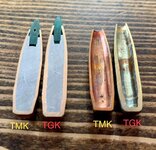
TGKSierra Gameking- or Tipped Gameking?
But I’m seeing people complaining about hollow points getting flat tips while in the middle and bottom of a magazine of heavier caliber rifles
I can only assume it would include a game king also?
- Joined
- Oct 22, 2014
- Messages
- 15,236
The TGK is a thick jacketed, “deep penetrating” bullet. It creates narrow wounds on average. It is not “the tip” of the TGK that causes it, it’s the construction of the bullet.

Well that’s not true. I was in Limpopo when we used Hornady 147 match and 143 Norma Bondstrikes. PH was less than impressed with the Bkndstrike and loved the 147. His only comment was he might not use the 147 on Eland. It was used on gemsbok, wildebeest and sable as well as smaller stuff. Not one was shot through the shoulders to get to the vitals.There isn’t a professional hunter above the Limpopo river that will let you use a match bullet, much less a Hornady anything. They love the bonded and mono stuff over there for very good
S-3 ranch
WKR
Yeah a little bit thicker “”TGK jacket was measured at 0.047" compared to the TMK's 0.026" jacket.”The TGK is a thick jacketed, “deep penetrating” bullet. It creates narrow wounds on average. It is not “the tip” of the TGK that causes it, it’s the construction of the bullet.
Still they upset pretty easily in a little faster caliber ( better at longer distances)
Probably not any worse than any other unbonded bullet?

That's some of the best coaching I've ever heard, congrats to you both on a great buck! I agree with Form, get a new lot and load on. I've had very good consistency from the 143's both aerial and terminal, with a couple different lots.Let's try this for the 2nd video......
- Joined
- Oct 22, 2014
- Messages
- 15,236
Yeah a little bit thicker “”TGK jacket was measured at 0.047" compared to the TMK's 0.026" jacket.”
Still they upset pretty easily in a little faster caliber ( better at longer distances)
Probably not any worse than any other unbonded bullet?
View attachment 987075
That’s not “a little thicker”- that is a huge difference.
Tipped Gamekings are deep penetrating, relatively narrow wounding bullets. TMK’s are not.

Thanks for all the comments and advise! I wish I wouldn't have turned the recording off between shots. But i'm proud of how she handled everything! and really glad how she was able to stay calm, jack another round in, and was ready to shoot again. I believe the 1st shot was lethal, but it wasn't ideal like the 2nd shot......
Also wish I would have taken pictures of the entry and exist after skinning, not sure what I was thinking there.
I don't have a ton of experience with the ELD-X, only this buck and a buck my dad shot last year, his was with the 143 but out of a 6.5 prc, that recovered bullet was a 200 yd shot
Definitely going to try the 130 tmk, I want a bullet that really upsets when it hits a deer
Also wish I would have taken pictures of the entry and exist after skinning, not sure what I was thinking there.
I don't have a ton of experience with the ELD-X, only this buck and a buck my dad shot last year, his was with the 143 but out of a 6.5 prc, that recovered bullet was a 200 yd shot
Definitely going to try the 130 tmk, I want a bullet that really upsets when it hits a deer
SouthPaw
WKR
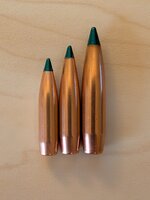
Makes sense looking at the oversized poly tip and huge associated hollow point on that 130, plus what we know about the internal construction and external geometry.One of the most reliably upsetting bullets made is the 130gr TMK.
77 95 130

hicountry1
WKR
- Joined
- Jan 15, 2022
- Messages
- 326
Eld X are nothing but cup and core. Expect cup and core performance.
Really just an interlok with a good BC.
Too many other better bullets available IMO , too mess with them.
Really just an interlok with a good BC.
Too many other better bullets available IMO , too mess with them.

LongWayAround
WKR
- Joined
- Aug 10, 2015
- Messages
- 4,035
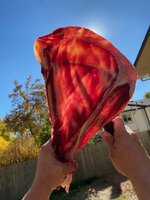
Ahh yes. The "guide" cites the impenetrable shoulder of the bull elk. Definitely not getting through that without a bonded bullet from a 300 something.

General RE LEE
WKR
- Joined
- Dec 28, 2019
- Messages
- 2,704
Ahh yes. The "guide" cites the impenetrable shoulder of the bull elk. Definitely not getting through that without a bonded bullet from a 300 something.
View attachment 987789
Looks 6 ARC ready

Ahh yes. The "guide" cites the impenetrable shoulder of the bull elk. Definitely not getting through that without a bonded bullet from a 300 something.
View attachment 987789
This tells you everything you need to know about said ‘guide’…
Attachments

Similar threads


- Replies
- 15
- Views
- 1K

- Replies
- 37
- Views
- 3K



Featured Video
Latest Articles
- From Big Bucks to Bear Hunts: Catching Up with Jordan Budd
- Mule Deer Days Wildlife Conservation Mashup
- A Hidden Gem: Hunting Washington with Kari Thomas
- Prime Divide Bow Review
- Knowledge From Storms: Surviving and Thriving in the Backcountry with John Barklow
- DIY Wyoming Pronghorn Hunt
- Unlock Precision Shooting: Master Your Hunting Game with Competitive Insights
- Topo Topper Rincon Review
- Tony Trietch on Big Mule Deer, Desert Bulls & Western Hunting Evolution
- The Right to Hunt & Fish Colorado (and North America)