ELD-X issues

Exactly. But expansion wasn’t really the problem. The core was all I really found and it was elongated or like Seeknelk said banana shaped. So penetration was more of an issue,
That sounds like what I wanted to hear. I know a few close friends and family member that have had success with them but trying to get a little more feedback. Especially close range stuff honestly. They are proven as a long range bullet which is what I wanted but I’m certainly not above jump shooting something either. I want something that does it all.

No offense to anyone, but I really really want to slow you down on this path towards match bullets for big game hunting. There is a reason that as an elk guide I would not allow match bullets to be shot at animals.

I think we need to back up to find the culprit here. What you experienced is one of those relatively rare “that doesn’t make any sense” moments with a certified big game bullet. These do happen, but they are rare. My godfather was professional hunter in Africa for 50 years. Saw thousands of animals taken in person. He noted that from time to time, a well made, properly calibrated bullet will hit an animal in the right place at the correct angle, and fail to adequately kill the animal for unknown reasons. This is the nature of high velocity projectiles made by imperfect humans. Things will sometimes go wrong and it’s not your fault. It’s not really the bullet’s fault either (well, probably not).

However, a match bullet would do what your bullet did more often. Match bullets are not a great choice on big game because the core is not well bonded to a thinner jacket, meaning when they hit tissue, they often violently expand, and lack penetration. You may here this referenced as uncontrolled expansion (more or less what happened with your bullet; total fragmentation). What some folks are getting wrong in this chat is exactly this: Uncontrolled expansion does often lead to a pretty devastating wound on the animals, and often kills them. Especially when that shot is well placed and especially on weak game like whitetail deer. However when you run the math, it’s a much better idea to have a thick jacketed bullet designed for hunting that has some expansion and is designed to penetrate as far as possible into the animal to reach the vital organs needed to kill it. Those guys who are killing elk with match bullets, I’m not doubting you’re telling the truth. You maybe shot 10 elk is the last 8 years if you’re good at what you do. That’s great! But your sample size is too small to know that those bullets are actually effective over the long run at killing elk. You don’t want to find that out when your match bullet fragments on the shoulder blade of a giant Arizona elk quartering away and basically bounces off of it.

The gentleman above, that notes that he killed a cow elk with a front shot with a .223 and match bullet, I can appreciate a good shot that worked out for you, but to put that on the internet and recommend it to random folks is not a good idea. You and I know that yes, an elk could be killed cleanly with a 223 but no, it’s not the ideal thing to recommend to folks. A rib bone or leg bone of a cow elk could easily turn that hunt into a nightmare scenario. Shot placement is key, lots of us could make that shot work, but it’s not the safe option for a clean ethical kill for most hunters.

OP, overexpansion actually was your fluke problem, and is tied to under-penetration. Your bullet deformed on angled impact with hard tissue (eg bone) and fragmented, slowing it down. The animal was able to survive the transfer of kinetic energy and the fragmented bullet didn’t disrupt vital organs, which is what you need to have happen. Hard to say why this ELDX did that, but that’s the unknown factor I describe above. A match bullet would do this more often, with worse results over a large sample size of animals shot. Long story short: your eldx fragmentation was a fluke, don’t go changing to match bullets that do it more often.

 
No offense to anyone, but I really really want to slow you down on this path towards match bullets for big game hunting. There is a reason that as an elk guide I would not allow match bullets to be shot at animals.

I think we need to back up to find the culprit here. What you experienced is one of those relatively rare “that doesn’t make any sense” moments with a certified big game bullet. These do happen, but they are rare. My godfather was professional hunter in Africa for 50 years. Saw thousands of animals taken in person. He noted that from time to time, a well made, properly calibrated bullet will hit an animal in the right place at the correct angle, and fail to adequately kill the animal for unknown reasons. This is the nature of high velocity projectiles made by imperfect humans. Things will sometimes go wrong and it’s not your fault. It’s not really the bullet’s fault either (well, probably not).

However, a match bullet would do what your bullet did more often. Match bullets are not a great choice on big game because the core is not well bonded to a thinner jacket, meaning when they hit tissue, they often violently expand, and lack penetration. You may here this referenced as uncontrolled expansion (more or less what happened with your bullet; total fragmentation). What some folks are getting wrong in this chat is exactly this: Uncontrolled expansion does often lead to a pretty devastating wound on the animals, and often kills them. Especially when that shot is well placed and especially on weak game like whitetail deer. However when you run the math, it’s a much better idea to have a thick jacketed bullet designed for hunting that has some expansion and is designed to penetrate as far as possible into the animal to reach the vital organs needed to kill it. Those guys who are killing elk with match bullets, I’m not doubting you’re telling the truth. You maybe shot 10 elk is the last 8 years if you’re good at what you do. That’s great! But your sample size is too small to know that those bullets are actually effective over the long run at killing elk. You don’t want to find that out when your match bullet fragments on the shoulder blade of a giant Arizona elk quartering away and basically bounces off of it.

The gentleman above, that notes that he killed a cow elk with a front shot with a .223 and match bullet, I can appreciate a good shot that worked out for you, but to put that on the internet and recommend it to random folks is not a good idea. You and I know that yes, an elk could be killed cleanly with a 223 but no, it’s not the ideal thing to recommend to folks. A rib bone or leg bone of a cow elk could easily turn that hunt into a nightmare scenario. Shot placement is key, lots of us could make that shot work, but it’s not the safe option for a clean ethical kill for most hunters.

OP, overexpansion actually was your fluke problem, and is tied to under-penetration. Your bullet deformed on angled impact with hard tissue (eg bone) and fragmented, slowing it down. The animal was able to survive the transfer of kinetic energy and the fragmented bullet didn’t disrupt vital organs, which is what you need to have happen. Hard to say why this ELDX did that, but that’s the unknown factor I describe above. A match bullet would do this more often, with worse results over a large sample size of animals shot. Long story short: your eldx fragmentation was a fluke, don’t go changing to match bullets that do it more often.

Edit: disregard, got OP mixed up with a different incident.
 
No offense to anyone, but I really really want to slow you down on this path towards match bullets for big game hunting. There is a reason that as an elk guide I would not allow match bullets to be shot at animals.

I think we need to back up to find the culprit here. What you experienced is one of those relatively rare “that doesn’t make any sense” moments with a certified big game bullet. These do happen, but they are rare. My godfather was professional hunter in Africa for 50 years. Saw thousands of animals taken in person. He noted that from time to time, a well made, properly calibrated bullet will hit an animal in the right place at the correct angle, and fail to adequately kill the animal for unknown reasons. This is the nature of high velocity projectiles made by imperfect humans. Things will sometimes go wrong and it’s not your fault. It’s not really the bullet’s fault either (well, probably not).

However, a match bullet would do what your bullet did more often. Match bullets are not a great choice on big game because the core is not well bonded to a thinner jacket, meaning when they hit tissue, they often violently expand, and lack penetration. You may here this referenced as uncontrolled expansion (more or less what happened with your bullet; total fragmentation). What some folks are getting wrong in this chat is exactly this: Uncontrolled expansion does often lead to a pretty devastating wound on the animals, and often kills them. Especially when that shot is well placed and especially on weak game like whitetail deer. However when you run the math, it’s a much better idea to have a thick jacketed bullet designed for hunting that has some expansion and is designed to penetrate as far as possible into the animal to reach the vital organs needed to kill it. Those guys who are killing elk with match bullets, I’m not doubting you’re telling the truth. You maybe shot 10 elk is the last 8 years if you’re good at what you do. That’s great! But your sample size is too small to know that those bullets are actually effective over the long run at killing elk. You don’t want to find that out when your match bullet fragments on the shoulder blade of a giant Arizona elk quartering away and basically bounces off of it.

The gentleman above, that notes that he killed a cow elk with a front shot with a .223 and match bullet, I can appreciate a good shot that worked out for you, but to put that on the internet and recommend it to random folks is not a good idea. You and I know that yes, an elk could be killed cleanly with a 223 but no, it’s not the ideal thing to recommend to folks. A rib bone or leg bone of a cow elk could easily turn that hunt into a nightmare scenario. Shot placement is key, lots of us could make that shot work, but it’s not the safe option for a clean ethical kill for most hunters.

OP, overexpansion actually was your fluke problem, and is tied to under-penetration. Your bullet deformed on angled impact with hard tissue (eg bone) and fragmented, slowing it down. The animal was able to survive the transfer of kinetic energy and the fragmented bullet didn’t disrupt vital organs, which is what you need to have happen. Hard to say why this ELDX did that, but that’s the unknown factor I describe above. A match bullet would do this more often, with worse results over a large sample size of animals shot. Long story short: your eldx fragmentation was a fluke, don’t go changing to match bullets that do it more often.
No offense to you either. But you still have a ton of learning to do.
 
Watched 2nd vid in slow mo a few more times. Looks like close to top of my red circle to me.
Yep 2nd shot was for sure above the 1st, I really wish I would have pics after we skinned the buck. In my close up pic of the shots in my first post you can see really good where the 2nd shot hit behind the shoulder.

She definitely learned to aim higher, this was only her 2nd deer ever. 1st one was last year and taken with a 22-250 55gr SP, that buck was standing about the same location as her 1st shot this year. That bullet hit right behind shoulder, buck had a noticeably bigger reaction to the shot. took off on a 45 yd death run and piled up in the food plot.

Even with the low 1st shot from this years buck I want a bullet that expands much more violently.
going to take Forms advise and try the 130gr TMK I think......
 
Yep 2nd shot was for sure above the 1st, I really wish I would have pics after we skinned the buck. In my close up pic of the shots in my first post you can see really good where the 2nd shot hit behind the shoulder.
I cant see definitive bullet impact in the pics in your post. I can see where the hide is rippled up but watching the video in slow mo you can see an impact location below and the hide ripple away from the impact location.
 
No offense to you either. But you still have a ton of learning to do.

Ah, so we drew one of these folks into the open!

Sir, I would love to hear this position of shooting at tough animals with match bullets defended around an outfitter’s campfire in Montana, Alaska, or Botswana (folks who do this for a living and know what they’re talking about.) Your moose guide will laugh all the way to the truck while retrieving the outfitter’s loaner rifle with bonded bullets that he will force you to shoot or send you home if you refuse. Talk about some learnin’!
 
Yep 2nd shot was for sure above the 1st, I really wish I would have pics after we skinned the buck. In my close up pic of the shots in my first post you can see really good where the 2nd shot hit behind the shoulder.

She definitely learned to aim higher, this was only her 2nd deer ever. 1st one was last year and taken with a 22-250 55gr SP, that buck was standing about the same location as her 1st shot this year. That bullet hit right behind shoulder, buck had a noticeably bigger reaction to the shot. took off on a 45 yd death run and piled up in the food plot.

Even with the low 1st shot from this years buck I want a bullet that expands much more violently.
going to take Forms advise and try the 130gr TMK I think......
The 130 TMK, in most cases, will create indistinguishable wounds from the 143 ELDX. It IS more reliable and consistent in how it behaves but in nearly all cases I’ve seen, it’s hard to differentiate.
 
Ah, so we drew one of these folks into the open!

Sir, I would love to hear this position of shooting at tough animals with match bullets defended around an outfitter’s campfire in Montana, Alaska, or Botswana (folks who do this for a living and know what they’re talking about.) Your moose guide will laugh all the way to the truck while retrieving the outfitter’s loaner rifle with bonded bullets that he will force you to shoot or send you home if you refuse. Talk about some learnin’!

I am pretty sure Johnny has killed more big game this past season than “the average hunter” will kill in 20 years.

And the funniest part about this is that he used to hold your opinions about terminal ballistics.
 
Ah, so we drew one of these folks into the open!

Sir, I would love to hear this position of shooting at tough animals with match bullets defended around an outfitter’s campfire in Montana, Alaska, or Botswana (folks who do this for a living and know what they’re talking about.) Your moose guide will laugh all the way to the truck while retrieving the outfitter’s loaner rifle with bonded bullets that he will force you to shoot or send you home if you refuse. Talk about some learnin’!
Ah so you like to call others out, but then when called out yourself it’s defensive mode time? Got it. I have as much to learn as anybody. Still learning every year.

Sorry, I didn’t use a “moose guide” so there was no backup gun available.

Just a 22 Creed with an 80 ELDX 🤷‍♂️

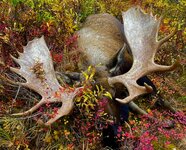
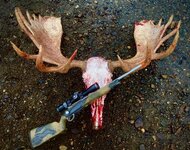
Roughly 2,180 impact velocity. Quartering slightly away. Moose was hit once, moved forward 20 feet behind some trees. Before I could shoot again he dropped (less than 5 seconds).

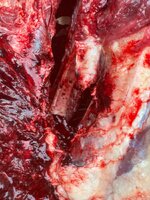
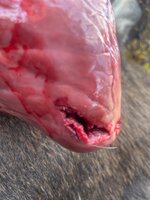
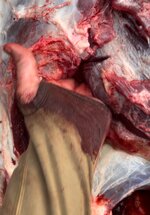
Entered on an angle above shoulder and tore through lung. Fragments sliced the bottom of the heart on the way through to the exit side lung. Broke two ribs and part of the scalpula before exiting. Both lungs were chunky mush and lung chunks on the ground and tree behind the moose where he was shot.

Two finger sized wound channel on the entrance side turned into a 4+ finger sized wound channel most of the way through the animal.

IMG_8845.jpeg
IMG_8855.jpeg
IMG_8875.jpeg
IMG_8865.jpeg
IMG_8887.jpeg
IMG_8882.jpeg
 
Before we get into another discussion about whether guides should be looked at as an authority on external ballistics, we've been there.

 
Before we get into another discussion about whether guides should be looked at as an authority on external ballistics, we've been there.

For real. It’s like a broken record every time. I’m almost didn’t even reply but said **** it.
 
I am pretty sure Johnny has killed more big game this past season than “the average hunter” will kill in 20 years.

And the funniest part about this is that he used to hold your opinions about terminal ballistics.
Yeah I’m still learning for sure.

I only started exploring and killing with “tipped style” bullets around 2012. Others have been at it for much longer with much more experience.

From 2013-2021ish my big game kill opportunities were basically limitless. Learned a ton and is the main reason for shooting what I kill with today (plus evidence from this site once I joined). I had never killed with anything smaller than my 243 and 243AIs for “big game” until Rokslide. Despite seeing it done with 223s 22-250s 220 swifts etc for a long time.

These days it’s normally only 20-30ish big game animals per year. Still enough for me to experiment and learn things and try to help others make informed decisions.
 
For real. It’s like a broken record every time. I’m almost didn’t even reply but said **** it.
I replied and deleted it.. but if I had $1 for every "the guide knows bullets/ im a guide" comment I could fund some more tikka 22creeds and 108's and make sure I walk past their empty meat pole as I pack out my meat.
 
I replied and deleted it.. but if I had $1 for every "the guide knows bullets/ im a guide" comment I could fund some more tikka 22creeds and 108's and make sure I walk past their empty meat pole as I pack out my meat.
“Guides” are probably some of the least informed and closed minded folks in all of the shooting and hunting world. Ask me how I know, I used to guide folks. I understand their position because people SUCK at shooting and their unfortunate answer is always the same. Bigger, tougher, faster, blah.

They are incredible outdoorsmans who know a ton about finding animals and are top notch in their specific regions. They are not incredible at knowing what kills effectively.
 
Back
Top