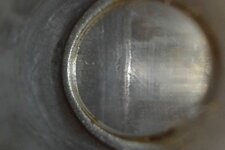
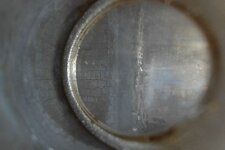
Educate me on this infamous thing called a Carbon Ring.

Absolutely possible, but unless I'm misunderstanding something, that wouldn't explain the sudden pressure signs and bullet scoring.
Additional friction due to a tight freebore certainly contributes to more pressure, especially as your barrel is "speeding up" (caused by the barrel roughing and building more pressure anyways). With no tolerance in the freebore, it scores the bullet as you chamber it with any kind of minimal buildup in that area.

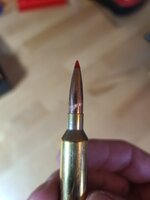
I had the exact same thing happen last year on a 6cm barrel. It was a prefit from a vendor that is popular here that was purchased during an annual sale. Likely lots of barrels being chambered by that reamer back to back. 200 rounds in, with loads below book max. Pressure signs, resistance when closing bolt, marred bullets... Sent the barrel back and sure enough the chamber was out of spec at freebore. They put a fresh reamer in it and voila no problems now.
 

Attachments

  • 20250726_132526.jpg
    20250726_132526.jpg
    112.9 KB · Views: 41
I threw together a training load for a tikka 243 with some extra 108 ELD-M's I had laying around, and intentionally made it mild in order to match quick-drop. 39 grains H4350, full-length resize, bullets set to match SAAMI COAL, and the load was trued at 2715 fps out of an 18" barrel.

However, they were randomly blowing roughly 1/5 primers, which was surprising as this was the mildest load I've shot in that rifle - was I finally getting the infamous carbon ring having never cleaned the rifle?

After discussion with @Formidilosus, he suspected the brass was worn out, specifically the primer pockets. The brass had 4-5 firings on it, and the first load in that batch of brass was hot. My understanding is that if the primer pockets are worn out, then they will prematurely blow out and mimic a pressure issue.

In order to test this, I shot 50 rounds of the exact same load, loaded with the exact same reloading process, in the same rifle (still without cleaning), but with virgin brass: zero pressure signs.

I'll load up a couple hundred more of this load, and report back if I have any issues.
 
You're not seeing the same pressure signs as what is being discussed in this thread. Popping a primer out because of loose primer pockets is not the same as having heavy bolt lift and ejector swipe on an over pressured round due to a carbon ring. Correct?
 
You're not seeing the same pressure signs as what is being discussed in this thread. Popping a primer out because of loose primer pockets is not the same as having heavy bolt lift and ejector swipe on an over pressured round due to a carbon ring. Correct?
Good question to clarify what's happening. If it was just popping the primer with no other signs, then I would've immediately assumed loose primer pockets, tossed the brass, and not questioned it further.

However, when a primer was popped it was accompanied heavy bolt lift and ejector swipe. One even blew the extractor out of the bolt.

FWIW I am not trying to push any narrative, but this situation seems like a good one to test the conventional wisdom of carbon rings, cleaning, and reloading practices. I still have 150 rounds of the problematic load if there's anything you'd suggest I test/check.
 
It's not like there's much of a downside to cleaning or it's a terrible chore, and it doesn't render the firearm unusable afterwards. In all my barrels there's no significant or measurable "clean bore" shift and the velocity is usually still within 1-2 SD of the mean for the first couple of shots from a totally clean bore.
 
It would be a good check with a borescope to see if a carbon ring exists. Then clean the throat area and see what the old ammo does.

The question now is IF it's a loose primer pocket, how does that increase pressure to the point of having issues? A carbon ring can explain why pressure would rise, a loose primer pocket wouldn't cause pressure to change, or so one would think.
 
It would be a good check with a borescope to see if a carbon ring exists. Then clean the throat area and see what the old ammo does.

The question now is IF it's a loose primer pocket, how does that increase pressure to the point of having issues? A carbon ring can explain why pressure would rise, a loose primer pocket wouldn't cause pressure to change, or so one would think.
You obviously don't know how a controlled explosion works, where bolt thrust comes from, or how bidirectional thrust works. Losing primers will cause the bullet to jump out of the neck and not have full pressure at the time of entering the leads (similar to jamming the bullet into the lands) because the pressure is going rearward before it goes forward.

Jay
 
Back
Top