Very long post with many references for those very interested in this topic. I will insert my usual disclaimers that I am not anti renewable, I am an "all of the above" energy policy believer. My concern is time constrained net zero incentivizing bad decision making.
I'm curious about the intersection of the "not all public land is valuable habitat, so it's ok if we sell some of it to developers" sentiment on this forum with the "there should be no solar on any public lands" sentiment.
I wanted to come back to this comment and provide some sourced facts about the public land hunting community's response to the "PLT bad but renewables good" point of view that portions the environmental and conservation community has largely adopted as well as provide updates on renewable energy (RE) progress. (all social media links/citations are primary source - from that person's/affliations so I am not accused of shilling). My intention is to inform the public land hunting community what the policy positions, legislation, and current permitting push are regarding RE. My intent of this post is not to provide a political hot take on those positions. The overwhelming majority of public land hunters and outdoor recreators at large view broad scale public land transfer negatively. The same can not be said for the opposite and the build out of renewables to meet net zero. Large sections of the environmental and conservation community have advocated for the industrialized development of large sections of public lands with renewable energy development and infrastructure to meet short term net zero energy policy. The lawsuit I linked provides indisputable evidence of that fact and as well as podcasts, legislation, or attempted legislation many hunters may not even aware of. Or in some cases renewables are outright omitted as an important public land issue such as this podcast not even mentioning renewable development. (@11:00 minutes in meateater / RN clip the question is "what are the big issues in the next 10 yrs" and renewables do not even come up (
Meateater Network w Randy Newberg). Examples in links and clips below.
Please No Iran War commentary- One Clip includes a lot of grid discussion but has a senator comment about iran.
Examples:
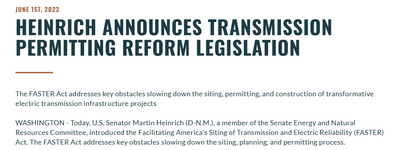 Excuse the Political Ad but it is the Sunzia Wind Project and Also Pinned Tweet for Senator Heinrich who is ranking member of the Senate Energy and Natural Resources Comittee
 Statement Source: Energy and Natural Resources Committee Democratic Official X Account
The western solar plan (WSP) opened peoples eyes to what lays in store for western public lands, but many public land hunters are not well informed about the WSP beyond maybe a podcast or 2, wind development issues, or do not know that for over a year some of the most intense debate in the senate committee that Utah Senator Mike Lee chairs has been regarding permitting of large scale development of public lands. The public land hunting/conservation media sources that many hunters rely on for public land hunting-related information have largely been lacking on detailed, up-to-date, and balanced information on the subject (please link any information or dm as I always link to read or listen to whats out there). Joel Webster on Rokcast is probably the stand out podcast I have heard on the subject from a western big game hunting perspective and that was way back in 2024. I encourage people to listen to it (
https://www.rokslide.com/mule-deer-migration-routes-with-trcp/ ). The Meateater podcast with The Nature Conservancy guy is okayyyyy. not the best, not the worst. I actually think Steve Rinella did ok in the start of the segment with tough but fair questions/points without being a jerk to the guest. Its 2 yrs old now and predates the WSP ROD.
BLM under the Biden Administration was eager to ensure the public that only a very small portion of the lands in the WSP would be developed with 700,000 acres cited in the WSP ROD. Media sources passed that figure on to their listeners/readers as the worst case "most development", ie
"On the other hand, while there might be lots of BLM land in Wyoming and other states open to development, realistically, only a small portion will actually see new projects. Of the 22 million total acres identified, the BLM predicts that only about 3% (697,809 acres) of that will need to be developed to meet Biden-administration clean energy goals." (
https://www.themeateater.com/conser...-plans-solar-projects-on-western-public-lands ). The 700,000 acres number cited in the press releases and repeated by many media outlets could actually be much larger depend on which modelling is used (
https://docs.nlr.gov/docs/fy25osti/91848.pdf). The cited number is for "Direct Federal Land Use" (~700,000 acres disturbed or inside the fence) instead of the "Total Federal Land Use" number which would have been 2,000,000 acres. Depending on the development scenario that number can get much bigger. The modelling shows that if total solar development in the US begins to favor federal land rather than private land, the "Total Federal Land Use" number grows ever more up to more like 4.8 million acres. Thats just solar FYI. Not transmission, not wind, not geothermal.
A lot has been happening since 2024 and the WSP decision and those modelled estimates too. Data centers are the current boogieman hot topic (I am not taking a pro or anti data center position in this post). BLM/DOI's official press release for the WSP and the WSP itself (
https://www.blm.gov/press-release/i...amework-future-solar-development-public-lands ) do not mention data centers a single time or a single reference to AI driven electricity demand. The studies and modelling the WSP relied upon for electricity demand and subsequent acreage needed for solar generation were not fully inclusive of mega investment and proliferation of AI energy demand and data centers. With the realization of what is happening with AI, data centers, and the associated energy demand, does anyone really think it is still the case the amount of acreage used to meet electric demand in a net zero economy is going to be "a small percentage"? Look at the estimated electricity use scenario published in this Lawrence Berkeley National Laboratory report (
https://escholarship.org/uc/item/32d6m0d1 ). From what I can tell that additional data center/AI demand is unaccounted for in the acreage calculations presented to the public for the WSP (Right side of figure). The energy and transmission sector seemed to knew exactly what was coming and negotiated the scale of potential development of public lands in anticipation of the net zero energy policy that everyone will be subjected to (
https://seia.org/news/seia-statemen...r-solar-development-across-11-western-states/). On top of that, the scale and number of planned projects is increasing. Massive projects like Sunzia entail ~900 windmills and the RioSol/Sunzia transmission projects to get the electricity from the New Mexico desert into Arizona so it can be put into the grid for use in California (
https://riosol.energy/old/riosol-sunzia-old/ )(
https://patternenergy.com/projects/sunzia/ ).
.
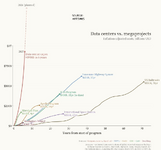
Credit NYTIMES
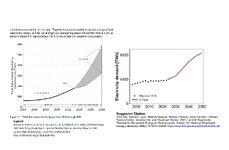 The calculations used in the Renewable Energy Estimates in the NREL Publication on the Right do not appear to have accounted for data centers using between 6.7% and 12% of US power consumption by 2028 (left side).
Here is a link I check from a time to time to view what permits are being considered under the Fast-41 Permitting Council. Those permits include a wide range of things such as mining, transmission, generation, etc.
The Permitting Council maintains an active portfolio of infrastructure projects that have obtained coverage under FAST-41. The list below details the FAST-41 projects currently receiving assistance from the Permitting Council for their federal permitting reviews.

www.permitting.gov
Here is a link to the National Renewable Energy Lab which also has useful information on the subject matter and link to their short paper on Data Center Siting since that is a topic of interest for many people presently.
National Renewable Energy Laboratory

www.energy.gov
Like the Rokcast podcast pointed out...the renewable development is coming, there is no stopping it at this point. The fight is probably limited to stopping individual projects when practical or possible, influencing very specific issues, or having a say in where some of those facilities are built with in the 31 million designated solar area for instance.




 ourgridfuture.org