Copper bullets and "sweet spot" calibers. Can some push copper bullets too fast?

Leatherneck

Lil-Rokslider
Joined
Mar 31, 2018
Messages
108
Location
USA
I've asked a lot of questions on here about calibers and copper bullets. This will be my last post about copper bullets! Most said copper bullets should be pushed fast. Now I've read that some experienced petals breaking off, i think it was with a 7mm Rem. Can some calibers push copper bullets too fast at ranges under 300 yards? Is there a "sweet spot" for copper bullet caliber and speed at ranges say under 350 yards?
 
My Tikka T3x 7mm Rem Mag ran Barnes VOR-TX with their 139 grain LRX at a bit more than 3200 fps - I certainly wouldn't have sacrificed any of that velocity given how much copper monos rely on it for their performance. I don't think I'd worry about losing a petal, but I'm also not a fan of copper monos and wouldn't choose to rely on them for general purpose hunting either.
 
I’m interested in learning about this too. My 300Win is shooting 180gr TTSX at 3100fps MV. At 350yds speed is 2530fps.

I killed an oryx with it last year at 75 yards. She ran 10 yards and hit the dirt. Entrance was bullet sized and exit was 1.5” hole.

Edit to add: I’m headed out elk hunting this weekend and am choosing to take a 6.5 creed shooting ELD-X instead of my 300 since there is a chance at taking sub 100 yard shots and I want an expanding and fragmenting bullet to do its job.
 
Last edited:
Is losing a petal or three on a mono a problem? Given all the hoopla around fragmenting bullets and how anything short of “explosive” fragmentation seems to be considered woefully inadequate on this site, I have a hard time thinking that losing a couple petals would be a problem, and it might even help. Note that all of the newer “boutique” mono/nonlead bullets exhibit some sort of fragmentation in order to increase the size of the wound channel.
I couldnt say personally. The only 2 monos Ive ever recovered went through large/heavy bone on the off-side of the animal (a femur ball joint and vertically through a vertebrae), each TTSX shed a petal at approx 2500 and 2700fps impact velocity, but otherwise functioned exactly as I want, ie smaller wound channel and animal down and dead quickly. But, between the small sample size and the lower velocity than I think you are asking about, I doubt that answers your question.

Edit: @JFK posted a photo of an antelope he shot with a mono that he said was 3300fps muzzle velocity the other day. I think the actual impact velocity there was lower (2800 or so) but he may have more insight into the question of performance at very high velocities.
 
Last edited:
I’m using 127 lrx out of a 264 win mag 3200 fps. Shot a cow elk last weekend at 80 yards caught the back of the front shoulder and found one tiny part on the far side under the hide. That’s the 8th animal I have killed with that load combo the rest have all exited so I’m assuming the bullet held together. I’m no expert on monos only recently started using them but I think more speed the better for them.
 
I killed a Roosevelt elk with a 100gr tsx in a 257wby. That bullet took off at 3600fps. The elk flopped on the shot. Every deer and dog that caught one did similar.

That gun killed like lightning but ate barrels like a fat kid at dairy queen.

If a gun can over cook one....that's a leading contender.
 
I have shot 80gr TTSX out of a .243 Winchester at 3450 fps and it was never an issue with those bullets. High velocity is your friend with copper mono’s especially the older designs (TSX, TTSX). The LRX is a little more prone to snapping petals but as mentioned I don’t think it’s a bad thing.
 
Shot a bull elk with a 7mm rem mag with a barnes factory loaded lrx or ttsx (can't remember which) at about 12 yards. Quartering away entered just behind ribs on one side and bullet through scapula and recovered against hide on other side with no petals left, just a slug. It did take a step or two before it went down.

I agree that I'm not concerned with the petals ripping off, and that may even be beneficial. I also am worried about the effectiveness of monos.
 
Is losing a petal or three on a mono a problem?

Definitely not. The main reason you hear people talk about projectile fragmentation as a bad thing is the way it happens in traditional, low quality cup-and-cores like core lokt whereby most of the bullet's mass ends up as thousands of tiny microfragments that are too small to do anything but macerate a small area.

Monos, even if they do "fragment" by losing a petal, tend to stay together in larger pieces- pieces that have enough energy and are large enough to inflict lethal damage. Hammers are designed to do exactly that, in fact.
 
I like my bullets to stay together and not pepper the meat with micro-sized lead frags. Which is why I use copper exclusively and respect their velocity needs.

Of the 15 or so deer and hogs I have shot with mono-coppers, I have only recovered three bullets. Only one of these shed a petal (a straight-on, between the eyes shot on a 205 hog that went through the skull and 6” of vertebrae). This was with a 16” 300blk and the 110gr Barnes. The other two I recovered are Bear Creek Ballistics’ 160gr 350 Legend loads.

The only anecdotal report I can remember about a copper bullet going possibly too fast and coming apart on impact was with the 300blk-specific Barnes 110 grain. Someone launched it from a larger capacity case like a 30-06 or 300 Win mag. Launching it well over 3000 fps when it was designed for 1300-2400 fps…well what do you expect?!
 
I’ve found a bit of copper fragment in meat. I bit down on it actually, which is not very easy on your teeth. That was from a 130gr TTSX. Bullet exited, but it must have shed some petals. I wouldn’t be concerned at all about pushing them too fast. I would be concerned about pushing them too slow. For me, with cooper, it’s gotta be 3000fps at the muzzle, or very close to it, or I’m looking for something else.
 
No such thing as too fast with a mono. I’ve shot a lot of animals with hammer bullets, designed to shed petals. Monos are not my first choice, but when required to shoot them they kill effectively, just not as well as lead. Have killed a few animals with .257 90gr absolute hammers with MV 3500-3700…great stuff. Also a number of them with 30 cal 150 grain bullets.

Whichever cartridge you choose get those suckers flying fast. I’d prefer to drop down in weight and have a zippy bullet. IE 110gr or lighter in 6.5cal, 150gr or lighter in 30 cal, etc. that extra impact velocity I believe helps create a larger permanent would cavity and offsets some of the limitations of a mono.
 
My 22-250 shoots tight groups with the 45 gr Barnes TSX FB at roughly 4000 fps (1/12 twist). I have not seen anything unusual at the range or on game.
 
Read the threads on this form about monos vs eld bullets. Monos leave a small wound channel vs the lead. I am stuck with monos but wish I was not.
 
As a lot of others have mentioned, I wouldn't worry at all about loosing petals from a mono. Might work even better. A couple of years ago I took a buck using the Barnes 110 Blackout bullet from a downloaded 308 at 2,700+ fps. Shot was in the chest just inside the shoulder. Lost all petals and found the base against the hide behind the offside shoulder. Buck only ran about 30 yards and piled up. Worked just fine.
 
Hunter reports of "small" wound channels, also has said hunter standing over and dressing out a dead animal...

A post above shared a bull elk shot at 12 yds with an mono and it took one or two steps. Then states a concern for the effectiveness of monos... With a fragmenting bullet, would the result be better?

A .358 200 gr TTSX at 2960 fps from my 35 Whelen AI with IMR4064 (or std Whelen using a newer powder such as Power Pro Varmint pushes it over 3000 fps for a bit more margin) is still going 2100 fps at 500 yds. Way overthinking thinking this, get within a quarter mile and some change...

Barnes mono bullets and over 35 dead critters from pronghorn, Kansas and Carolina whitetails, Colorado Muleys and Elk, the bulk of them elk in the past 30 seasons don't lie. Cartridges varied between the .270 Win (110 TSX/TTSX), '06 (130 TSX/TTSX), 280 Rem (150 original X), 300 Win Mag (180 XBT) and 35 Whelen AI (200/225/250 X and 200 TTSX). Each one of the named cartridges has killed elk and deer, and all but one has killed a pronghorn (Whelen AI) with monos.

Don't believe everything you read, which would include what I posted. However I've shown to myself beyond a doubt monos are very effective. My experience is I haven't had to find more than 3 animals beyond 30-40 yds from where they were hit, most pretty much where they stood or within less than first down yardage from where they were hit. Have not had to worry about excessive meat loss on shoulder shots (or any shot) or hard shot angles on the biggest of those critters.

 
I like to tell people mono bullets kill like arrows+broadheads. They love speed. The Barnes LRX probably has the lowest operating window getting 1.5x expansion all the way down to like 1800fps impact velocity. Copper bullets are very tough so I’m also typically aiming for shoulders and bone to help aid expansion. Bone fragments also act as shrapnel.

I don’t like the idea of a bunch of micro lead fragments everywhere. There’s no doubt people use eldms or bergers for example with great success, they have lower operating windows compared to monos. Something like 1500fps or less to get expansion. I’m just not a fan of how those bullets operate, if it works for you great!

A good compromise is bonded bullets and that’s my next experiment for hunting, using a terminal ascent, fusion, bondstrike, or accubond.

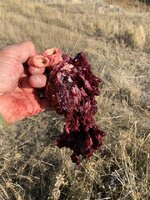
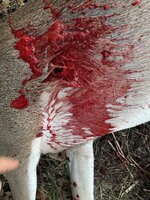
Pic: Barnes 127lrx 6.5cm exit wound

IMG_9057.jpeg
 
Back
Top