Cold bore zero versus (very) Hot bore zero “test”

So one forum member asks me to post whatever I have knowing I don't have Rockslide standard data targets. The next member tells me my posts are meaningless.

Yes. It’s nothing personal. Your groups are just too small. Start by putting 10 rounds into the same target and measuring the group. Take as much time as you want. No one cares if you take two minutes or 10 days. That’s a good measure of how well your rifle and you shoot.

Tikka T3, 1:10” twist factory barrel cut down to 16”, using ADI 55-grain .223, 5/rpm, front and rear bag from bench.
22891957ed74424cce7579b7ca7343ed.jpg

Shots marked roughly in order (marked based on memory after group was done).
7e05ddbf64efd0ce11affb329f112959.jpg

This was done while testing a whole bunch of different ammo to find what the rifle likes so I could order enough to practice for a few months. This load shot the best out of ~15 different factory loadings, with ADI 69-grain .223 and Frontier 52-grain 5.56 coming in second and third. For trajectory reasons, I ended up buying more of the 69-grain load than the 55-grain or 62-grain loads, but it is all good enough for me to use to run Carl Ross drills and practice positional shooting.

I’m not suggesting I am some kind of world class shooter or that I have the finest rifle on the planet, but anyone who wants to disparage this honest group isn’t worth my time.

This isn’t a place for just posting your best 3-shot groups from your best days. There’s a whole thread “what did you do at the range today?” where you can go see how people are shooting (at least those who care to share). If you don’t want to show your ass to the world, then don’t. Just be honest with yourself. Stop accepting mediocrity with cherry-picked small groups. Chase the dream of consistent, reliable performance that is “good enough” to ethically take game animals at “your maximum range” on demand. I can’t speak for everyone around here, but that’s my goal.
 
OK I was asked to share some of my targets. I didn't do my load development with the intent to post them on Rockslide so I don't have a spread of data sheets. About 5 years ago I threw away a mountain of targets because my rifles all had their loads and some for a few decades. Then about 3 years ago a friend invited me to go mule deer/coyote hunting in eastern Montana and indicated that they had a 1,000 yd range set up on their farm. So this got me started again on checking, tweaking and creating some longer range hunting loads.

I will start with posting some groups with my 243 that I checked/tweaked/ or developed for 300 yard targets. I started longer range woodchuck hunting for field practice and data with various loads testing for accuracy and bullet expansion. I'm also testing my shooting in various field positions. I select one load as a 00 elevation and 00 windage baseline. The other loads get shot at 300 and then I record the POI adjustments needed to switch bullets in the field without resighting in. During the course of this testing I installed a brake and then a suppressor.

So here goes with some groupings and kill shots for the 87 grain Hornady

Zero confirmation shots at 300 yds

View attachment 999869

Interestingly enough I killed two chucks at 300 yds from the same hole in about a week's time. I shot from my ATV from a bipod sitting that was sitting on a platform on my front rack using the handlebars to stabilize my arms.

Here is a pic of the shooting rig with my 223 pictured (not my 243)

View attachment 999879

From this rig with 243 (with a brake) are two first round kill shots at 300 yds

View attachment 999886

View attachment 999887

243 with a previously developed 100 grain Speer BTSP at 420 yds from a bog bipod (243 unbraked and unsuppressed). The chuck was sitting at its hole and I could only see the top of the shoulders and head above the hay. First round kill headshot. I was using a 400 yd ballistic dot and almost held too high but it was dead center hit and took off the top of his head.

View attachment 999889

Another load with a Berger at 300 yds

View attachment 999890

Another 300 yd load with an ELDX. The measured rounds are the group and then their is the scope adjustment shot to confirm POI with the ELDX load. As you will see I use my reactive targets over and over because I was not intending to post clean targets online.

View attachment 999891


Great stuff. Most of that ask was to ensure you weren't flinging AI copy pasta from Russia, or your mom's basement. Again, welcome to the forum.
 
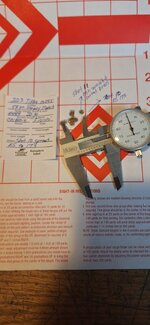
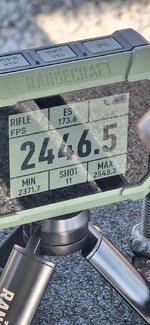
OK guys I found some time in my day to assemble a reduced 223 load from some factory Fiocchi brass. I didn't want to sit too long at the range today so I used reduced loads. I only had 20 cases from which to sort 10 of the best. Then I mistakenly loaded 1 grain less from my normal reduced load. It still shot fairly well until the 10th round for some reason created an ES of 173 fps. I shot one more from my non sorted brass. I had my good group going till the last shot and then the 11th shot ... such is life! I guess it was what I deserved! :cool:

223 11 shots reduced load.jpg

223 radar of 11 shots.jpg
 
Notice that if you zeroed off the first 9 then you’d be a click off to the left? The true center shifted to the right with those last two.

It’s that type of stuff the guys on here are trying to explain.

Now the next trip out shoot ten more at that same target, same point of aim. Get more of the story.

My most accurate hunting rifles average 0.8 for ten shots, but even then there’s variability group to group. Some are as large as 1.15”, some are down at 0.59”. The vast majority of rifles will average somewhere just above or below 1.5” for ten shot groups. Yours is A+

Shoot more shots. Get a good true zero and a true cone of fire. You’ll see it fill in as you shoot more.
 
Should we tell him about the painless reloading method yet?
This thread has me questioning getting back into reloading. The data shows I lack the skill set to see the improvement for hunting conditions. However reloading will allow me to shoot the bullet I want which are not loaded available commercially
 
hread has me questioning getting back into reloading. The data shows I lack the skill set to see the improvement for hunting conditions. However reloading will allow me to shoot the bullet I want which are not loaded available commercially

Do it, just skip all the typical crap of playing with different primers and seating depths and weighing cases 1/10 grain charge ladders and all that crap.
 
This thread has me questioning getting back into reloading. The data shows I lack the skill set to see the improvement for hunting conditions. However reloading will allow me to shoot the bullet I want which are not loaded available commercially
As a bit of a testimonial, I started reloading based on the painless method and the simplicity of it. I loaded up 15 at various book charges and took them to the range just to make sure I wasn't going to blow myself up. By the end of the day, I was content with what I saw so I went home and loaded 40. That next weekend I shot 10 to check my zero and see what my group was like (1.2" @ 100) then took the remaining 30 and trued my shooter app to my gun/round. I did it all based on the information freely shared on this forum and probably wouldn't have taken the plunge if it weren't for this place.
 
….link to this painless reloading method?

I reload bc far too many times different lots of ammo were way off (like the manufacturer changed powder arbitrarily without telling anyone), ammo lines were unavailable or discontinued. Now I don’t care. I can buy however much I want if whatever components I want and shoot to my heart’s content, never needing to find a new load or sight in again or mess with any of that stuff.
 
….link to this painless reloading method?

I reload bc far too many times different lots of ammo were way off (like the manufacturer changed powder arbitrarily without telling anyone), ammo lines were unavailable or discontinued. Now I don’t care. I can buy however much I want if whatever components I want and shoot to my heart’s content, never needing to find a new load or sight in again or mess with any of that stuff.

Painless load development (mine)
 
OK guys I found some time in my day to assemble a reduced 223 load from some factory Fiocchi brass. I didn't want to sit too long at the range today so I used reduced loads. I only had 20 cases from which to sort 10 of the best. Then I mistakenly loaded 1 grain less from my normal reduced load. It still shot fairly well until the 10th round for some reason created an ES of 173 fps. I shot one more from my non sorted brass. I had my good group going till the last shot and then the 11th shot ... such is life! I guess it was what I deserved! :cool:

View attachment 1000092

View attachment 1000093
Was your group fired all 10 at once, or in groups of three like you indicated either?

Re: group size. Even if you did eliminate the last 2 shots (not saying you should, just hypothetically) its really easy to see that if you took a random 3 of the other holes it would indicate a different “zero”, as well as could shrink the group extreme spread (talking dispersion here) significantly, with the next three printing elsewhere. On an extremely accurate rifle it might not change the zero more than a scope click, but on most rifles it does change the zero more than a scope click. Thats really the only point, that until you can see that entire bell curve of dispersal, you cant really say whether your zero is accurate to the nearest click, and not knowing the true extreme spread of dispersal you cant say that one group “moved” relative to the other. If you have a crazy accurate rifle setup and your group goes from .2-.4 moa 3-round groups, up to .6-1.2moa 10-round groups, thats still the exact same rifle with exactly the same precision. The only difference is that a larger shot-count group tells you something about the entire bell curve, while a 3 or 5 round group simply gives you few-enough data points that it doesnt tell you much until you overlay it with more data points.

Re: the chucks. Just b/c the extreme spread of the big group is 1.2 or 1.5 moa, doesnt mean that MOST shots dont still land near the center of that group. So you’d expect a first round hit on a smaller target to still happen MOST of the time.
67% of the time within 1sd, 95% within 2 sd, and some very small part farther out. It just means that if you get a few shots once in a while that land 2+ standard deviations from the center of the group, that you know what that represents. Not necessarily a “flier” or “heat stringing”, but a statistically predictable result some small % of the time.
 
Translate better to WHAT for hunting? We agree that having a better zero, and being able to much more definitively say when a shot is outside the actual precision of the gun, is useful for a hunting rifle.
Sure, you can do same with multiple small groups if they are overlaid on top of the same aiming point. But unless its an older gun that walks when hot and requires it, thats tedious and Id rather spend my time practicing. Shooting groups isnt practicing. This post shows its not necessary on many guns though. I’ll get zeroed faster and just as well, and then be done with it. Then I’ll practice positional shooting and not shoot groups at all. When I do positional practice I dont find that my zero is off. Maybe doing a 10-round group building a new position every shot would be the best way to zero for some. Hasnt seemed worthwhile to me. If Im doing a build-and-break drill thats practice for getting into a stable field position. But thats not how I interpreted “multiple 3 round groups”. Define the goal of the groups. Then decide if its helpful to do it one way or the other.
 
So I understand the cone of fire with 10, 30,100 rd group, and the higher confidence of data but for hunting purposes multiple small groups translate better correct ?
Seems like the point of the test outlined in the original post was to find out which was better. The conclusion was that it does not seem to make a significant difference how the shots are fired. Whether you do 1, 3, 10, or 30 at a time so long as you compile them all into a statistically significant cone of fire to determine your zero point.
 
So I understand the cone of fire with 10, 30,100 rd group, and the higher confidence of data but for hunting purposes multiple small groups translate better correct ?

No. The average of multiple small groups tells you just that, the average group size.
The cone of fire tells you that same average group size but in reference to the same aiming point. So you get more data when you establish the cone of fire. You establish true zero that’s not a click or two off, and a better understanding of what size target you can engage at x-distance because you see the whole cone your rifle produces.

If you’re meaning that you shoot three at a time, five at a time, ten at a time…doesn’t matter. If you're meaning multiple small groups due to barrel heating, also doesn’t matter. And if it does, you have a problem with the way your barrel was manufactured.

What’s important is that you keep stacking them at the same target to establish your cone of fire. Heck even ten shots doesn’t establish your true cone, it’s a minimum that’s used to “gut check” my rifle when I suspect something is off.
 
Back
Top