This only argues for the need to use mechanical accuracy and cameras to eliminate the possibility of skewed data.Good question!
There are very very few .5 moa rifles/shooters. Even less if you are only talking hunting rifles.

Navigation
Install the app
How to install the app on iOS
Follow along with the video below to see how to install our site as a web app on your home screen.
Note: This feature may not be available in some browsers.
More options
Style variation
You are using an out of date browser. It may not display this or other websites correctly.
You should upgrade or use an alternative browser.
You should upgrade or use an alternative browser.
Cold bore zero versus (very) Hot bore zero “test”
- Thread starter Formidilosus
- Start date
And now we have empirical sarcasm and emotion as part of the statistical data.Why- there was no shift in the groups. Therefore there was no error that needed reducing.
Why- there was no shift in the groups. Therefore there was no error that needed reducing.
Why- there was no shift in the groups. Therefore there was no error that needed reducing.
Why- there was no shift in the groups. Therefore there was no error that needed reducing.
Why- there was no shift in the groups. Therefore there was no error that needed reducing.
You don’t understand basic statistical reality or statistical validity, why are you trying act like you understand peer reviewed research?
Stop acting like you understand testing- you don’t. I understand that it completely refutes what you want to believe and what you argue about….
How’s your 3 shot groups with imbalanced bullets going?
Why would you not want to eliminate as many variables as possible in your testing to isolate the one premise that is being determined?
This is a fair question but it also has a certain criteria baked into it. For many years the firearms industry in general has considered an average of multiple 3 shot groups to be determinate of MOA sporter capability. They advertise and guarantee their rifles accordingly. For heavier varmint barrels the 5 shot group is the industry expectation.Can I ask one genuine question: have you shot a 10-shot group that has been .5 MOA?
If you introduce a higher industry standard to establish MOA or .5MOA while that may be a better judge of accuracy it is still changing the rules of a recognized standard that is even legally recognized by rifle guarantees from rifle companies.
All this is recognized in the comments which are allegedly "exploding traditional myths."
So having said that I can say no I have never tried to shoot a .5MOA group based on successive 10 shots with no cooling in a sporter barrel. We can see group size increasing in these tests even if there is no recognized POI shift.

It’s a bit shocking how complicated you want to make this. The smartest people I know can distill things down in a simple manner. I don’t want to discourage participation and discourse, but you’re trying to set a lofty bar and articulating it in an extremely obtuse manner by calling for all of these extreme measures. While they could all help, this is hunting, not peer reviewed science. What’s happening here is challenging an idea, testing with real life setups (just like any person can do one range) and reporting results.This is a fair question but it also has a certain criteria baked into it. For many years the firearms industry in general has considered an average of multiple 3 shot groups to be determinate of MOA sporter capability. They advertise and guarantee their rifles accordingly. For heavier varmint barrels the 5 shot group is the industry expectation.
If you introduce a higher industry standard to establish MOA or .5MOA while that may be a better judge of accuracy it is still changing the rules of a recognized standard that is even legally recognized by rifle guarantees from rifle companies.
All this is recognized in the comments which are allegedly "exploding traditional myths."
So having said that I can say no I have never tried to shoot a .5MOA group based on successive 10 shots with no cooling in a sporter barrel. We can see group size increasing in these tests even if there is no recognized POI shift.
I’ll pick out one example. Re: barrels - you are calling for having them all hit the same temperature. Well, is that bore temp or exterior temp? How are you going to measure that accurately? Obviously the heat flow from bore to barrel exterior will vary by profile, materials, fluting etc. So even your “call out” to do it right is non-specific enough.
If you want to call it all out as biased and refute it - do so with your own testing and data. Record your shots, measure your temps, etc. Show the way please, don’t just complain.

RyanT26
WKR
- Joined
- Apr 8, 2020
- Messages
- 1,641
You used a hell of a lot of words to simply say, No I haven’t.This is a fair question but it also has a certain criteria baked into it. For many years the firearms industry in general has considered an average of multiple 3 shot groups to be determinate of MOA sporter capability. They advertise and guarantee their rifles accordingly. For heavier varmint barrels the 5 shot group is the industry expectation.
If you introduce a higher industry standard to establish MOA or .5MOA while that may be a better judge of accuracy it is still changing the rules of a recognized standard that is even legally recognized by rifle guarantees from rifle companies.
All this is recognized in the comments which are allegedly "exploding traditional myths."
So having said that I can say no I have never tried to shoot a .5MOA group based on successive 10 shots with no cooling in a sporter barrel. We can see group size increasing in these tests even if there is no recognized POI shift.
This is precisely the problem. You have some homework to do to understand the “why” on several of the facets of this exercise that you are stuck on.If the groups were smaller there might be noticeable deviations in POI shift.
Concisely stated you cannot ask an MOA question while changing a recognized industry recognized MOA standard? The question could have been whether I have ever fired three or four 3-shot groups that averaged .5MOA or if I had fired two 5-shot groups that averaged MOA and the answer to that would have been yes.You used a hell of a lot of words to simply say, No I haven’t.
Axlrod
WKR
You are a contrarian. Much like my 12 year old. I tell him save the word salad for when you get your own podcast. You will have lots of time to spew endless nonsence.Concisely stated you cannot ask an MOA question while changing a recognized industry recognized MOA standard? The question could have been whether I have ever fired three or four 3-shot groups that averaged .5MOA or if I had fired two 5-shot groups that averaged MOA and the answer to that would have been yes.

Hurley88
Lil-Rokslider
- Joined
- Dec 11, 2022
- Messages
- 292
Concisely stated you cannot ask an MOA question while changing a recognized industry recognized MOA standard? The question could have been whether I have ever fired three or four 3-shot groups that averaged .5MOA or if I had fired two 5-shot groups that averaged MOA and the answer to that would have been yes.
Dude I used to think the same way. Read up on Gaussian distribution, statistics…heck at least watch Hornady’s podcast on this subject. Then go shoot 10-shot, 20-shot, 30-shot groups. Let the rifle cool between each shot or shoot all in a row, heck do it both ways.
Go do it. Test it for yourself. You’re soapboxing about something from a position of ignorance. Not trying to talk down, just…I went and read up on it then I did it now I get it.
Your posts sound like me telling David Goggins he knows nothing about long distance running.
I accept these as fair questions. At the outset if we are trying to create ballistic lab data to make sweeping conclusions from which all other data will be judged then we need to eliminate all variables. That was what I was pointing out in my list.It’s a bit shocking how complicated you want to make this. The smartest people I know can distill things down in a simple manner. I don’t want to discourage participation and discourse, but you’re trying to set a lofty bar and articulating it in an extremely obtuse manner by calling for all of these extreme measures. While they could all help, this is hunting, not peer reviewed science. What’s happening here is challenging an idea, testing with real life setups (just like any person can do one range) and reporting results.
I’ll pick out one example. Re: barrels - you are calling for having them all hit the same temperature. Well, is that bore temp or exterior temp? How are you going to measure that accurately? Obviously the heat flow from bore to barrel exterior will vary by profile, materials, fluting etc. So even your “call out” to do it right is non-specific enough.
If you want to call it all out as biased and refute it - do so with your own testing and data. Record your shots, measure your temps, etc. Show the way please, don’t just complain.
If we are trying to duplicate hunting scenarios and gain knowledge from that data then we need to do just that.
1. The one shot cold bore groups are a great data point because this is what we strive for--first round kills. However I think the ambient temps, the rifle, and the ammo need to reflect around 25+/- degrees to duplicate general hunting temps of when we are in the field with our rifle and ammo in those temps. This can give both POI data and group data.
2. If we want to know if our rifle will shift in 10 consecutive shots from heat we still need to start with the ambient temps and rifle and ammo temps duplicating the first shot in field conditions. The string needs to start at 25+/- degrees and then there should be a consistently timed rate of fire since we are looking at data from a number of different rifles and trying to make general observations. There might be significant difference based on starting with an ambient 90 degree temp vs. an ambient 25 degree temp in the group spread.
3. There has to be consideration of shooting in similar light conditions i.e. cloudy vs sunny and time of day based where the sun is, if we are looking for precise POI data. How our eyes perceive the target can shift in different lighting conditions. This is why competitive shooters shoot a few right before the match.
4. There also needs to be bore cleaning regimen that is consistent with each grouping.
5. I would also like to see some comparative data from 3 and 5 shot groups starting from a cold bore to 3 and 5 shots. They could be four 3-shot groups (big game) and two 5-shot groups (varmints). This is more indicative of field conditions.
Finally, I do not need to produce any criteria data on these points as they are well recognized among shooters. I did not go looking for this "debate." The tester found me in another thread and immediately dismissed all my data because it did not align with his conclusions. In looking at this thread it appears like he he is trying to set a new MOA criteria standard so the onus is completely on him to prove everything conclusively beyond all reasonable doubt before he or anyone can say that he exploded long held traditions or recognized standards.
It would also be interesting to see the criteria used for current snipers for judging accuracy.

Billogna
WKR
I used to ascribe to the 3-5 shot "groups". It gave me a warm fuzzy to see that the gun was "doing it's part" as long as I do mine. It also gave me a goose to chase when something went wrong!! And then back to warm fuzzy when it got all better. What I wasn't seeing with 3-5 shot groups, was the ACTUAL cone of fire the gun shoots pretty much all the time, no matter what (ON DEMAND so to speak). Since switching to 10 shot groups minimum (sometimes 20 - because it's more funner, and gooder data), I actually gained peace of mind knowing what my rifle system (me included as part of that system) will do ON DEMAND (from a bench) with ZERO excuses (temperature, humidity, allergies, moon phase, Saturn is in Gemini etc..) No throwing out "fliers" (this hurt my heart at first). So nowadays when I go out to the range and everything lands within that cone of fire (averaging around 1.5- 1.75 MOA from a bench for 10 - I know... I suck!!) I know everything is all good in the hood! I have nothing but thanks for the people on this site that have provided all the Tylenol for the headaches I was having!!

Fireflyfishing
WKR
Late to this thread as it’s the first I’ve seen and read it. I would have read the whole thing, but it got derailed and I lost interest after page 5. Anyway…this thread confirms what I’ve been seeing. Cold bore zero is a waste of time.

This made me laugh out loudThat's a lot of words that don't add up to a pile of road apples. You are obviously hunting for clout and recognition of which you'll get none spouting that drivel. Everyone who reads what you wrote will now be dumber thanks to what you have written. Your knowledge of statistics and the scientific method is clearly lacking.
Jay

Chris in TN
WKR
- Joined
- Jun 17, 2025
- Messages
- 1,966
The problem with the 'proof' in the original post of this thread is that it may well demonstrate that modern barrels with modern stress relief are more or less immune to 'walking' but it doesn't even begin to touch on the question of whether this was a thing with historical rifles (say, 20-100+ years old) that most of us learned to shoot with.
I have a rifle with an early 90's era Douglas barrel that has a propensity to walk to the right (IIRC) after warming up. It's relatively long and skinny and a caliber that gets hot fast. I don't lose sleep over it, I just shoot it 2x, no more than 3x, and let it cool before shooting again, for whatever reason - load testing or zeroing. I don't treat those first 2-3 shots as a group for the purpose of determining accuracy or zero.
Notably, the rifle is built on a WWII era surplus M98 action and I do *not* know whether the face/threads/lugs/etc have ever been trued but no not think they have, and it's entirely possible that I have a great barrel screwed onto a mediocre action, in terms of concentricity and stress relief.
(It was installed in the early 90's, my understanding was that it was a NOS blank at the time, no clue when the blank was made).
I could (probably? possibly?) either prove this or prove myself wrong with this rifle by going to the range and firing 2 shots then cooling then 2 more, for a total of ten shots, then firing a single rapid 10-shot group, and comparing the two. But that would require scrounging up all my brass and loading 20 rounds of ammo and making a separate trip to the range (because it would be incredibly rare for me to shoot an unsuppressed rifle here at home, much less for 20 shots, simply because I have cows on my rifle range right now - I wouldn't mind if they were closer to the target but right now they're grazing close to the firing position). The root problem here is that I don't enjoy shooting that rifle enough to make that much effort and the knowledge I might gain from it isn't worth it to me at the moment. I'm not even certain I have enough components (brass and bullets) to make up enough ammo to run such a test. The adage that 'only accurate rifles are interesting' applies to me. Testing a rifle that I wrote off as being mediocre in the accuracy department thirty years ago, is fairly low on my list of things to do, even if it would prove a point to me, or the internet.
You're missing the point. The industry standard has long been wrong, precisely because it wasn't sampling enough to matter. Instead of averaging numerous groups they should have been making a composite of them. The composites - of ten to thirty shots - would come much closer to telling the tale for us. Ten shots that go into maybe 1.5moa might consist of several hypothetical three-shot clusters that measured 0.25 moa or might have measured 1.4moa, on average, but both depend on chance, and the composite actually tells us the part of the story that matters.
Also, as for whether this industry standard is sacrosanct, I'd point out that at least Rick Jameson was speaking against it at least a decade ago and maybe much longer - I'm old enough that there's no way I can remember when I read an article a decade or two ago. But after many years of chasing rifle accuracy (and, yes, owning some truly very accurate rifles over the years) something that RJ said once stuck with me - a rifle that will put ten shots into 1.5moa, is a good one. I don't know if he said that ten years ago or 20 or 25, but I know it was him that said it, and I remembered that much.
I used to be a regular poster on another forum and a well respected guy there used to do a lot of ammo testing with statistically meaningful samples and he'd often joke about the folly of 3-shot groups and it never failed that people would argue with him and show off their 3-shot clusters shot with ammo quite literally incapable of sustainable precision. But they had that one 3-shot cluster and would keep that photo and trot it out forever.
(Specifically, those were usually 3-shot clusters fired with surplus M193, which, day in and day out, is 3moa ammo at best, or, worse, M855)
In short, the OP is absolutely right from a statistical standpoint in how he tests guns/ammo. The fact that people are arguing against him simply shows they don't understand that problem.
However, OP isn't necessarily right about the cold vs hot bore issue, as he's taking a dataset of modern rifles with modern barrels and applying his conclusions from them across the board as an answer to a question a lot of us have been asking (or assuming an answer to) since the Dark Ages of rifle production. I *do* believe he has well demonstrated his point about cold vs hot, as it pertains to modern rifles with higher-quality barrels. I'm simply unsure as to whether such results can fairly be applied to older or cheaper barrels. I'm not saying he's wrong, I'm simply saying it hasn't been shown one way or the other, and I will freely admit that *I* may be wrong in my long-held assumptions. I'm just less sure that I care enough to test those assumptions by spending a day of my life testing a rifle I largely lost interest in 30 years ago.
Edited to bold the part that matters - I'm not saying OP is wrong; I'm saying his results may or may not universally apply to rifles from 30 years ago.
I have a rifle with an early 90's era Douglas barrel that has a propensity to walk to the right (IIRC) after warming up. It's relatively long and skinny and a caliber that gets hot fast. I don't lose sleep over it, I just shoot it 2x, no more than 3x, and let it cool before shooting again, for whatever reason - load testing or zeroing. I don't treat those first 2-3 shots as a group for the purpose of determining accuracy or zero.
Notably, the rifle is built on a WWII era surplus M98 action and I do *not* know whether the face/threads/lugs/etc have ever been trued but no not think they have, and it's entirely possible that I have a great barrel screwed onto a mediocre action, in terms of concentricity and stress relief.
(It was installed in the early 90's, my understanding was that it was a NOS blank at the time, no clue when the blank was made).
I could (probably? possibly?) either prove this or prove myself wrong with this rifle by going to the range and firing 2 shots then cooling then 2 more, for a total of ten shots, then firing a single rapid 10-shot group, and comparing the two. But that would require scrounging up all my brass and loading 20 rounds of ammo and making a separate trip to the range (because it would be incredibly rare for me to shoot an unsuppressed rifle here at home, much less for 20 shots, simply because I have cows on my rifle range right now - I wouldn't mind if they were closer to the target but right now they're grazing close to the firing position). The root problem here is that I don't enjoy shooting that rifle enough to make that much effort and the knowledge I might gain from it isn't worth it to me at the moment. I'm not even certain I have enough components (brass and bullets) to make up enough ammo to run such a test. The adage that 'only accurate rifles are interesting' applies to me. Testing a rifle that I wrote off as being mediocre in the accuracy department thirty years ago, is fairly low on my list of things to do, even if it would prove a point to me, or the internet.
Concisely stated you cannot ask an MOA question while changing a recognized industry recognized MOA standard? The question could have been whether I have ever fired three or four 3-shot groups that averaged .5MOA or if I had fired two 5-shot groups that averaged MOA and the answer to that would have been yes.
You're missing the point. The industry standard has long been wrong, precisely because it wasn't sampling enough to matter. Instead of averaging numerous groups they should have been making a composite of them. The composites - of ten to thirty shots - would come much closer to telling the tale for us. Ten shots that go into maybe 1.5moa might consist of several hypothetical three-shot clusters that measured 0.25 moa or might have measured 1.4moa, on average, but both depend on chance, and the composite actually tells us the part of the story that matters.
Also, as for whether this industry standard is sacrosanct, I'd point out that at least Rick Jameson was speaking against it at least a decade ago and maybe much longer - I'm old enough that there's no way I can remember when I read an article a decade or two ago. But after many years of chasing rifle accuracy (and, yes, owning some truly very accurate rifles over the years) something that RJ said once stuck with me - a rifle that will put ten shots into 1.5moa, is a good one. I don't know if he said that ten years ago or 20 or 25, but I know it was him that said it, and I remembered that much.
I used to be a regular poster on another forum and a well respected guy there used to do a lot of ammo testing with statistically meaningful samples and he'd often joke about the folly of 3-shot groups and it never failed that people would argue with him and show off their 3-shot clusters shot with ammo quite literally incapable of sustainable precision. But they had that one 3-shot cluster and would keep that photo and trot it out forever.
(Specifically, those were usually 3-shot clusters fired with surplus M193, which, day in and day out, is 3moa ammo at best, or, worse, M855)
In short, the OP is absolutely right from a statistical standpoint in how he tests guns/ammo. The fact that people are arguing against him simply shows they don't understand that problem.
However, OP isn't necessarily right about the cold vs hot bore issue, as he's taking a dataset of modern rifles with modern barrels and applying his conclusions from them across the board as an answer to a question a lot of us have been asking (or assuming an answer to) since the Dark Ages of rifle production. I *do* believe he has well demonstrated his point about cold vs hot, as it pertains to modern rifles with higher-quality barrels. I'm simply unsure as to whether such results can fairly be applied to older or cheaper barrels. I'm not saying he's wrong, I'm simply saying it hasn't been shown one way or the other, and I will freely admit that *I* may be wrong in my long-held assumptions. I'm just less sure that I care enough to test those assumptions by spending a day of my life testing a rifle I largely lost interest in 30 years ago.
Edited to bold the part that matters - I'm not saying OP is wrong; I'm saying his results may or may not universally apply to rifles from 30 years ago.
@T-Stick belongs in r/IAmVerySmart.
RyanT26
WKR
- Joined
- Apr 8, 2020
- Messages
- 1,641
I don’t know if you honestly talk like that or you put your responses in the chathpt to make it sound like you’re smarter.Concisely stated you cannot ask an MOA question while changing a recognized industry recognized MOA standard? The question could have been whether I have ever fired three or four 3-shot groups that averaged .5MOA or if I had fired two 5-shot groups that averaged MOA and the answer to that would have been yes.
Anyway, I don’t care what the recognized industry moa standard is. Basing load development or really anything off 3 round groups at 100 is silliness. That said when I started reloading and shooting I did the same thing. I spent more time chasing nonsense that I would like to admit.
You seem just absolutely hell bent to make reloading, load development, and just shooting in a general as complicated as humanly possible. It doesn’t have to be and it’s not.
Good luck
Chris in TN
WKR
- Joined
- Jun 17, 2025
- Messages
- 1,966
My typical deer kill might happen at 70 degrees or 25 degrees. I've also hunted and killed deer - not to mention coyotes - at temps above 80 and below 20. And plenty of people here shoot down into the negative F range. I'm not sure where you're getting the 25 degree figure.. However I think the ambient temps, the rifle, and the ammo need to reflect around 25+/- degrees to duplicate general hunting temps of when we are in the field with our rifle and ammo in those temps. This can give both POI data and group data.
lol.If you introduce a higher industry standard to establish MOA or .5MOA while that may be a better judge of accuracy it is still changing the rules of a recognized standard that is even legally recognized by rifle guarantees from rifle companies.
Those guarantees are based on their grasp of statistics that leads them to be certain that an honest assessment of their accuracy will produce at least enough 3-shot clusters to argue that their rifles meet their guarantee.
In short, those guarantees are based on them understanding statistics and using that understanding against us.

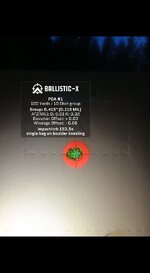
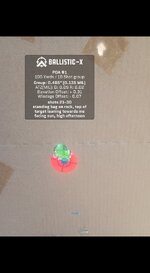
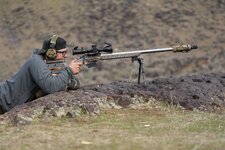
10 shot .5moa guns exist, but I ain't hauling this thing hunting 
Also this barrel has more rounds on it now and I've never shot a 10 round group like that since. It is steady around 3/4" for 10
Also this barrel has more rounds on it now and I've never shot a 10 round group like that since. It is steady around 3/4" for 10
Attachments

Billogna
WKR
This!!! How many times have we heard about a gun that "won't shoot" being sent back, only to be tested by the manufacturers QC to be determined that "Nothing is wrong!! Shoots fine for us!" and shipped back to the customer with no repairs made?Those guarantees are based on their grasp of statistics that leads them to be certain that an honest assessment of their accuracy will produce at least enough 3-shot clusters to argue that their rifles meet their guarantee.
In short, those guarantees are based on them understanding statistics and using that understanding against us

I wrote a long reply, detailing the lack of understanding for what peer review is and the miss use of the word empirical and asking why an arbitrary 25 degrees and if the was K, C, or F degrees, Etc. It reads like AI slop.
Decided in the end, it just isn't worth it. My rifles show no meaningful cold bore shift from 80 F to -15 F (temps I have shot groups in).
Decided in the end, it just isn't worth it. My rifles show no meaningful cold bore shift from 80 F to -15 F (temps I have shot groups in).
I'm not rereading the thread, but I'm pretty sure @Formidilosus has repeatedly specified good barrels and proper rifle design (no pressure points, Etc). The point isn't that nothing shifts, the point is there is no excuse for a rifle to shift going from cold to hot, so if it does shift, fix or replace it. Or, keep it for sentimental value and just know what it is.The problem with the 'proof' in the original post of this thread is that it may well demonstrate that modern barrels with modern stress relief are more or less immune to 'walking' but it doesn't even begin to touch on the question of whether this was a thing with historical rifles (say, 20-100+ years old) that most of us learned to shoot with.
I have a rifle with an early 90's era Douglas barrel that has a propensity to walk to the right (IIRC) after warming up. It's relatively long and skinny and a caliber that gets hot fast. I don't lose sleep over it, I just shoot it 2x, no more than 3x, and let it cool before shooting again, for whatever reason - load testing or zeroing. I don't treat those first 2-3 shots as a group for the purpose of determining accuracy or zero.
Notably, the rifle is built on a WWII era surplus M98 action and I do *not* know whether the face/threads/lugs/etc have ever been trued but no not think they have, and it's entirely possible that I have a great barrel screwed onto a mediocre action, in terms of concentricity and stress relief.
(It was installed in the early 90's, my understanding was that it was a NOS blank at the time, no clue when the blank was made).
I could (probably? possibly?) either prove this or prove myself wrong with this rifle by going to the range and firing 2 shots then cooling then 2 more, for a total of ten shots, then firing a single rapid 10-shot group, and comparing the two. But that would require scrounging up all my brass and loading 20 rounds of ammo and making a separate trip to the range (because it would be incredibly rare for me to shoot an unsuppressed rifle here at home, much less for 20 shots, simply because I have cows on my rifle range right now - I wouldn't mind if they were closer to the target but right now they're grazing close to the firing position). The root problem here is that I don't enjoy shooting that rifle enough to make that much effort and the knowledge I might gain from it isn't worth it to me at the moment. I'm not even certain I have enough components (brass and bullets) to make up enough ammo to run such a test. The adage that 'only accurate rifles are interesting' applies to me. Testing a rifle that I wrote off as being mediocre in the accuracy department thirty years ago, is fairly low on my list of things to do, even if it would prove a point to me, or the internet.
You're missing the point. The industry standard has long been wrong, precisely because it wasn't sampling enough to matter. Instead of averaging numerous groups they should have been making a composite of them. The composites - of ten to thirty shots - would come much closer to telling the tale for us. Ten shots that go into maybe 1.5moa might consist of several hypothetical three-shot clusters that measured 0.25 moa or might have measured 1.4moa, on average, but both depend on chance, and the composite actually tells us the part of the story that matters.
Also, as for whether this industry standard is sacrosanct, I'd point out that at least Rick Jameson was speaking against it at least a decade ago and maybe much longer - I'm old enough that there's no way I can remember when I read an article a decade or two ago. But after many years of chasing rifle accuracy (and, yes, owning some truly very accurate rifles over the years) something that RJ said once stuck with me - a rifle that will put ten shots into 1.5moa, is a good one. I don't know if he said that ten years ago or 20 or 25, but I know it was him that said it, and I remembered that much.
I used to be a regular poster on another forum and a well respected guy there used to do a lot of ammo testing with statistically meaningful samples and he'd often joke about the folly of 3-shot groups and it never failed that people would argue with him and show off their 3-shot clusters shot with ammo quite literally incapable of sustainable precision. But they had that one 3-shot cluster and would keep that photo and trot it out forever.
(Specifically, those were usually 3-shot clusters fired with surplus M193, which, day in and day out, is 3moa ammo at best, or, worse, M855)
In short, the OP is absolutely right from a statistical standpoint in how he tests guns/ammo. The fact that people are arguing against him simply shows they don't understand that problem.
However, OP isn't necessarily right about the cold vs hot bore issue, as he's taking a dataset of modern rifles with modern barrels and applying his conclusions from them across the board as an answer to a question a lot of us have been asking (or assuming an answer to) since the Dark Ages of rifle production. I *do* believe he has well demonstrated his point about cold vs hot, as it pertains to modern rifles with higher-quality barrels. I'm simply unsure as to whether such results can fairly be applied to older or cheaper barrels. I'm not saying he's wrong, I'm simply saying it hasn't been shown one way or the other, and I will freely admit that *I* may be wrong in my long-held assumptions. I'm just less sure that I care enough to test those assumptions by spending a day of my life testing a rifle I largely lost interest in 30 years ago.
Edited to bold the part that matters - I'm not saying OP is wrong; I'm saying his results may or may not universally apply to rifles from 30 years ago.
Similar threads



Featured Video
Latest Articles
- The Fundamentals of Scouting For Mule Deer & Elk | Hunt West Crossover
- Wiser Precision BA-7 Sparrow Binocular Adapter Review
- How to Kill Giant Bulls with Ryan Carter
- Kifaru Enters the Hunting Apparel Space: Review
- From Big Bucks to Bear Hunts: Catching Up with Jordan Budd
- Mule Deer Days Wildlife Conservation Mashup
- A Hidden Gem: Hunting Washington with Kari Thomas
- Prime Divide Bow Review
- Knowledge From Storms: Surviving and Thriving in the Backcountry with John Barklow
- DIY Wyoming Pronghorn Hunt