Clarification of Dry Fire #'s

So, I watched those exchanges unfold, wanting to know the same thing you do. My genuine take was that his "I don't know" answer was actually very fair.

Here's why:

What he essentially said is that you can hear the firing pin drop on a genuinely subsonic bullet with a big, effective suppressor. And, that those shots measure around 120dB.

What I interpreted from his statements, is that he's not really sure what's going on in why firing pins and suppressed subs are measuring around 120dB, and doesn't have deeper answers. But the observations are still what's being observed, objectively, repeatedly, and consistently. And, that he's open to the possibility that something's generally weird with measurement equipment, but that the observed effects seem to consistently occur.

Based on all this, I'm mystified by why firing pins and suppressed subs are registering in the same volume, while hours of dry-fire practice doesn't ring my ears like hours of subs would. But I am comfortable saying that I've seen and heard the same thing - even if it doesn't make a damn bit of sense.

So, I don't know what's going on, and that seems like a pretty fair thing for someone to say.

And, it would be important for their integrity to say that, if they're actually trying to do valid science.

I believe there are a few factors at play, psychoacoustic and otherwise;

-the firing pin rings the whole receiver like a bell. This results in not just the impulse but a frequency and a measurable decay.

-face in contact with stock. With insufficient beard loft we literally feel the firing pin fall in our bones.

-suppressed impulse is 'wider' with more displacement (energy under the curve) kind of like the difference between a 120dB BASS Drum and a 120dB WOOD block if that makes sense?

The bass drum is going to FEEL a helluva lot louder and more fatiguing than the wood block, even if both have the same PEAK SPL.

To say it another way, they might both measure the same peak SPL, but the kick drum (suppressor in this analogy) moves a LOT more air.
 
I believe there are a few factors at play, psychoacoustic and otherwise;

-the firing pin rings the whole receiver like a bell. This results in not just the impulse but a frequency and a measurable decay.

-face in contact with stock. With insufficient beard loft we literally feel the firing pin fall in our bones.

-suppressed impulse is 'wider' with more displacement (energy under the curve) kind of like the difference between a 120dB BASS Drum and a 120dB WOOD block if that makes sense?

The bass drum is going to FEEL a helluva lot louder and more fatiguing than the wood block, even if both have the same PEAK SPL.

These are all interesting possibilities that would be great to see pursued.

It also reminds me a bit of the nature of recoil, in how a sharp, quick, full impulse of energy from the shot can feel a lot harsher than one that's distributed over a longer duration. A bolt or pump-action, vs semi-auto of the same cartridge. Not sure how that would relate to sound, but it seems it's in there somewhere.
 
I don’t. How could the sound of a firing pin drop be the same as a siren, chainsaw, or shotgun blast?
Easy, it’s an impulse. The time at that sound level is milliseconds for the firing pin and constant for the siren and chainsaw. So they are perceived differently and may have the same maximum spl. I am not saying they do as I don’t have enough data, but they could.

As to why you can hear the firing pin drop over the report, simple, it happens first. There is a delay between the firing pin dropping and the bullet leaving the muzzle. A small time, but it can be measured and with fast enough measuring equipment the two events could be measured separately. I know at the silencer summit they filter out the reflected sound from the building or can identify it.

A shotgun is in the 150 db range from what I have found published.
 
Yes 1000%

I can influence the readings on a meter by 15+ db simply from where I put it and what I put around it, and 40+ db by changing settings in the meter itself.
There was actually a study I read that researched if the shooters head changed the exposure between the two ears. I believe the right ear is slightly shielded by the head and reads lower for a bolt action and right handed shooter.
 
So, I watched those exchanges unfold, wanting to know the same thing you do. My genuine take was that his "I don't know" answer was actually very fair.

So to be fair, I had a professor who handled things like that.


His approach was when you see stuff like that you call BS.

You know it can't be true.

Find the error before it repeats itself.


Thats why stuff got worked out long hand, so we recognized false returns.
 
I had the same question from the same comments. Glad someone asked.

I am understanding the response to mean:
“The same equipment/same setup used for cans also measures a dry fire at 120db. Right or wrong, it is un-plausible for the same thing measured with the same equipment, but WITH an explosion, to meter the same—its clearly not the same. Therefore I call bs on any explosion+firing pin drop being LESS than whats measured without the explosion. This is backed up by other data where there seems to be a lower limit at that same db level. One explanation of which could be that the floor is determined by that firing pin/action sound”.

The explanation of distance from trigger/action to measuring device being different from muzzle to measuring device should be irrelevant, because they will always be positioned that way, ie the trigger will always be closer to your ear. If it is true that trigger/action noise measures 120db at your ear, then it will always determine the lower limit of what is possible for a suppressor to measure at the same place. It might somehow be a 110db can, but if the trigger meters at 120, then the meter is going to read 120 until you can somehow eliminate that action noise, or show the metered db’s over time.

To me it seems to reinforce that the equipment isnt capable of hearing what we’re after in the first place, or the db figure isnt capable of communicating it. Which seems to make all the suppressor db-quibbling something of a waste, at least past some point and maybe entirely.
 
To me it seems to reinforce that the equipment isnt capable of hearing what we’re after in the first place, or the db figure isnt capable of communicating it. Which seems to make all the suppressor db-quibbling something of a waste, at least past some point and maybe entirely.

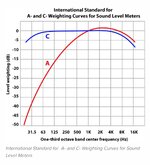
One important consideration that could be addressed is the 'weighting'.

dBC tells a more complete story than dBA, but it's still only one data point

Nobody wants to use a dBC measurement, because it reads higher, but guaranteed the C weighting factor will more accurately quantify the difference between subsonic suppressed report and the falling of the firing pin.

That's because the A-wrighting includes very little low frequency information.

Screenshot_2026-05-06-20-16-30~(1).jpg

The conversation could be much improved with this simple toggle switch 🤓

I have an Earthworks TC30 measurement microphone (linear to 150dB or so). It would be interesting to do a full FFT (Fourier transform) analysis of the audio from a dry fire event vs subsonic w/ can vs supersonic w/ can

I lack the anechoic facilities required to properly conduct such an analysis, and unfortunately suppressors are prohibited devices in my country 😔

I'd consider travel if somebody wanted to commission a report 🤷‍♂️ 🤣
 
Back
Top