Chasing Accuracy Twice - 6.5 PRC Reloading Log

he_lives

Lil-Rokslider
Joined
Jan 16, 2017
Messages
178
Location
Washington
I started reloading back in 2012 with a Lee Challenger reloading kit, relying on what I could learn from books and whatever was posted on forums at the time. Lots of trial and error. I spent the first few years throwing powder charges with the Lee plastic powder measure, trickling powder by hand hunched over the included beam scale, and loading ammo into spent brass I had collected. It was time consuming, and didn’t yield the best ammo, but it was good enough to fill my tags and I haven’t hunted with commercial ammo since.

I started reloading when I had more time than money, originally just wanting ammo to go hunt with for cheaper than I could buy it. Now, raising a young family has shifted my focus to prioritizing time a bit more than doing things cheaply and I’ve upgraded to better equipment.

I also wanted to point out that I fully agree with the “painless load development” concept that Form has posted and see how it can quickly get a rifle shooting accurately enough for any reasonable hunting scenario. I reload as a hobby. I enjoy most aspects of it and like to tinker with new loads and rifle combinations. These days, it’s easier to carve out a couple hours of range time, versus the time it requires me travel to hunt. Developing a load is something I enjoy doing, even if it could be done quicker with the painless method. If you’re at a place in life where you can be away from home hunting, absolutely do the painless method and don’t waste that time at the range or in the reloading room

To the point of enjoying tinkering with my setups, I’m currently pulling a 300 wsm barrel off a Tikka action to try out a 6.5 PRC barrel I bought off a member here. Nothing wrong with the 300 wsm, and nothing really to be gained by switching calibers. It shoots repeatable 1.1 to 1.25-moa groups with 168-eldm and 185-juggernauts. I just feel like seeing was the rifle is like in 6.5 PRC.

Shortly after buying the Tikka 6.5 PRC barrel, an Origin carbon Proof 6.5 PRC barrel fell into my lap at a price I couldn’t say no to. I had no plans to put together two 6.5 PRC rifles, but I’m going to play around with it as well.

Since I am going to work through load development on two different rifles, I figured I would start a reloading log to show my process. It may provide a couple tips to new reloaders, and I’m sure anyone that may read this could provide some critiques to my current process.

Here are the rifles I’ll be working with:

Tikka:
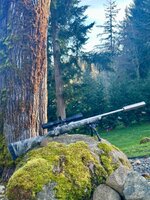
  • Factory 6.5 PRC 1:8 Twist Barrel, cut to 20" and threaded 1/2" with adapter to 5/8". Purchased from a member here with 50-rounds on the barrel. Unsure who did the barrel work or where the adapter was made/ purchased from.
  • SWFA 3-15 scope in Sportsmatch Rings
  • DDC Enticer LTi direct thread.
  • Stock except for Tikka vertical grip and Limbsaver Airtech recoil pad.
  • The unloaded rifle with suppressor weighs 8.4-pounds and is ~ 48-inches total length
Note: Photo is with 20" 300 wsm barrel still installed, but same final form.

IMG_4033.jpeg


Solus spare parts rifle:

I had originally planned to install the Proof barrel on a long action and run the bullets long. After measuring the COAL for several bullets at the lands, it looks like a short action is best suited to this barrel.
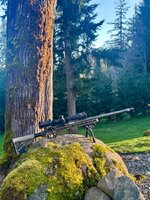
  • 24" Proof 6.5 PRC with 1:7.5 Twist. Area 419 Hellfire Brake
  • Solus Lightweight Short Action
  • Trijicon Tenmile 3-18 in Seekins Precision rings
  • XLR Magnesium Chassis with Magpul MOE stock and 3D printed grip, thumbrest, and bag rider.
  • The unloaded rifle weights 9.2-pounds and is ~44-inches with the stock in the position that fits me.
IMG_4018.jpeg

I will update this as I work through the load development process.

 
Cool, looking forward to seeing how it goes....

I am pretty much a "painless" reloader from a efficiency of the actual reloading steps, or lack there of. But, I like to tinker with load development as well, And I will be doing similar with my 6.5 creed.
 
Step 1

These two rifles are not good examples of my normal first step as the barrels were both purchased from the classifieds.

Typically, when I am trying to pick out a barrel, cartridge, and bullet combinations, I build a spreadsheet to organize the different options. Here are my steps:
  • Select a bullet (or several) that I want to hunt with
  • Use GRT to play with barrel length and powder combinations that meet my needs. I'm not trying to be perfect with exact measurements here, but I'm looking for bullet & powder combos that provide burnt powder ratios close to 100% and case fill somewhere in the 90% range. I also don't prefer to operate at the ragged edge of being over pressure.
  • I take the GRT estimate and plug that into a ballistic calculator. I hunt deer every year at EL.1400' and most my elk hunting is between EL. 5000' and EL. 7500'. I limit my shots to 600-yards, hopefully less. I'll set conservative "minimum" expansion velocity for deer (typically 1900-fps) and a little higher "desired" velocity for elk (typically 2000-fps).
  • The last two bullet points are iterative. I will go back and forth on several bullet/powder combos and vary the barrel length until I find the shortest barrel with the lowest recoil that meets my velocity goals at 600-yards.
  • Once I have a few bullet/powder combinations that I think will produce the desired velocities at reasonable pressures, I will order a barrel.

Here is a simplified example of the spreadsheet I built to organize potential combinations:

1774996917398.png

As mentioned, I bought these barrels first and did the research second this time. For a better example, here's my spreadsheet playing with bullet/powder combinations in advance of ordering a 280ai barrel last fall:

1774997025836.png

The highlighted rows are combinations I think look promising.
 
Step 2

Once the barrel is available, I find where the bullets I have selected touch the lands.

When I first started, I would cut a slot in a spare case to relieve some neck tension. I'd place the bullet in the case, chamber the round, and measure the cartridge after the bullet seated itself against the lands. This isn't repeatable, but can get you close if this is all you have.

I next moved to the Hornady OAL gauge with modified cases. I will still use this for rifles where I don't want to pull the barrel.

The most repeatable method I've found is outlined in this article: LINK

In summary, load a bullet seated long. With the barrel removed, place it in the chamber with light tapping. Then bump the bullet shorter and shorter until it doesn't "stick" in the lands. I use this method when its feasible to have the barrel off.

Tools Used:
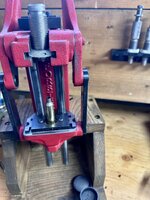
  • Reloading Press
  • Seating Die
  • Collet Bullet Puller / Inertia Bullet Puller
  • Bullet Comparator. I use the Hornady set. Link for Reference
  • Dial Calipers. Any decent quality set will work. I use the Mitutoyo 505 calipers
  • Optional - OAL Gauge. I use the Hornady set. Link for Reference
  • Optional - Modified Case for 6.5 PRC. See above link.

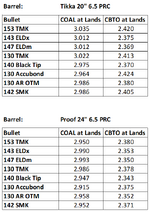
Since I never know what bullets I will end up using, I like to measure the distance to the lands on several of the bullet options I have on hand before the barrel is installed. Here are the results from these two barrels:

1775066407754.png

The internal length of the Tikka mag is ~3.3" so no issues with COAL on the Tikka.

I mentioned earlier that I had planned to put the Proof barrel on a long action and seat bullets long. Currently, I'm most interested in a load using the new 153 TMK bullets and plan to work on them first. I had assumed, incorrectly, that I'd need more mag length than a short action mag would allow. You can see from my measurements that the bullet touches the lands with a COAL that fits short action mag length.

If the 153 TMK bullets don't pan out, I'll likely move to a 143/147 Hornady. My measurements show I can fit those at mag length with a reasonable jump.
 
This isn't necessarily a load development step, but part of the overall process that might be helpful to someone just starting out.

Now that measurements have been measured for potential bullets, the barrels are installed with internal wrenches and torqued to 75 ft-lbs.

I need to make some rounds to sight in, test for any issues, and typically keep a few for warm up rounds.

I have new ADG brass that I am going to use in the Proof barrel. The Tikka will use 1x fired Norma brass.

For the new ADG brass, I simply dry lube the necks with Imperial Dry Neck Lube and run them through a PMA Tool neck expanding mandrel. Then chamfer and debur the case mouth.

The Norma brass was fired in a different rifle. I didn't clean the brass. I just lube with Imperial Sizing Wax, re-size full length based on standard die settings, wipe off the wax, chamfer and debur the case mouths.

IMG_4062.jpeg

IMG_4063.jpeg


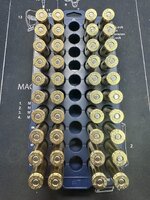
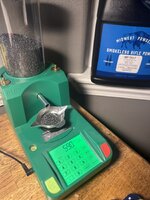
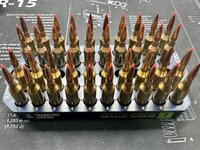
With the price of components these days, I go really cheap with these sight in rounds. For both rifles, I'm using 59 grains of pull down Mag Pro powder, a mixed lot of pulled 140 ELD-m bullets, and primers I punched out of some other reloads I broke down. They're a bit ugly, but will work for getting me on paper.

IMG_4065.jpeg

IMG_4066.jpeg

IMG_4068.jpeg

Hoping to get to the range to sight these rifles in soon.
 
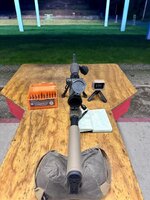
I was able to get to the range yesterday to sight in and function check the rifles.

Had good conditions. Low 50’s, low/no wind, clear.

IMG_4076.jpeg

I shot 5 rounds in each rifle to check function and sight in the new barrels.

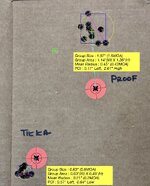
I then shot 10-shot 100 yard groups with each rifle, allowing 45-60 seconds between shots.

I’m not planning to do anything with these loads using pull down components, but I record them anyway.

Here’s how they shot:

IMG_4084.jpeg

24” Proof - Avg: 2724-fps, ES: 87-fps, SD: 28.2-fps, 10-shot group: 1.5-moa

20” Tikka - Avg: 2556-fps, ES: 45-fps, SD: 13.3-fps, 10-shot group: 0.6-moa

These turned out to be about at 6.5cm velocities, but worked well enough for sight in and to get a few rounds on the barrel.

I mentioned earlier that the tikka barrel was used, with an unknown round count believed to be less than 50. Since it’s low, I’m not going to guess at what the previous round count might be, and will just track the rounds I’ve shot.

Current round count on both barrels: 15
 
What primers and coal were you using for the tikka load?

Sent from my SM-G986W using Tapatalk
 
What primers and coal were you using for the tikka load?

Sent from my SM-G986W using Tapatalk


The primers were punched out of previous reloads I had broken down and the bullets were pulled from mixed lots.

They were CCI 250 primers at 2.900" COAL.
 
Step 3

As we've all seen, barrels typically speed up initially then normalize somewhere in the range of 100 to 200 rounds fired.

At this point in the past (15-rounds fired), with a load combination that is shooting at least 1.5-moa, I'll load up another 80 to 100 rounds of the loads used for sighting in, and use those for general practice until I see the velocities settle in.

I've done the popular Berger seating test in the past, and have also developed great shooting loads without playing with seating depth at all. I'm not convinced seating tests are needed, but, because the 153 TMK bullets are new, I think I will use some of this initial barrel life to test for a forgiving seating depth range.

It has been noted by a few others that these bullets are long with an equally long bearing surface length. In both my barrels, the bearing surface will be seated deeper than the neck/shoulder junction, even when seated touching the lands. This might be the case for most barrels without a custom chamber.

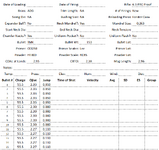
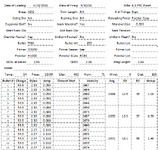
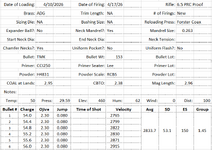
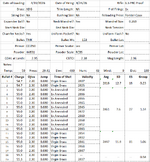
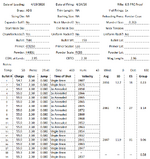
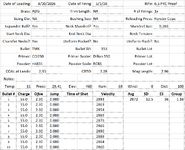
Since it doesn't appear I keep these 153 TMK bullets out of the case neck junction at any seating depth, I'm going to run a test jumping 0.050", 0.080", and 0.110" to see if there is a measurable difference. These will be loaded in new brass. Here are my notes for the seating test rounds in the Proof barrel:

1775601984004.png

I had originally planned to use 143 eldx or 147 eldm in the 20" Tikka 6.5 PRC barrel. However, I have a separate Tikka rifle in 6.5cm that shoots 143-eldx around 2,700-fps. Looking at the GRT estimates summarized above, pursuing a 143 or 147 load in this 20" 6.5 PRC Tikka doesn't offer much advantage over the 6.5cm.

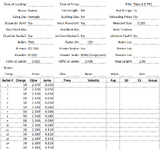
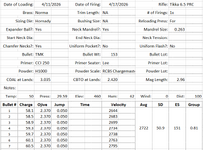
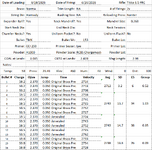
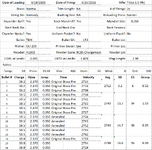
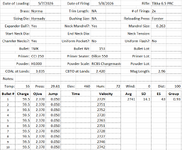
I may change my mind later, but I'm going to try to work on a 153 TMK load for the 20" Tikka barrel as well. Here are my notes for the seating test rounds in the Tikka barrel:

1775603450569.png

The different charge weights are due to the different seating depths based on the measurement to the lands in each barrel. Additionally, the ADG brass fired in the Proof barrel has less estimated case capacity than the Norma brass fired in the Tikka barrel.

For the Tikka, the bullets are seated longer in cases with slightly more estimated volume, allowing for additional powder.
 
Made it to the range last night to shoot some seating depth tests / get some additional rounds on the barrels. Similar conditions to last week, low 50's, clear, minimal wind.

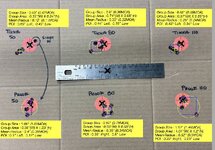
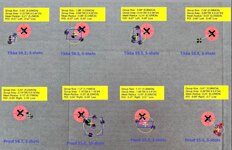
These groups were shot in "snake" order - 50, 80, 110 then 110, 80, 50, then 50, 80, 110 until done. I shot 3-shots at a time, one at each jump and allowed 45-60 seconds between those shots. I then let the rifles cool for 7 to 10-minutes between 3-shot sequences. This means that for each 5-shot group you see on paper, I broke position each time and had about 40-minutes from the first shot to the last. This method probably introduces more shooter error, but is done to distribute conditions and fatigue more evenly across all groups.

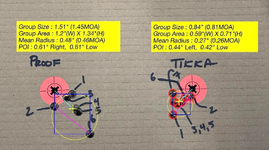
Here are the targets:

IMG_4279.jpg

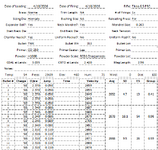
Here is the velocity data:

Tikka:

1775915303008.png

Proof:

1775915358149.png

Current round count on both barrels: 31
 
Using last week's seating depth results, I loaded ladder tests to take a look at where velocities were at before proceeding further.

The Tikka barrel allows the bullets to be seated longer and the Norma cases have a little more estimated case capacity. This let me fit up to about 60.5 grains of H1000 when loading 0.050" off the lands.

The Proof barrel requires a shorter COAL combined with ADG brass that has less estimated case capacity. This limits me to fitting about 55.5 to 60 grains of H1000 and doesn't appear to provide the velocities I was hoping to see. I loaded a ladder with H4831 to see what velocities that powder would produce.

I shot these last night, here are the targets:

1776520344904.png

Here is the velocity data:

Proof:

1776520515789.png


Tikka:

1776520572772.png

Shooting ladders like this don't provide large enough data sets to be conclusive. There are two takeaways from these groups:

1. Velocities are acceptable for terminal performance out to 600-yards
2. These Barrel / Powder combinations are grouping together reasonably well over 1.5 to 2 grain powder
difference and 150-fps variation. Important for hunting ammunition that might see use in variable environmental conditions.

Current round count - Tikka: 39 Proof: 38
 
Up until this point, I had been using virgin ADG brass in the Proof barrel and sized 1x fired Norma brass in the Tikka barrel.

I now had enough brass to test the loads further with fired casings.

I measured the fired brass headspace using my dial calipers and a Hornady "E" bushing.

I chose to anneal the brass for these barrels. If you aren't setup to anneal, this step likely adds very little benefit, and I wouldn't worry about skipping it. I'm annealing primarily because I have the equipment, and these are small batches of brass that don't take much time.

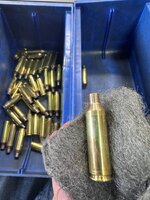
My process for prepping the brass was to lightly clean the necks with steel wool:

IMG_4388.jpeg

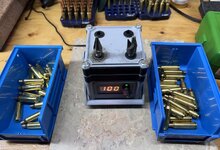
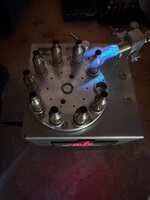
Then anneal with an AGS annealer, torch pointed at the shoulder/neck junction, lights off, looking for a slight orange glow:

IMG_4477.jpeg

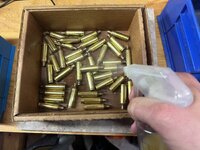
Next, I'll either use sizing wax or an alcohol & lanolin mixture for case lube. Since I had a few to do, I sprayed them down with the homemade alcohol & lanolin mix:

IMG_4486.jpeg

I have a Hornady FL sizing die that I will use for the brass in each barrel. I start by backing the die off a ways, then gradually adjusting it down until I get ~0.002" shoulder bump, when compared to the fired brass measurement.

After FL sizing, I chamfer the necks and tumble the brass in corn cob media to remove the spray lube.

After tumbling, I use dry graphite powder to lube the case necks, and run the brass through a neck mandrel.

I typically hand prime in an old Lee hand prime tool, but have recently been priming on a DIllon 550.

I took a look at the total length of the brass. Nothing too long, and I didn't spend the time to trim.


Using the velocity data from the last range session and knowing that both rifles grouped well across a 1.5 to 2 grain powder window, I picked out charges to test further in the fired and prepped brass.

I sometimes see fired brass produce different results than virgin brass. So as a control, I also loaded some rounds using the remainder of the virgin and brass that was originally prepped for the TIkka barrel.

For the Tikka barrel, I used 59.5 grains of H1000. For the Proof barrel, I used 55.0 grains of H4831sc.

In addition to shooting a 10-shot group, I shot small groups 0.3 grains above and below each target charge weight to represent variation real world conditions.

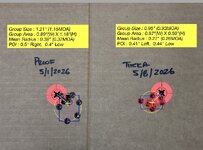
Here are the targets I shot:

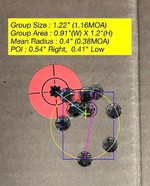
IMG_4688.jpg

Here is the velocity data:

Here is the velocity data:

Proof:

1778278161581.png


Tikka:


1778279012536.png

On the Tikka barrel, during the 5-shot groups, I had a couple rounds that had a slightly sticky bolt. Then, during the 59.8 grain powder charge group, I had a clicker. More on this in my next post.

Current round count - Tikka: 56 Proof: 58
 

Attachments

  • 1778278217890.png
    1778278217890.png
    97.9 KB · Views: 4
  • 1778278121674.png
    1778278121674.png
    108.4 KB · Views: 4
I haven't loaded for a PRC before, and up until now had never had a clicker.

I did some research and settled on trying to remedy this with an AW2 reamer. While waiting for the reamer to arrive for the Tikka barrel, I loaded and shot another 10-shot group with 55.0 grains of H4831sc in the Proof Barrel. All brass was 1x annealed.

Here is that group:

1778279713325.png

And velocity data:

1778279803014.png

Current round count - Tikka: 56 Proof: 69

This load in the Proof barrel has now shot two 10-shot groups a little under 1.2-moa. It appears to hold point of aim with slight variations in powder charge (which represents changing real world conditions). It is also producing enough velocity for terminal performance past 600-yards.

In years past, I would have continued to play with this load in hopes of finding a sub 1-moa combination. Learning from others on the forums and running hit probability models, the difference between where I'm at with a 1.2-moa load and where I want to be with a 1-moa load, doesn't translate to a large difference when hunting inside 600-yards. For now, I think I am going to fight the urge to play with this more, and call this good enough for the Proof barrel.

My range only goes to 200-yards. When I have time, I plan to shoot this load out to 600-yards to get actual dope and verify that it doesn't fall apart at longer ranges.

A question for anyone that might be reading, Id like your opinion here:

With this barrel having only ~70-rounds on it, it is likely to speed up at some point. I typically handle this by loading up smaller 20 to 30 round batches of ammo and monitor velocity every 10 rounds or so. When the barrel speeds up, I'll shoot until it stabilizes and then reduce my powder charge to replicate the velocity I was getting during load development. Any issue with this?

More to come as I finish load development on the TIkka Barrel.
 
I rented an AW2 reamer and used it to open the chamber of the Tikka barrel.

I also noticed that during prep, my final pass with the neck expand mandrel was pulling the shoulder bump back out of the prepped brass. Using a little more dry lube on the necks before final sizing remedied that.

With the chamber reamed and brass prep issues fixed, here is the group I shot with the AW2 chamber. No clickers this time.

IMG_4704.jpeg

Here is the velocity data:

1778345044155.png

Current round count - Tikka: 67 Proof: 69

The Tikka barrel has now shot 5-shot and 10-shot groups right around 1-MOA with this load. It appears to hold point of aim with slight variations in powder charge and it is also producing enough velocity for terminal performance past 600-yards.

I’m going to call this load development done until I have a chance to shoot at longer distances.

I recorded my brass measurements ~ 0.200 from the base to compare the effects of the reamer. Here’s what I got:

Fired in Factory Chamber - 0.5325”
Sized after 2x Firing - 0.5315”

Click happened after this firing and chamber was reamed.

Fired in AW2 Chamber - 0.5335”
Sized after Firing in AW2 - 0.5315”

Do those measurements align with what you guys are seeing after using the AW2 reamer?
 
I’ll have to measure some cases but I opened up my tikka chamber as well, coming into my 2nd firing of 100pieces of peterson

I’d be curious what others are getting. I know the AW2 is spec’d to cut the chamber to 0.5350”.

I was expecting my fired brass to be close to the 0.5350” chamber, but my brass measured 0.5335”. Maybe this is what others are seeing and is normal?
 
I’d be curious what others are getting. I know the AW2 is spec’d to cut the chamber to 0.5350”.

I was expecting my fired brass to be close to the 0.5350” chamber, but my brass measured 0.5335”. Maybe this is what others are seeing and is normal?

That is what I am seeing at my .200 line after renting a reamer. I haven’t played with the gun enough to see if it resolved the issue since reaming.


Sent from my iPhone using Tapatalk
 
That is what I am seeing at my .200 line after renting a reamer. I haven’t played with the gun enough to see if it resolved the issue since reaming.


Sent from my iPhone using Tapatalk

After using the reamer, your fired brass is about like mine ~0.5335” at the 0.200 line?
 
Back
Top