YukonJim
FNG
- Joined
- Dec 29, 2025
- Messages
- 23
I finally got around to making a Rokslide account instead of just lurking like I have for ages. Figured I might as well share this piece I wrote a while back about the Porcupine Herd in northeastern Alaska. Posted in two part to meet the character limit.

The Porcupine Herd is made up of approximately 218,000 barren ground caribou, who’s migratory range spans an immense 1,500 mile span across western Canada into Alaska. Each year the herd make the traverse from their wintering grounds in the northern boreal forests of Alaska and Yukon to their calving grounds along the Porcupine River to what is known as 1002 Area on Alaska’s coastal plain in the Arctic National Wildlife Refuge. The herd’s yearly migration to and from their wintering and calving grounds makes for the longest migration of any land mammal on the planet.
Around the first of August each year I take the time to lay out my gear and begin packing for the better part of a month I will soon be spending on the southern slopes of the Brooks Range in northeastern Alaska in the pursuit of these animals. While I’m not held to quite the weight restrictions our clients are, it is still always tough to pack for how long I will be in the field. Eventually though, I am able to fit all of my gear into a pair of gym sized duffel bags, along with my empty frame pack and rifle in its soft case. 80 pounds feels like a lot to bring, but I’ve learned that having a couple of small creature comforts makes spending that amount of time in a tent much more enjoyable.
The weather this year was perfect this year a week later and I climbed into the outfitter, Charlie’s Cessna 180, soon leaving all trace of civilization behind. The mosquitoes were truly astonishing in number when we landed on the lake we use for our camp and it made setting up for the season something of an endeavor, despite the thick layer of bug dope I’d covered myself in. Nonetheless, by the time the clients had arrived with Charlie’s second trip everything was all in place and after a short briefing on things like the bathroom procedure (bring your gun and dig a hole) we were ready to hunt first thing the following morning.
That first morning started out well. We glassed up two caribou crossing along the far side of the lake from camp, as well as a cow moose and a pair of wolves elsewhere in the valley. Sadly, for the next several days, that was all we saw aside from an arctic grizzly cresting a distant hillside. One of the most difficult parts of being a guide is keeping a client motivated and into the hunt when you’re just not seeing any animals. They were out there and they were on their way. The herd was just late to arrive to the area that we were hunting. Adding insult to injury, I discovered during the fifth day of the hunt that the waterproofing on my boots had failed. I had debated buying a new pair heading into the season as mine had already survived three years of hard abuse, but convinced myself that they would be good for just one more camp. I was wrong, and the gallon Ziploc bags I wore as boot liners for the next several days were a constant reminder that its always worth spending that extra money on your feet. It really can make or break a hunt.

Unlike many other caribou herds, like the Mulchatna or the Western Arctic, the Porcupine herd has been consistently healthy in size, even growing considerably, since population monitoring began in the 1970s. While debate about management, land development, and the future of the species swirls around much of the population globally, the Porcupine has remained something of a positive beacon that some herds are still able to do well. While the changing climate is an ever-looming threat to arctic dwelling species, the development of their calving grounds in 1002 Area for the oil and gas industry may prove to be far more dire.
In 1987 the Secretary of the Interior, Donald Hodel, recommended to Congress that 1002 Area be opened for oil and gas leasing despite the Department of the Interior’s own environmental impact statement indicating that “expected displacement and reduction of wildlife populations and natural processes would cause a major reduction in the value of the area as a pristine, natural scientific laboratory." Two years later, the Exxon-Valdez disaster occurred and the development proposal for 1002 Area was soon shut down. Over the following 30 years several more proposals have been made to begin oil development of the region, but whether the political tide prevented any momentum or Congress was dissuaded by the economic and environmental burden of undertaking such a project, so far, the region as been able to avoid development and remain a pristine wilderness.

Finally, on day eight, we spotted a band of about 40 cows and calves emerging from the mist down the valley. Over the next several hours hundreds of animals began to pour through. We had gone from worrying about getting skunked while we sat in camp eating our breakfast that morning to now glassing and trying to find the client’s dream bulls within the herd.
At around 2:00pm we spotted a large bull with a group of about twelve cows descending into the thick willows of the gully below us. I grabbed my client and we moved to cut them off where we expected them to emerge. Soon, we heard the grunts and clicks of several caribou passing by, concealed just out of view except for brief flashes by the vegetation. We waited a little longer, but never got so much as a glimpse of the big bull’s antlers, so we began a slow circle back to where we had originally seen him.
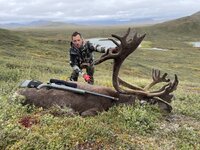
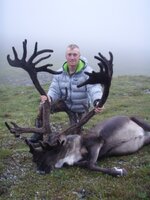
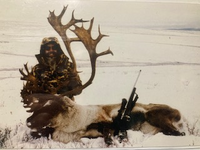
Suddenly, I saw him about 75 yards away stepping out of the willows and my client and I dropped behind the closest spruce for what little cover we could manage. The bull gave us a clean broadside at 36 yards, and the client dropped him with a perfect double lung shot. It was an awesome moment after how discouraging the past several days had been. I quartered and skinned our caribou, then hauled it back to camp. No sooner had I gotten the meat on the pole then I heard the report of another rifle. Andy, with our other client had shot a bull of their own. I hurried to finish up with ours and hurried to go and help pack out the second. We were going to eat like kings that night.
The remaining two days with these clients were uneventful save for attempting a stalk on the valley’s white wolf that appeared to be interested in one of the gut piles. He eluded us, as he has done now at least a half dozen times to me previously. He is beginning to make me better understand Captain Ahab’s obsession with Moby Dick.

The Porcupine Herd is made up of approximately 218,000 barren ground caribou, who’s migratory range spans an immense 1,500 mile span across western Canada into Alaska. Each year the herd make the traverse from their wintering grounds in the northern boreal forests of Alaska and Yukon to their calving grounds along the Porcupine River to what is known as 1002 Area on Alaska’s coastal plain in the Arctic National Wildlife Refuge. The herd’s yearly migration to and from their wintering and calving grounds makes for the longest migration of any land mammal on the planet.
Around the first of August each year I take the time to lay out my gear and begin packing for the better part of a month I will soon be spending on the southern slopes of the Brooks Range in northeastern Alaska in the pursuit of these animals. While I’m not held to quite the weight restrictions our clients are, it is still always tough to pack for how long I will be in the field. Eventually though, I am able to fit all of my gear into a pair of gym sized duffel bags, along with my empty frame pack and rifle in its soft case. 80 pounds feels like a lot to bring, but I’ve learned that having a couple of small creature comforts makes spending that amount of time in a tent much more enjoyable.
The weather this year was perfect this year a week later and I climbed into the outfitter, Charlie’s Cessna 180, soon leaving all trace of civilization behind. The mosquitoes were truly astonishing in number when we landed on the lake we use for our camp and it made setting up for the season something of an endeavor, despite the thick layer of bug dope I’d covered myself in. Nonetheless, by the time the clients had arrived with Charlie’s second trip everything was all in place and after a short briefing on things like the bathroom procedure (bring your gun and dig a hole) we were ready to hunt first thing the following morning.
That first morning started out well. We glassed up two caribou crossing along the far side of the lake from camp, as well as a cow moose and a pair of wolves elsewhere in the valley. Sadly, for the next several days, that was all we saw aside from an arctic grizzly cresting a distant hillside. One of the most difficult parts of being a guide is keeping a client motivated and into the hunt when you’re just not seeing any animals. They were out there and they were on their way. The herd was just late to arrive to the area that we were hunting. Adding insult to injury, I discovered during the fifth day of the hunt that the waterproofing on my boots had failed. I had debated buying a new pair heading into the season as mine had already survived three years of hard abuse, but convinced myself that they would be good for just one more camp. I was wrong, and the gallon Ziploc bags I wore as boot liners for the next several days were a constant reminder that its always worth spending that extra money on your feet. It really can make or break a hunt.

Unlike many other caribou herds, like the Mulchatna or the Western Arctic, the Porcupine herd has been consistently healthy in size, even growing considerably, since population monitoring began in the 1970s. While debate about management, land development, and the future of the species swirls around much of the population globally, the Porcupine has remained something of a positive beacon that some herds are still able to do well. While the changing climate is an ever-looming threat to arctic dwelling species, the development of their calving grounds in 1002 Area for the oil and gas industry may prove to be far more dire.
In 1987 the Secretary of the Interior, Donald Hodel, recommended to Congress that 1002 Area be opened for oil and gas leasing despite the Department of the Interior’s own environmental impact statement indicating that “expected displacement and reduction of wildlife populations and natural processes would cause a major reduction in the value of the area as a pristine, natural scientific laboratory." Two years later, the Exxon-Valdez disaster occurred and the development proposal for 1002 Area was soon shut down. Over the following 30 years several more proposals have been made to begin oil development of the region, but whether the political tide prevented any momentum or Congress was dissuaded by the economic and environmental burden of undertaking such a project, so far, the region as been able to avoid development and remain a pristine wilderness.

Finally, on day eight, we spotted a band of about 40 cows and calves emerging from the mist down the valley. Over the next several hours hundreds of animals began to pour through. We had gone from worrying about getting skunked while we sat in camp eating our breakfast that morning to now glassing and trying to find the client’s dream bulls within the herd.
At around 2:00pm we spotted a large bull with a group of about twelve cows descending into the thick willows of the gully below us. I grabbed my client and we moved to cut them off where we expected them to emerge. Soon, we heard the grunts and clicks of several caribou passing by, concealed just out of view except for brief flashes by the vegetation. We waited a little longer, but never got so much as a glimpse of the big bull’s antlers, so we began a slow circle back to where we had originally seen him.
Suddenly, I saw him about 75 yards away stepping out of the willows and my client and I dropped behind the closest spruce for what little cover we could manage. The bull gave us a clean broadside at 36 yards, and the client dropped him with a perfect double lung shot. It was an awesome moment after how discouraging the past several days had been. I quartered and skinned our caribou, then hauled it back to camp. No sooner had I gotten the meat on the pole then I heard the report of another rifle. Andy, with our other client had shot a bull of their own. I hurried to finish up with ours and hurried to go and help pack out the second. We were going to eat like kings that night.
The remaining two days with these clients were uneventful save for attempting a stalk on the valley’s white wolf that appeared to be interested in one of the gut piles. He eluded us, as he has done now at least a half dozen times to me previously. He is beginning to make me better understand Captain Ahab’s obsession with Moby Dick.