The pistons in that caliper picture you posted are done for. They're going to become a problem sooner than later. That caliper should have been replaced, or it's going to need to be in a matter of time. What's going to happen next is because the seals/bellows around the pistons are compromised, water and dust are going to get in between the piston and bore, and seize the piston in place. You will apply the brakes one day, and one or both of those pistons won't release, it'll just stay clamped onto the rotor. You may not notice it, especially if it's a windy day or you're on rough roads. If you drive it like that long enough, it'll get hot enough to smoke, but you won't notice that until you come to a stop and see the smoke rolling up over the hood. If you keep driving it like that, it will start a fire.
I lived on a gravel road for many years. Seized caliper slider pins are a part of life. Because of it, I've replaced calipers on trucks, cars, SUVs, even a street motorcycle once, always just the one that's bad, and never the other side (unless/until it also needs it). Maybe you live on a paved road, but likely you're on gravel/dirt FS roads often enough? Same thing.
What happens is the fine dust, silt and water get into the pin (which is usually sealed inside a rubber bellows). Eventually the pin surface corrodes and stops sliding freely, but it will move if brake force is strong enough. You can often see telltale evidence of this when the fixed pad is worn much thinner than the piston side pad.
How you deal with this is to inspect the pins every time you have a wheel off, for any reason. Carefully pull back the bellows so you can inspect the pin surface it covers. If there's visible corrosion on the sliding surface of the pin at all, replace it (that may mean replacing the entire abutment bracket, or just the pins, depending on how it's designed). If the bellows is swollen or torn, replace it. If the sliding surface is OK, wipe away anything that doesn't look like the fresh, clean grease it had on it.
Be careful using solvents to clean around brake stuff. It's not uncommon for EPDM "rubber" to be used around brake parts, because it tolerates DOT 3/4 brake fluid well. However, a lot of common solvents, oils and greases will cause EPDM to swell. If your bellows swells, it will let even more silt and water in between it and the pin.
If your pins and bellows are OK, ensure the bellows are "comfortably full" (not packed or stuffed tightly) with the correct grease, not just whatever grease you had around. The correct grease is "Ceramlube" (like: lube with ceramic in it). Ask for it by that name in your local parts store. The grease itself is purple, although it usually comes in a white container. One small container will probably last you the rest of your life.
If there are any pins that slide through holes in the pads to retain them, replace those pins every time you replace pads. Those can corrode and seize a pad in place too. You can find them on Rock Auto, or ask your local parts store to look them up. Usually it's only a few bucks for a kit that has all the pins and clips you need in it. Same goes for the other special bolts around the caliper and/or abutment bracket. It's way easier to spend a few bucks to get each of those bolts new when you replace rotors, than it is to fight those same old bolts on and off every time you have to do anything with the brakes.



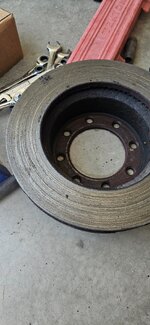

 ...your doing it wrong...If you think this is a good idea put the tools down and step away.

 ...your doing it wrong...If you think this is a good idea put the tools down and step away.
 ...
...


