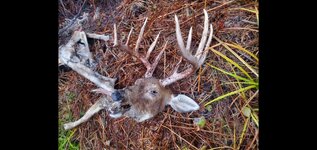
Are we overlooking hydatid spread from wolves?

Wrench

WKR
Joined
Aug 23, 2018
Messages
7,136
Location
WA
I've been watching our whitetail herd vanish. I have seen 100's of deer die off. The game department is pushing this as CWD....however in discussion with the biologist, she said they found 4 specimens testing positive so far in the last few YEARS of collecting samples.....including mandatory sampling.

EHD is a more likely potential....but I am seeing the die offs occurring in areas that tend to be heavily wolf predated, which has me wondering if perhaps what we're seeing is the wolves spreading hydatid and the deer responding to this by dying a slow miserable death.

I haven’t seen any studies to link the die offs....but symptoms AND locations tend to point to the potential.....and because it would be due to the wolves, I know the biologists are never going to entertain the idea.

Anyone looked into this?
 
Just had a look since I used to hunt that area in late 2000s/early 2010s (Kettle Falls).

Sounds like you are correct in that CWD is unlikely (low rate of prevalence and slow die offs) and EHD is probably it. Hadn’t looked at hydatid-related deaths. From a quick look, it seems like it’s well established in wolves but a tapeworm that’d have to get from the feces to the deer while browsing? I’d guess the possibility is there though large die-offs don’t seem as likely as EHD.

On a side note, I vaguely remember the nematode issue in northern Great Lakes infecting deer by a similar mechanism (I think snails were the culprit). Don’t know where that went - it was the late 90s when I was up there.

But you’re correct about DFW - my direct experience with wolf expansion was they’ll make any excuse possible to eliminate them as a possible problem.

Also crazy to see how CWD is pushed as the end of the world in many areas while most folks are not even familiar with EHD.
 
Just had a look since I used to hunt that area in late 2000s/early 2010s (Kettle Falls).

Sounds like you are correct in that CWD is unlikely (low rate of prevalence and slow die offs) and EHD is probably it. Hadn’t looked at hydatid-related deaths. From a quick look, it seems like it’s well established in wolves but a tapeworm that’d have to get from the feces to the deer while browsing? I’d guess the possibility is there though large die-offs don’t seem as likely as EHD.

On a side note, I vaguely remember the nematode issue in northern Great Lakes infecting deer by a similar mechanism (I think snails were the culprit). Don’t know where that went - it was the late 90s when I was up there.

But you’re correct about DFW - my direct experience with wolf expansion was they’ll make any excuse possible to eliminate them as a possible problem.

Also crazy to see how CWD is pushed as the end of the world in many areas while most folks are not even familiar with EHD.
I'm in my 50's and have hunted at least 60 days a year since the 90's. I do not recall ever seeing back to back to back die offs of whitetail deer. 25 years ago I thought they were more like coyotes and would survive anything.....now I see so few that I won't even shoot them.
 
Is there a heavy domestic sheep population in the areas you are talking about? Even though they SHOULD be wormed.. Also its fairly uncommon in regions that drench such as the US Canada and western Europe.
 
Did a quick search on the googs, midgets or "no-see-em's" seem to be the carrier that passes EHD to ruminant animals? What is the link between wolves and EHD?
 
I'm in my 50's and have hunted at least 60 days a year since the 90's. I do not recall ever seeing back to back to back die offs of whitetail deer. 25 years ago I thought they were more like coyotes and would survive anything.....now I see so few that I won't even shoot them.
Crazy… I can see why there’s curiosity if we’re missing something major. So much money funneled to CWD it’s hard to rule out overlooking something.

I’ve heard the EHD deaths are typically near watering holes - but I’m pretty sure you knew that and maybe seeing something different.
 
Nothing to add other than I made a trip to that area in the winter of 2005. As I drove along I saw what I thought were herd after herd of goats (it was early morning, dark). Pop over a hill and see another. As it grew lighter I realized they were not goats. Then I started seeing turkeys. I mentioned it to the fellow I went to visit and he told me to kindly keep my mouth shut. . I’d never seen the likes of that, ever.

I’m sorry that it isn’t that way any more. Hope they rebound for you. They are very resilient.
 
I'm not sure about the die off correlation. I have been butchering my own animals for 35 plus years. In the last 10 years, the amount of tapeworm cytsts I've found in both deer and elk is astonishing. I don't remember seeing them prior to that.
 
Is there a heavy domestic sheep population in the areas you are talking about? Even though they SHOULD be wormed.. Also its fairly uncommon in regions that drench such as the US Canada and western Europe.
We have nearly no sheep within 20 miles of typical whitetail habitat.
 
Crazy… I can see why there’s curiosity if we’re missing something major. So much money funneled to CWD it’s hard to rule out overlooking something.

I’ve heard the EHD deaths are typically near watering holes - but I’m pretty sure you knew that and maybe seeing something different.
In my areas we have very little stagnant water. Most is flowing springs, seeps and rivers/creeks.
 
In my areas we have very little stagnant water. Most is flowing springs, seeps and rivers/creeks.

It wouldn't be a surprise if a parasite caused host behavior to take it to the place it would most easily spread - lots of cases like that with other parasites. When the parasite reaches a stage of maximum transmissibility...deer gets really thirsty, dies near water, spores/eggs get into water and flow with it to new hosts?
 
I think the wolf reintroduction and EHD/bluetongue outbreaks are the cumulative culprit. If hydatid were the cause I would surely think if a deer is able to contract it from browsing with infected feces on the landscape, humans would be contracting it from field processing and butchering, and there would be a correlative rise in human infection rates in the area. We have had a pretty bad string of drought years but I would agree that it's a bit suspicious farther up North where there is a lot more flowing water sources than stagnant. It's a sad state of affairs..
 
Back
Top