Are African trackers really that good?

I flubbed a shot on a blue wildebeest one morning (not proud of it). We tracked it all day until it was dark covering several miles in the process. Marked the spot of the last sign and came back the next day to resume. Followed the tracks for another hour until, much to my relief, there was the wildebeest dead in some brush.

The trackers are pretty darn amazing in my opinion.
 
I was impressed with what we experienced in RSA. The water holes while bow hunting were a cluster, and the trackers would most often find the paths of the shot animals. If they didn't get on the tracks after a few minutes, they would waste no time and get the dog.
 
How soaked were you during this hunt?

Bongo hunting is supposed to be pretty miserable.
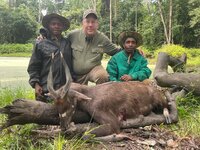
I submitted an extensive bongo and forest sitatunga hunt report on Africa Hunting Forum under my same username upon return.

Without overinflating my own ego, but in all seriousness, forest hunting in the equatorial African jungles for bongo, forest buffalo, and forest sitatunga is some of the toughest hunting on the planet. You can’t worry or even think about the continual misery. Oppressive heat, unlimited and unknown types of insects, humidity, constant sweat, and constricting vegetation make the Alaska and other mountains hunts seem like cakewalk.

Difficult rugid adventure. Nothing is easy in the jungle. Very blessed, thankful and grateful for the opportunity. Happy hunting to all, TheGrayRider a.k.a Tom.

IMG_3303.jpeg

Forest sitatunga a.k.a forest fairy.

IMG_3190.jpeg

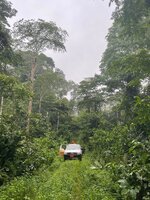
Old logging roads. Start of a daily hunt.
 
My PH who has had a PH hunting school for 30 years amazed me my last trip. We were in the back of the hunting rig probably going about 15-20 mph. We were all looking ahead in typical dry, sandy north African country. He saw leopard track on the trail in front of the rig while we were clipping along. We got out and even the trackers were amazed.
 
I've ran into amazing trackers in Namibia, Botswana and Zimbabwe. I think a big part of it is they start young and they don't ruin their exceptional vision by looking at computer, tv or phone screens. I haven't been to Africa in a decade so it's probably changed but they couldn't and didn't read books as well .
 
Yes the good ones are that good. Are all of them no. In general 99.9% of hunters are complete sh!t at tracking even with blood.
 
As the old saying goes, "you just have to see it to believe it." I watched them track a kudu for over a mile in a place where there were millions of tracks. They did this a pace that was hard for me to keep up. We caught up with the kudu, but he was still just out of bow range. If you could have seen how many tracks were on the ground it was literally unbelievable what they were able to do.
 
Yes, they are. In both Namibia and South Africa, I watched their ability to spot and track game appear almost magical. After a few days, it becomes a contest to see if you can out-spot the tracker.

Spoiler: you cannot and you suck. 😁
 
Am impressed. Truly. This is the same guy that told me he was buying coordinates from some guy for an elk in CO, so you can see my incredulity. I’m sure the dude just sold him some random coords (he didn’t kill).

Now you people are going to tell me it’s legal to sell a location of an animal on public land without violating the Lacy Act!
 
I've ran into amazing trackers in Namibia, Botswana and Zimbabwe. I think a big part of it is they start young and they don't ruin their exceptional vision by looking at computer, tv or phone screens. I haven't been to Africa in a decade so it's probably changed but they couldn't and didn't read books as well .
Probably some truth to this and the fact that they are doing it from birth and on a regular basis for a living. Use or lose it.
 
I watched a tracker in South Africa follow an injured wildebeest for almost a mile. The hunter from that pulled the trigger was a full time guide from South Texas that’s been on a lot of tracks. Him and I both lost the track after a couple hundred yards. Not the African, he followed that thing through waist high grass, and mixed terrain to the animal that was still alive. It was quite impressive.
 
I don’t remember what thread or who said it, but it was similar to what @Lionhound1975 said. Biggest advantage is knowing the area and being familiar with it. Now, that I can see. Having a “feel” for the natural presentation and behavior of things. Then take them to a new area and they are mere mortals.

There was a book about native Americans (maybe it was inuit) and their ability to navigate without compass and map. Take them to a new area and they were lost as shit.
Apologies if this is a sidetrack from the thread...and just meant as an anecdote, not disagreeing with what you said. .

I am half Inuit, my Dad was in the Air Force and spent a couple of years in northern Alaska, where he met my Mom. Dad was from Maine, worked for the Forest Service and US Geological Survey before he joined, and knew his way around a compass and around the Maine woods...

He said once that he and my Uncle Nathan (Mom's brother) went seal hunting in an umiak (boat made of walrus skin). They went far out to sea, and had to dodge a lot of free ice on the journey home. There were no landmarks to be seen where they were.

He said Uncle Nate would go left around one large floe, and right around the next...Dad had no idea where they were. He was impressed as hell, when the first land they could see was the village of Unalakleet where they had departed from. He said he had no idea how my Uncle did it, and strongly doubted his own ability to have done the same feat.

Just a story from a time mostly in the past....
 
Yes, they are good. Particularly the ones I've met from Zimbabwe.
Zimbabwe used to be Rhodesia. Rhodesia produced one of the best combat tracker units in history: the Selous Scouts (Selous is pronounced Sell-ooo).

The Selous Scouts was a racially integrated unit in an army that was mostly segregated. They became much more than combat trackers; they eventually did a broad spectrum of special operations.

Link: https://selousscouts.tripod.com/home_page.htm

Just love hearing this: https://selousscouts.tripod.com/SS.wav
 
I know some pretty good trackers, seen them follow sign on hard pan for much longer than you would think possible. They weren’t from Africa.
The Border Patrol has produced many amazing trackers. Ab Taylor, Joel Hardin, and Jack Kearney probably became the best known because they taught others and had a big influence on search and rescue.
 
My PH who has had a PH hunting school for 30 years amazed me my last trip. We were in the back of the hunting rig probably going about 15-20 mph. We were all looking ahead in typical dry, sandy north African country. He saw leopard track on the trail in front of the rig while we were clipping along. We got out and even the trackers were amazed.

Something similar starts happening to me after the first few days of scouting for mule deer, driving between spots I want to hit hard for sign. After I've spent a few days walking around various food plots in the desert, looking for buck tracks, the brain just starts dialing in and perceiving things you just don't pick up on at all, until the rust gets blown off. After a week or so, deer and antelope tracks often just stand out on dirt roads if I'm not driving too fast. Especially if it's early in the morning or late in the day, with the sun low in the sky. The shadows of the tracks really pop then. But it just doesn't happen that way until I've been obsessively looking for sign for a few days, at least. Once it does start clicking in again though, it's a trip. The eye-brain connection is a crazy thing sometimes.
 
Echo what has been said. My tracker was alMost spooky. Would get to a spot and he would talk about animal laid here. Moved this way. Circled back here. I thought he was FOS until lo and behold we would come up on the animal.

Also their ability to spot animals was amazing. You would be driving and he would stop. We would be sitting in back and couldn’t see a thing. We would get out and start moving that way and finally see an animal that maybe 2 inches was visible. Amazing.
 
Back
Top