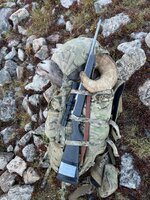
A bit of common sense on rifle weight??

Most people don't shoot well enough to handle >50gr of powder out of a rifle that weighs less than <8#. When I used public ranges I regularly saw people who couldn't even zero a lightweight .308 class rifle, off the bench, solely because they couldn't shoot well enough.

The focus on buying guns is far greater than the effort in learning to use them. That's much more the problem than how much it weighs. We see most kids in beginner level competitive shooting whose parents are clueless.

Less consumerism, more wearing out barrels. Please.
 
I love pushing ultralight boundaries as much as anyone, but the drawbacks are real. Obviously, a million variables exist, but if punching tags is the goal, lightweight guns are often a liability. Total weight in the 7- to 9-pound range merges shootability with easy carry. Go below that, and they're trickier to shoot. Go above that, and they become harder to pack.

On the once-in-a-lifetime Idaho sheep hunt I hope to someday draw, I'd use a 10-pound rifle. Carrying it would suck, but if/when an opportunity occurred, I could shoot to the best of my abilities.

Over the years, a few have vehemently disagreed with my posts. I expected that before pressing the Post button. With merit on both sides of the discussion - we'll just agree to disagree.

Once again, I know my opinion here will agree with a few, but probably not the many. So, here goes.....

My humble / experienced opinion, FWIW: Unquestionably and rightfully so, hunts in very high elevations, every ounce matters in the total gear / rifle weight being carried.

For the other 90% of hunting situations...a few points to consider:

1. Another pound or three in the rifle will noticeably reduce "felt" recoil - and especially with 7 Rem Mag, 30-06, 300 Win mag and similar cartridges in light weight rifles often carried into upper altitudes. A joy to carry? Absolutely. To shoot "accurately?"

2. Proven countless times - not always mind you - extra weight in a rifle typically improves both "rifle and shooter" accuracy. Referring to the countless words written and spoken to the critical importance of bullet "placement."

3. Spoken from long experience - taking a serious approach to getting in shape minimizes the work it takes to haul stuff into / up / and all over the mountains. Those out of shape who find themselves in the middle of that - quickly learn the lesson. For some, reducing gear / rifle weight is the answer. Likely so. See # 1 and # 2 above. If you can handle that and maintain your accuracy - good on you. Me personally - I've always felt getting in shape to "comfortably" carry a heavier rifle - which I do - always took priority - maintaining my accuracy when it came time to pull the trigger. YMMV.

JM2CW.

Cheers.
I generally agree. I will add something: the stock geometry and rifle balance are very important, that’s something i learned the hard way.

Everything depends on the applications in my opinion. If you plan to shoot long distance (or you need extra accurate shot placement because targets are small, like in my case hunting mostly small 50 pounds roe deer), you get a lot of benefits from a bit heavier rifle.. for example, with a 308 with not too fast loads, around 9 pounds is ideal of you still and shoot up to 300 yards or so. If the shot starts to get to 350-450 yards, with a small target, even a 9 pounds rifle is less forgiving on positional changes.
That said, i had issues (leaving to my only miss while hunting until now) with a 11 pound rifle and a hot 308 load not because of the recoil but because of the geometry of the stock: a stock with low buttstock tends to make the rifle jump much more. The CF mcs-t i had on the rifle was making it pretty impossible to control the recoil, and when shots were taken from a slightly different position/angle, especially uphill, they ended up high by even two MOA. That thing recoiled brutally even being just a 308, i never managed to have it recoil straight back once. Until i had it recoil in the same way (never “straight”), it was extremely accurate, even changing positions between bipod and bench at the range, merging more or less 40 shots from different groups from the first 10 shots of every range sesssions, i didn’t see a single bullet going outside a .8 MOA circle in the middle of the POA and 5 shot individual groups were basically a rugged hole, but the consistency of POI in field positions proved to be poor.

So i understood that for those kind of shots you need a stock with a buttpad closer to the line of recoil (the bore), in order to have more margin of error.

Recently i talked with a very good stock builder, who makes ultralight adjustable cheekpiece carbon fiber stocks with an amazing reputation and he told me that, more than the weight itself, which obviously helps, what matters the most is the balance. Not so much the front-rear balance but more the top down one. For example, a heavy stock with a light scope could give recoil control issues in his opinion.
This was very interesting to hear

What do you guys think?

 
OTOH, I'd argue it's not common sense to say "this is my experience, so it should apply to you, too".

I've never had trouble successfully hunting with my sub-6lb, all up, 308s, but I understand that doesn't mean that others will have the same results with them, across the board.

Some people (maybe a lot of people?) may have more trouble shooting a rifle that light successfully, so yeah, it's not a good choice for them. No argument at all that they'd be better served with a rifle they can shoot better.
True, everything depends in the applications. I imagine that if you had to be surgical in shot placement a heavier rifle would make your hit rate even higher.

To me is more important to be able to hit reliably than being more comfortable while carrying the rifle.
That said, of you have to walk miles in the mountains and you can’t cut weight on the rest of the equipment, you don’t have much choice and you have to go lightweight. Same if you have to shoot off hand or at close, moving targets
 
I didn't realize rifles were heavy until I started hanging out on a couple hunting forums, lol.

I've done several death marches during spring gobbler season toting an 8-8.5 lb shotgun (all up).

I like a light weight rifle as much as anyone, but the sweet spot for me is right around 7-7.5 lbs on a rifle. YMMV.
 
True, everything depends in the applications. I imagine that if you had to be surgical in shot placement a heavier rifle would make your hit rate even higher.
In my case, if I had to be more precise in my shooting, I'd be shooting animals that were small enough to where a 308 would probably make little sense. I'd choose a rifle of a similar weight, but chambered in a smaller cartridge, like 223, e.g.

To me is more important to be able to hit reliably than being more comfortable while carrying the rifle. That said, of you have to walk miles in the mountains and you can’t cut weight on the rest of the equipment, you don’t have much choice and you have to go lightweight. Same if you have to shoot off hand or at close, moving targets
In my case anyway, hitting reliably and carrying/shooting an ultralight 308 have been in no way mutually exclusive. Like I've said before, I can't speak to the experience of others.

I do find it interesting to read about what works for various people, but I think that the use of "I" in these kinds of discussions is much more pertinent than when we use "you". There are so many other variables in comparing two different shooters/hunters, that generalizing what system works well for one can't be reliably applied to another.
 
Rifle weight is all about making compromises, just like anything else.

If you’re not shooting game over 600 yards, there are a lot of very good, very light options that will reliably bang vitals sized targets, Barrett FC’s and Kimber Montanas for me. I struggle with those rifles on smaller targets past 600, personally.

I’ve started aiming to be sub 9lbs with a scope and suppressor and a full magazine, because I enjoy the capabilities to shoot well past 600 very accurately, and I can still strap them to the pack and not be too sad about the extra weight.

On my sheep hunt in 2022 and the goat hunt the next year, I was doing 10+ miles a day above 11,000 feet almost every day of my hunts, and I was very happy to be toting a Fieldcraft along, and I was shooting 10” steel at 600 very easily with that rifle. I did kill a ram and a billy at a measly 330 Yards each with said Fieldcraft, so not exactly a long precision test.

IMG_1092.jpeg

All that being said… if I know it’s going to be a death march, it’s awfully hard to not grab the 16” Montana 6.5 Creed, and any elk or deer at 600 and under is going to die. I most certainly don’t need 9Lbs+ for that job….


Tanner
 
and I was shooting 10” steel at 600 very easily with that rifle.

You should participate in the cold bore challenge if you haven't. I am not saying you aren't capable of this, but it humbles many.


I am currently putting together a new do it all rifle and my goal weight is 9.5-10 lbs. I know I will be able to handle it better than something lighter and I would gladly carry an extra lb or 2 for the confidence that it gives me.
 
You should participate in the cold bore challenge if you haven't. I am not saying you aren't capable of this, but it humbles many.


I am currently putting together a new do it all rifle and my goal weight is 9.5-10 lbs. I know I will be able to handle it better than something lighter and I would gladly carry an extra lb or 2 for the confidence that it gives me.
Sure, point me towards it and I’d be happy to give it a go next time I’m out.

Tanner
 
Recently i talked with a very good stock builder, who makes ultralight adjustable cheekpiece carbon fiber stocks with an amazing reputation and he told me that, more than the weight itself, which obviously helps, what matters the most is the balance. Not so much the front-rear balance but more the top down one. For example, a heavy stock with a light scope could give recoil control issues in his opinion.
Hard to say from a snippet of conversation related by another person, but I am extremely skeptical of this. Sure, some people will be sensitive to the feel of a rifle—mostly thats preference. Sure, at the extremes, perhaps something with regard to a “top heavy” rifle could be quantified. BUT to say that a heavy stock with a light scope (or vice versa) is MORE important than weight or geometry to being able to control recoil and shoot consistently, I think is false. I suspect a misunderstanding or something out of context.
 
In my case, if I had to be more precise in my shooting, I'd be shooting animals that were small enough to where a 308 would probably make little sense. I'd choose a rifle of a similar weight, but chambered in a smaller cartridge, like 223, e.g.


In my case anyway, hitting reliably and carrying/shooting an ultralight 308 have been in no way mutually exclusive. Like I've said before, I can't speak to the experience of others.

I do find it interesting to read about what works for various people, but I think that the use of "I" in these kinds of discussions is much more pertinent than when we use "you". There are so many other variables in comparing two different shooters/hunters, that generalizing what system works well for one can't be reliably applied to another.
I agree on everyone being a different shooter but for the same shooter more weight directly means less chance of inaccuracy with the same identical setup, that’s just physic (does it spell like that? I am not american ahah)

That said, i think 6.5 is a good caliber for my application. 223 would be an option but for stupid italian hunting laws i can’t use it always even for roe deer. Anyway i would like a slightly bigger caliber in case i had to shoot a big boar or a red deer (both can weight up to 500 pounds roughly). I know 223 is plenty but 6.5 is really forgiving and easy to shoot anyway
 
I agree on everyone being a different shooter but for the same shooter more weight directly means less chance of inaccuracy with the same identical setup, that’s just physic (does it spell like that? I am not american ahah)
I'd say that's pretty true across the board. I can just say for myself, if I'm not missing the vitals of animals with a 6lb all-up rifle, for example, carrying a 9lb all-up rifle is just adding 3 unnecessary pounds to carry around the mountains.
 
Hard to say from a snippet of conversation related by another person, but I am extremely skeptical of this. Sure, some people will be sensitive to the feel of a rifle—mostly thats preference. Sure, at the extremes, perhaps something with regard to a “top heavy” rifle could be quantified. BUT to say that a heavy stock with a light scope (or vice versa) is MORE important than weight or geometry to being able to control recoil and shoot consistently, I think is false. I suspect a misunderstanding or something out of context.
I think i didn’t explain myself.. english is not my native language XD

he wasn’t saying this at all. He was saying that the top down balance of the rifle (with weight more or less evenly dostributed above and below bore Line) is very important, and it is an underestimated factor. Weight for sure helps, it’s physics. But also where the weight is is important to how the rifle recoils (should recoil straight) and so a lightweight stock rifle, as long as it is well balanced and with a good stock geometry, can shoot very consistently.

Of course a similar rifle weighting twice that would be even more forgiving
 
I'd say that's pretty true across the board. I can just say for myself, if I'm not missing the vitals of animals with a 6lb all-up rifle, for example, carrying a 9lb all-up rifle is just adding 3 unnecessary pounds to carry around the mountains.
You are not but you are more likely to.. but if you are sucj a good shooter to minimize the difference to the point where it is not impacting at all your shooting outcome, then you are set!

For me i am sure 100% that the advantages of a heavier rifle would never disappear in real hunting.. I hunt more than 20 animals per year and i found myself shooting in less than ideal conditions many times. Many Times i didn’t take shots that I am 100% sure i could have taken succssfully with a heavier piece of artillery

Assuming the stock geometry is adequate (see my post above about a .3 5 shot groups at the range rifle sucking in field conditions)
 
Back
Top