
77 Tmk in 1-9 twist

woods89

WKR
Joined
Sep 3, 2014
Messages
2,040
Location
Southern MO Ozarks
Tried a few 77 gr TMK out of my CZ today that another member was kind enough to send me to see if they would stabilize. Used LC case, CCI 450, and Varget. I'm guessing velocity was low to mid 2600s.

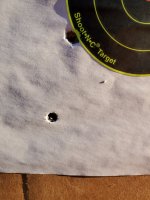
The holes appeared to be nice and round. Group size wasn't bad and I wasn't really shooting for groups. Range was 180 yds. I'm attaching a pic below of one of the holes.

I've never tried a bullet on the ragged edge of a twist rate so I'm just checking to make sure this is good enough to continue workup. Also open to suggestions on powders, as Varget is getting crunchy.

Oh, and what is the best technique for getting a die to quit putting a ring on bullets?20201220_155832.jpg
 
When you say 'crunchy', I am assuming you are compressing your load?
Can you seat the bullets farther out (longer) and stop compressing or are you at max length?
The ring on your bullet in from the contact that the seater is making with your bullet, and compressing the load is resulting in more force having to be applied to the bullet with the seater. Or it could just be the type of seater you have.
I would shoot for groups at distance and let that tell you if the bullets are stabilized or not. That will be a better indicator if you are on the edge of stability, which you probably are with that twist rate and bullet wt.
 
When you say 'crunchy', I am assuming you are compressing your load?
Can you seat the bullets farther out (longer) and stop compressing or are you at max length?
The ring on your bullet in from the contact that the seater is making with your bullet, and compressing the load is resulting in more force having to be applied to the bullet with the seater. Or it could just be the type of seater you have.
I would shoot for groups at distance and let that tell you if the bullets are stabilized or not. That will be a better indicator if you are on the edge of stability, which you probably are with that twist rate and bullet wt.
Yes, the load is compressed. I've been seating 68 gr HPBT at a similar base depth without rings, so I'm guessing it has to do with the jacket composition of the TMK? Seating die is a Forster Ultra Micrometer. I read a blog post from Sierra suggesting polishing the seating stem so I may try that. I'm limited on seating longer by my magazine.
180 yds is as far as I can shoot on my place but I will try to stretch that out a bit. I was honestly expecting some oblong holes so I'm crossing my fingers.
 
Same base depth, or same base to ogive length?

I'd agree with LaHunter, back the powder down till you ain't crunching powder and those rings will go away. At least they did for me on the regular non-tipped Matchking. You could also try a faster powder to use up less case volume.
 
So which one is the 77?
Both of them. I know, one looks a little better than the other. Looking at the back of the target board they both look nice and round, though.

I think it's a good idea to shoot a few more at about double that range and see what that looks like.
 
Same base depth, or same base to ogive length?

I'd agree with LaHunter, back the powder down till you ain't crunching powder and those rings will go away. At least they did for me on the regular non-tipped Matchking. You could also try a faster powder to use up less case volume.
Base of bullet is in the same approximate location.

I'd love to find some faster powder, but that's kind of tough right now. Might have to back those charge weights off a bit.

What is hard to understand thought is that I have compressed powder to the same extent with both this rifle and different bullets and with my 6.5 Creedmoor (RL 16 and 156 Bergers at 2.815 COAL) and haven't had this problem with them.
 
Both of them. I know, one looks a little better than the other. Looking at the back of the target board they both look nice and round, though.

I think it's a good idea to shoot a few more at about double that range and see what that looks like.
Hmmmm, they really look different from this side. Curious about this as I have a 1:9 rifle I really like. Very accurate with 55gr varmint tips.
 
What elevation are you at? At 6500 feet I have to push them way faster to keep them stable at long range. Like 2775 or better.


Sent from my iPhone using Tapatalk
 
I have an AR with a 24” 1:9 twist barrel and it shoots the Federal Gold Medal Match ammo loaded with the 69 grain Sierra match king bullets well.
Something to keep in mind regarding the powder charge, as you decrease the charge, this will obviously reduce MV, but it will also reduce bullet rpm. This will likely reduce bullet stability
 
What elevation are you at? At 6500 feet I have to push them way faster to keep them stable at long range. Like 2775 or better.


Sent from my iPhone using Tapatalk
I'm at about 1000 ft. I won't lie, I'm half expecting them to be unstable at longer range from what I'm hearing.
 
I have an AR with a 24” 1:9 twist barrel and it shoots the Federal Gold Medal Match ammo loaded with the 69 grain Sierra match king bullets well.
Something to keep in mind regarding the powder charge, as you decrease the charge, this will obviously reduce MV, but it will also reduce bullet rpm. This will likely reduce bullet stability
That is why I'm compressing powder, lol. I need to just hunt down some faster powder.
 
I'm at about 1000 ft. I won't lie, I'm half expecting them to be unstable at longer range from what I'm hearing.
Also even if they appear stable on paper at say 600 yards that doesnt mean they will perform on game ad intended due to their inadequate stability

Sent from my SM-G892A using Tapatalk
 
... Something to keep in mind regarding the powder charge, as you decrease the charge, this will obviously reduce MV, but it will also reduce bullet rpm. This will likely reduce bullet stability
I thought that bullet RPM was determined by the barrel twist rate. How will reducing the MV also reduce the bullet rpm? Does that mean if you are shooting a bullet that requires a faster twist rate, you can compensate by increasing the velocity?
 
I thought that bullet RPM was determined by the barrel twist rate. How will reducing the MV also reduce the bullet rpm? Does that mean if you are shooting a bullet that requires a faster twist rate, you can compensate by increasing the velocity?
At a given twist rate, the faster the bullet travels down the barrel the faster the bullet spins. Slower velocity in given barrel = slower spin on bullet.
 
At a given twist rate, the faster the bullet travels down the barrel the faster the bullet spins. Slower velocity in given barrel = slower spin on bullet.
What you say could be true, however once the bullet has engaged the rifling, I can't imagine it would spin faster than the rifling. That would tend to obliterate the marks on the bearing surface, and make the rifling grooves on the bullet unreadable. It's possible you are correct.
 
Adding to my previous post, if a barrel is 1 in 9 twist, I don't think there is anything you can do to make the bullet rotate at a 1 revolution in 10 inches or 1 revolution in 8 inches. If the bullet is the correct diameter, it will rotate at whatever the twist rate of the barrel is.
 
Adding to my previous post, if a barrel is 1 in 9 twist, I don't think there is anything you can do to make the bullet rotate at a 1 revolution in 10 inches or 1 revolution in 8 inches. If the bullet is the correct diameter, it will rotate at whatever the twist rate of the barrel is.
Correct twist is constant
That twist rate dictates how often the bullet will rotate
So a 1:8 will make more rotations than a 1:10 both twist rates are also affected by velocity since the bullet will make more rotations with the added fps

Sent from my SM-G892A using Tapatalk
 
Back
Top
