1911’s in general, 9mm versions specifically

View attachment 1083528

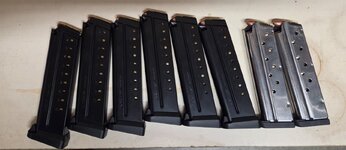
Midway USA backorder finally arrived. When I backordered them they were only $17 but looks like the price jumped back up to $21.
Probably going to be wishing I ordered a dozen @$17 if they run as good as everyone says.
Will be interested to hear if all of yours take 10 rounds easily ... some of mine only seem to want to take 9 - and some seem to have a hard time keeping them in line with the follower, with the rounds poking up and against the feed lips. Could be something I'm doing wrong, but it doesn't happen with some other mags ...
 
Will be interested to hear if all of yours take 10 rounds easily ... some of mine only seem to want to take 9 - and some seem to have a hard time keeping them in line with the follower, with the rounds poking up and against the feed lips. Could be something I'm doing wrong, but it doesn't happen with some other mags ...
I'll load them up this evening and report back.
 
So I’ve seen in a number of places (including this thread I think) that commander length 9mm’s are potentially more reliable (or maybe just easier to make reliable) than full length ones. Do you guys think this is the case? If so, is it a significant difference?

I'm not sure I'd agree with this on the whole...there's more going on than just form factor.

At one level, a shorter slide means less weight that needs to be cycled, in reliably ejecting a casing and forcefully stripping a loaded round off a mag and firmly chambering it. That's sometimes why commander-length guns can be a bit snappier - the slide's going faster with there being less weight to move. And to some degree that might make some companies' builds "more reliable", as they're just keeping slide velocity up.

But the flip side of this is simply spring power - if a full-length government slide is going too slow, a slightly lighter recoil spring reduces that resistance, and increases slide velocity enough to eject and chamber reliably. Similar tuning can be done with the hammer spring - hammer leverage and their friction on the cocking-radius at the bottom of the firing pin stop are just about the least commonly appreciated sources of cycling resistance in the 1911 space. But a small change in hammer-spring weight can yield big differences in resistance and cycling reliability.

Separate from all of this, is, IIRC, there were some teething problems early on with 9mm 1911s, but the commanders seemed to have fewer problems than gov't length guns. This is a really faint memory, so I could be off on this, but don't underestimate the power and durability of fudd-lore hanging around. In general, I'm not aware of any differences in reliability between commander and full-size 9mms, on the whole.
 
Will be interested to hear if all of yours take 10 rounds easily ... some of mine only seem to want to take 9 - and some seem to have a hard time keeping them in line with the follower, with the rounds poking up and against the feed lips. Could be something I'm doing wrong, but it doesn't happen with some other mags ...
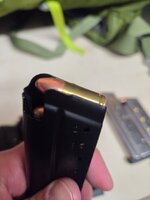
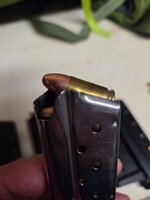
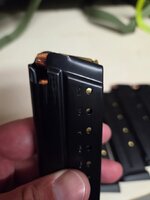
All six loaded 10 rounds without fuss. Even with them being brand new the were just about as easy to load as my Sig factory mags that have had several hundred rounds through each of them.
One thing I did notice was that a bit of a push on the 10th round would get it to nose dive a bit in the feed lips. Not sure if it will cause feeding issues, have to wait until next weekend at the range to unload all of them.
 

Attachments

  • 20260621_212231.jpg
    20260621_212231.jpg
    139.3 KB · Views: 10
  • 20260621_212122.jpg
    20260621_212122.jpg
    136.5 KB · Views: 10
  • 20260621_212215.jpg
    20260621_212215.jpg
    109.2 KB · Views: 10
  • 20260621_212154.jpg
    20260621_212154.jpg
    109.2 KB · Views: 9
All six loaded 10 rounds without fuss. Even with them being brand new the were just about as easy to load as my Sig factory mags that have had several hundred rounds through each of them.
One thing I did notice was that a bit of a push on the 10th round would get it to nose dive a bit in the feed lips. Not sure if it will cause feeding issues, have to wait until next weekend at the range to unload all of them.
Thanks. That's some of the funkiness I've seen too - last round noses down or up and has me concerned about the feed lips. Was wondering if it was just me! But would still love to know if there's some kind of technique solution for this.
 
Was wondering if it was just me! But would still love to know if there's some kind of technique solution for this.
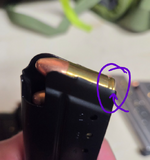
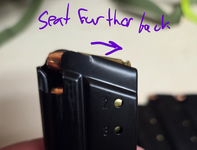
For the mecgar 10 round 9mm mags, make sure the top round is pushed all the way to the back of the magazine. Really a good idea to be in the habit of doing this for every round loaded.
From @sbaker0029 photo above, there is a little flare at the back of the feed lips that the case rim seats/snaps into. If the top round is not seated all the way back you can get some wonky presentations.
1782164061280.png 1782164474516.png
 
PSA on springs...

I have somewhere between 15,000 and 18,000 rounds on a Dan Wesson DWX Compact, and recently tore it down for a deep cleaning and maintenance. I wanted to see how far it would go just in proofing the mechanical design, and decided somewhere around 15k-ish rounds was good enough. Part of all this is checking springs, and if the interval has been long enough, swapping springs out as preventative maintenance. I don't know if there's a maintenance schedule for this gun that's been published yet, but gun springs in general are just best considered consumable items.

This is the recoil spring - you can see how much shorter the used one is.
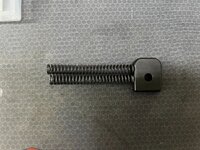

image0 - Copy.jpeg


With 1911s in .45 ACP, the lifespan of normal piano-wire recoil springs is about 3000 rounds. I don't know what that is in 9mm variants - if anyone does, please share. The flat-wire ones like this though, are known to go in excess of 20,000 rounds, sometimes far more, depending on the company/gun, etc. But even at 18K on the high side here, you can see how much it has shortened, which decreases its strength. That translates to increased slide velocity backward, and less power going forward. When you start getting increasing numbers of failures to go into battery on an otherwise reliable and maintained gun, especially if it's high round-count, that's often the culprit.


This next photo is the firing-pin return spring. Including dry-fires, it easily has in excess of 40,000 cycles on it, and quite possibly as high as 60k. Notice the shard of spring just below the shorter one - that easily could have jammed up the firing pin at some point, and it just fell out when I pulled the firing pin. An old rule-of-thumb with 1911s is to replace the firing-pin return spring every other time you change the recoil spring. Conservatively, with .45s that's every 5k rounds, 10k on the high side. With 9mms there's less power in the hammer springs, and so you might stretch that out a bit if it's not an EDC gun. But every 10k rounds would probably be a good point to swap them out.
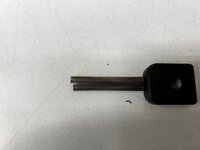

image1 - Copy.jpeg


The key takeaways here are that springs can shorten up and lose power faster than you realize, unless you have something to check against them - and that guns can keep running "fine" with high mileage springs. And then suddenly they don't. This DWXc was cycling great, but at any time that spring shard could have shut the firing pin down.

The great thing about springs, is they're cheap. I always keep several spares of each on hand. Someone once told me to think about it like getting a fresh set of tires every few oil changes - zero need to wait until they blow out or just fail. Plus, it feels good knowing you're in top maintenance.

 
**I effing suck at shooting**
I am not the super duper high level shooter that some are on this thread. I’ll defer to their expertise and preferences. But I’m working on it, and have seen a lot of growth. Some general principles have become very clear:

1. Shooting is shooting. Meaning someone who shoots at a very high level with one platform will also shoot any other platform at an objectively very high level. The gun handling, vision, timing, and control that make a good shooter translates between platforms.
2. This also means that if someone sucks with a striker gun, picking up a different platform won’t make them any better. They simply have not developed the gunhandling, vision, cadence, or control.
3. Are there differences between guns? Yes!! Look at hit factor scores for USPSA classifiers. Certain guns give very well trained shooters a competitive advantage. But the majority of shooters are not good enough with their baseline skills to reap the fullness of that advantage. The differences in gun performance is the last 1% of performance that’s on the table.
Your wrong on #2. I dont shoot my glock 19 or sig 365 axg legion very well but I can shoot dam good comparatively with my staccato xc.
Its far more accurate and easily the most shootable pistol I have ever touched.
And I cant shoot it anywhere near what its capable of

Sent from my SM-S928U using Tapatalk
 
Back
Top