Roads in the West

Joined
Sep 7, 2021
Messages
76
Location
Colorado
Hey everyone,
Did some searching of the threads before considering posting and didn't see anything super applicable to my topic.

Gonna be doing my first elk hunt OTC 2nd rifle this year. My buddy (who actually makes maps professionally & lived in CO for a few yrs) was in charge of e-scouting, & figuring out the logistics of where to camp for us.. well he backed out in late August & told me he hadn't even started doing anything. Hard lesson learned, do everything myself from here out.

So, over the past month trying to research & using gohunt maps I've narrowed it down to units 54 & 551. Possibly unit 11 if it's already cold and lots of snow. But that's more of a last resort. It seems like anywhere I go, I'm gonna see a lot of people. So I've settled on 54 & 551 just because i need a game plan and they seem to have a lot of pubic land. Probably do a mix of national Forest and wilderness area hunting.

My issue is I have no idea what the roads are like. On gohunt, there's seasonal closed roads and roads open all year - some of these roads look like paved roads and some don't look like anything more than a trail (at best).
Now I've been on plenty of forest service roads and trails in Tennessee and north Carolina, but only been to Colorado once. I camped 1 night near Colorado springs in a dispersed camp site with the Mrs back in April. I didn't see anything that worried me at that time, but I'm sure that was not representative of the places I'm looking to go for hunting.
I also understand there will probably be snow. I'm comfortable & competent driving in snow. I probably won't have tire chains this year.

I drive a Raptor & getting new 35" all terrain tires next month before heading over. I may or may not have a 15-20ft trailer to camp in. I have another friend that's supposed to be coming along who has the trailer... But now I trust no one & I'm making plans for with and without, just in case he backs out last minute.

So my questions are:
How far am I gonna be able to go & get back with my just my truck on these forest service roads?
How far will I be able to go, and get back down, with a 15-20ft trailer?
When do they generally close the "seasonal roads"?

Any relevant and useful thoughts or tips would be appreciated!
Thanks in advance!
 
Roads are going to vary anywhere in the mountains. Maintained county roads down low usually, unmaintained and high clearance/4x4 type roads the higher you go generally. Drop your trailer and camp somewhere you know you can get it out even if it snows, then drive as far as you are comfortable with and hike in from there. If you don't have winch + chains and other recovery gear I would play it safe. You don't want to cut into your hunt time by having to call for an expensive tow.
 
Roads are going to vary anywhere in the mountains. Maintained county roads down low usually, unmaintained and high clearance/4x4 type roads the higher you go generally. Drop your trailer and camp somewhere you know you can get it out even if it snows, then drive as far as you are comfortable with and hike in from there. If you don't have winch + chains and other recovery gear I would play it safe. You don't want to cut into your hunt time by having to call for an expensive tow.
I was going to say basically the same thing. I wouldn't drive any questionable road with the trailer until you drive it first without and confirm your clearance and turnaround points. Roads in those areas also are fairly high in clay, and can turn into a greasy, washed out mess quickly. I've taken roads off some of the passes up there that were easy on the way in and almost impassible without a winch and some serious roadbuilding on the way out. Also be really aware of the drop offs, some of the high altitude roads, you will roll a long way if you get sideways.
 
When dry the forest service roads in that area are smoother than an interstate. I’d have no problem hunting in a Honda Civic. Rain or snow changes that completely though because the ones I’ve been on have some spots that could very well be the end of you if a tire goes off. Chains and smart driving when wet. I’m not joking though, when dry they make me jealous of how much better they are than most paved roads here.
 
I hunt that area and I’ll just reiterate what others have said. I’ll base camp low and use a sxs to get deeper. The mornings are usually ok to drive because everything is frozen but at night after everything is thawed during the day it can be a pain even in a sxs.
 
There’s roads in 54 and 551 that will leave that Honda Civic hunter crying for a tow mid summer drought and there’s roads that Civic will get to a wilderness trailhead. It all depends which USFS road you plan on punching up and the weather. The best advice already given is park the camper low USFS/BLM and take the pickup up to where you’re thinking of hunting. If it’s still a dry season you can relocate the camper as you go. I can’t speak for GMU 11.

The few county roads the pavement usually ends before or at the public land boundary. I’ve seen a few maps pretending the county roads keep going at the boundary line but there’s only a few of those like CR12 going over Kebler Pass to Paonia or the Doyleville cutoff road.
 
Just a heads up on driving in in the morning and trying to come out that evening. I've had a truck in there that was no problem getting in early but almost impossible to get out once everything thawed. Was not fun
 
Raptors are wide, that’s going to limit where you can put your tires on the road. If there’s a drop off on a narrow road that’s wet and your sliding you’re going to be crapping your pants. This is where chains are worth having.

Call the local ranger about closures. Typically seasonal closures are December to May. There’s always a chance that one is closed for forest growth.
 
To everyone recommending chains...
Will rear chains be enough?
I know there is not enough clearance for front chains on my truck, unfortunately.
 
If it is marked at Class III or IV, you are good in a passenger car most of the time.

If it is Class II, my experience (including 551, 521, and 43 specifically) is that it’s a flip of a coin whether or not you can get a full sized truck down it without scratching or beating the hell out of it. Some are easy and you just have to go slow…others have deep ruts, overgrown vegetation, or just some random hole that will cause you to bottom out your front end.

Definitely would want chains for snow or melting snow. Those switchbacks are no joke when slippery.
 
To everyone recommending chains...
Will rear chains be enough?
I know there is not enough clearance for front chains on my truck, unfortunately.
Not in slippery mud, you can't steer. My tundra has the same problem. last year I had to throw one set on a back tire and one on the opposite front tire and crawl out of it. Front chains were knocking but it was my only choice or I would have been stuck till the road froze at night again.
 
County roads may be marked with signs that say they are not plowed or maintained. Seen some of the worse mud I’ve ever experienced were on CO backroads. Be careful if you go too deep on a road and then the roads gets wet. My buddy had a Raptor and we barely made it out
 
Reviving this old thread from the archives. I'm planning to try for an archery elk tag this year and am familiar with the mid & low country in 551 but not the high. Does anyone know if the roads are high enough to base camp and day hunt to get into elk, or if backpacking deeper in is necessary? I have heart failure and cannot backpack much due to shoulder strap pressure on my defibrillator. Used to do it often back in the day, but I think those days are now over. Possibly a 2/3 day spike camp? I expect I can hunt up to maybe 10,500 max, but won't know for sure until I get there. My last few elk hunts I hunted LW climbing tree stands over wallows half the time, run-n-gunned half. I don't use ATV's, but have an ebike if it would helpful. However, it's not very powerful and not good on steep roads. Just retired last year so I'd be able to arrive a week early to scout for wallows to sit, and could hunt the full season. Thx.
 
Reviving this old thread from the archives. I'm planning to try for an archery elk tag this year and am familiar with the mid & low country in 551 but not the high. Does anyone know if the roads are high enough to base camp and day hunt to get into elk, or if backpacking deeper in is necessary? I have heart failure and cannot backpack much due to shoulder strap pressure on my defibrillator. Used to do it often back in the day, but I think those days are now over. Possibly a 2/3 day spike camp? I expect I can hunt up to maybe 10,500 max, but won't know for sure until I get there. My last few elk hunts I hunted LW climbing tree stands over wallows half the time, run-n-gunned half. I don't use ATV's, but have an ebike if it would helpful. However, it's not very powerful and not good on steep roads. Just retired last year so I'd be able to arrive a week early to scout for wallows to sit, and could hunt the full season. Thx.
You have to stop posting easy to draw unit numbers over all the hunting forums.
 
Reviving this old thread from the archives. I'm planning to try for an archery elk tag this year and am familiar with the mid & low country in 551 but not the high. Does anyone know if the roads are high enough to base camp and day hunt to get into elk, or if backpacking deeper in is necessary? I have heart failure and cannot backpack much due to shoulder strap pressure on my defibrillator. Used to do it often back in the day, but I think those days are now over. Possibly a 2/3 day spike camp? I expect I can hunt up to maybe 10,500 max, but won't know for sure until I get there. My last few elk hunts I hunted LW climbing tree stands over wallows half the time, run-n-gunned half. I don't use ATV's, but have an ebike if it would helpful. However, it's not very powerful and not good on steep roads. Just retired last year so I'd be able to arrive a week early to scout for wallows to sit, and could hunt the full season. Thx.
This is a type of spot burning information that isn’t allowed. You’re just asking about parking spots to day hunt from but that bread crumb leads to someone’s hunting spot or ten more trucks trying to get that spot.
 
This is a type of spot burning information that isn’t allowed. You’re just asking about parking spots to day hunt from but that bread crumb leads to someone’s hunting spot or ten more trucks trying to get that spot.
Im asking about general information. Not FS road #’s, trailheads, etc. Same as all the posts above mine.
 
Im asking about general information. Not FS road #’s, trailheads, etc. Same as all the posts above mine.

All of those posts have burned spots already. Even if it's 1% of people that have searched out and viewed this thread, there will be 30 additional people in that area. Posting this kind of info on a publicly searchable forum degrades the quality of hunting for everyone.

If you plan to be there a week early and hunt the whole season, then do it. When you find your own spots, don't go posting about them if you want them to stay halfway good.

Screenshot 2026-03-02 at 8.30.52 AM.png
 
Im asking about general information. Not FS road #’s, trailheads, etc. Same as all the posts above mine.
There’s not a whole lot of roads up high in any national forest or BLM. So any information you get on a public forum is really gonna narrow the scope. And just because you’re asking a question doesn’t mean there isn’t 300 other people reading the answers.

I will try to answer your question in general though. Check with the local management agency and use something like on X maps to be sure of what’s private property or closed for the season, etc. As far as road conditions go if it’s an old mining road, you might want a high clearance vehicle with some skid plates if it’s a logging road you’re probably fine to take a Prius down it unless weather hits.
 
How far am I gonna be able to go & get back with my just my truck on these forest service roads?
How far will I be able to go, and get back down, with a 15-20ft trailer?
When do they generally close the "seasonal roads"?


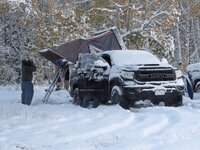
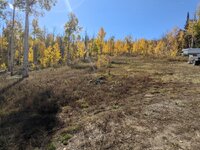
elk-1.jpg. elk-2.jpg

Above are two photos from the same parking area a year apart (I was just standing about 100yds back from the left). The photo on the left was taken about 10 days earlier than the one on the right, in different years. So obviously, you need to plan/prepare for both.

A lot depends on your driving skill. There are plenty of big trailers and campers where I go, and they get in and out. But the roads aren't plowed and steep bits can be treacherous. It's actually worse with warm weather because rain or melting snow turns the roads into chocolate grease, far worse than snow or ice IMO.

Bring chains, a good shovel, a bow or chain saw, a "kinetic" recovery rope and appropriate shackles, and a winch if you have one. If you use a winch, I'd bring an extra 50' cable or line and a cambium saver. There are road sections where you won't have trees, or they're just saplings, and you may need more line to reach something solid.

In general, if you're polite and respectful, people will go out of their way to help you. I've had two cases where I slid into a ditch (if you haven't gone into a ditch, are you really having fun?) and get stuck, and both times I had people help me recover before I even had all my self-recovery gear pulled out and ready to use. Just don't expect it as a guarantee.

Seasonal road closures aren't random / "generally" type things. They all have specific dates. If Gohunt doesn't cover that for you, you can look at the USFS "Interactive Visitor Map". Make sure the "OHV greater than 50" category is selected, zoom into your area, and you'll see all the official USFS roads. Click one and it'll tell you the dates it's open/closed.
 
Back
Top