DIY Underground Leak Detection

Joined
Oct 5, 2018
Messages
2,327
Location
Colorado
I have an underground water leak somewhere along a 100 yard underground line that's fed via irrigation pump. When the pump is on it continuously cycles because it fails to fully pressurize which is how I knew there was a leak. When I pressurize the line with air it goes from 80 psi to 40 psi in about 20 minutes so it's probably a pin hole size leak.

Anyone have any tips or techniques on how to find the spot to dig without getting a professional (expensive) leak detector service to come out, or having to dig up the entire line until I find it?

There is no sign of water or mushy ground anywhere so the leaked water is staying underground. The only thing the line serves is 2 above ground hydrants. Thanks
 
How deep is it buried? Just thinking off the top of my head your easiest solution may be to just keep feeding it water until some damp ground appears. As long as the pump isn’t cycling too frequently. A cheap thermal imager “may” be able to see a cooler section of ground during the heat of the day. Etc.
 
I have an underground water leak somewhere along a 100 yard underground line that's fed via irrigation pump. When the pump is on it continuously cycles because it fails to fully pressurize which is how I knew there was a leak. When I pressurize the line with air it goes from 80 psi to 40 psi in about 20 minutes so it's probably a pin hole size leak.

Anyone have any tips or techniques on how to find the spot to dig without getting a professional (expensive) leak detector service to come out, or having to dig up the entire line until I find it?

There is no sign of water or mushy ground anywhere so the leaked water is staying underground. The only thing the line serves is 2 above ground hydrants. Thanks

Sorry to hear about your troubles, are you sure the hydrants aren't leaking (I'm thinking frost free lawn hydrants). I had one that was doing the same thing but stopped when I opened and closed it a couple times (or rebuild it).

Now, if someone knows how to find where perimeter drains used to daylight but were buried, I'm all ears.
 
I have an underground water leak somewhere along a 100 yard underground line that's fed via irrigation pump. When the pump is on it continuously cycles because it fails to fully pressurize which is how I knew there was a leak. When I pressurize the line with air it goes from 80 psi to 40 psi in about 20 minutes so it's probably a pin hole size leak.

Anyone have any tips or techniques on how to find the spot to dig without getting a professional (expensive) leak detector service to come out, or having to dig up the entire line until I find it?

There is no sign of water or mushy ground anywhere so the leaked water is staying underground. The only thing the line serves is 2 above ground hydrants. Thanks
80 psi in air is a lot of pressure in a water line. What type of pipe? Bury depth? Are your joints glued or spigot and gasket?
Have you tried to put an ear against the hydrants? Water leaks are acoustic and a lot of times can be heard through metallic fittings.
 
what size is the waterline? when you pressurize the system with air how are you doing that? is there shutoff valves in the system or just pressurizing against the hydrants? Going half way in the system and either separating it or adding an inline valve may help determine which way to start looking. you might be a able to get a stethoscope cheap and listen for the leak like mentioned before. Placing the stethoscope on the hydrant or a metal stake probed in the ground might help.
 
I would start by excavating the hydrants themselves.

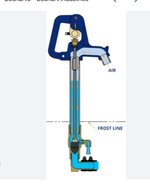
If they're the typical "frost proof" hydrants I'm familiar with, they'll have a bottom "tee" set on a foot or so of large gravel. These hydrants are nearly always a galvanized pipe with a brass valve and fittings on the bottom. Your water line is probably 1" plastic? When setting these hydrants it's very common for the leak to occur at this joint. Typically the "tee" is a plastic fitting threaded on the vertical side to attach to the hydrant, with hose-barb fittings for the inlet/outlet. A loose clamp, cracked fitting, insufficiently tightened thread, etc can all cause leaks and this is much more common IMO than a crack somewhere along the line itself.

Equally important, a crack somewhere along the line tends not to lose pressure as quickly as you say because as the line gets re-buried, it gets mostly sealed by the earth. It takes a pretty big crack AND fissure in your bedrock (or sinkhole or something like that) for that much water to escape. But the hydrant's gravel pit is literally designed to allow that - that's how the "frost-proof" portion of its mechanism works. When you lower the handle, the valve at the bottom is 2-way. It closes the water supply but opens a bottom port that lets the water inside the hydrant dump out into that gravel.

Fixing that is a real pain because you need a wide enough hole to get yourself down into - the hydrants can be serviced without doing this, but not the fittings. But determining if this is the cause is usually easy because most folks don't go out of their way to use a plate compactor when filling the hole back in - it's not necessary. So if you're lucky this is usually an hour's shovel/post-hole-digger work to at least expose the bottom and confirm the cause...
 
Maybe have someone come out and smoke test the drains or have a push camera ran through it.

On the lost perimeter drains, there is no known inlet, either, so I'd have to excavate at the the foundation and at that point I'd have lots of options.
 
I’d start at the hydrants. If it’s only backfilled with dirt, frost can grab it at ground level and pull it up as the dirt expands and contracts. Secondarily, connections between plastic and brass are often leak prone. Thirdly, a leaky valve is more likely to have a small leak than solid line.

Before I’d do anything try the easy stuff first - with full water pressure fully open and close each hydrant 10 times. The sealing surfaces can get water scale and not fully seal. If that doesn’t work, fully cycle each one 10 more times. Does the water line pass through a frost prone layer of dirt? If so dig that up first. Only then would I start digging up the line where it meets the hydrants. If both are a-ok I’d be tempted to rent a trencher and install new lines to the hydrants rather than hand dig the existing. If it broke this year, you might get a break every year.
IMG_0501.jpeg
 
Been there…see post #8, #9 too. Obviously try the non-intrusive stuff like turning on/off, etc first, you never know. But black plastic pipe is hard to crack, it expands enough that even freezing doesnt crack it. If its copper pipe, different story, depending on your soil and water it can erode and cause holes. If you want to feel better about yourself ask me about the water line we owned and had to repair that was leaking under a state highway.
 
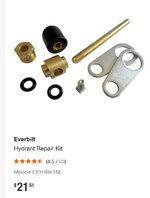
Some hydrants have an above ground adjustment for pressure on the moving valve part. After working the valve to knock any debris off the sealing surfaces, if it’s adjustable, it makes sense to adjust in more valve pressure. Rebuild kits with a new rubber valve seal are $20ish. Having dug up a few hydrants, I’d try everything possible before bringing out the shovel.

IMG_0502.jpeg
 
80 psi in air is a lot of pressure in a water line. What type of pipe? Bury depth? Are your joints glued or spigot and gasket?
Have you tried to put an ear against the hydrants? Water leaks are acoustic and a lot of times can be heard through metallic fittings.
I put 80 psi in because the pump says max psi is 108 psi so I figured 80 was safe. So maybe high pressure is part of the issue. Pump is a grundfos mq3-45. This is the previous owner's setup and the line is all copper except for a pvc shutoff valve at the pump. The above ground hydrants are not frost free hydrants just copper sticking up out of the ground with a hose bib. I have to winterize this line every fall and blow it out with air due to this.

How deep is it buried?
Only 3 ft, but I winterize it and blow the water out every fall so it doesn't freeze. It's just for garden irrigation in summer.

when you pressurize the system with air how are you doing that?
I close the shutoff valve at the pump and hook up my air compressor to one of the hose bibs with a special adapter tool for blowing out lines. I then disconnect the compressor, turn off the faucet, attach a pressure gauge to the faucet and turn back on for 20 or 30 minutes. So the line should be closed from both ends and not losing air pressure. It should basically just be confirming my leak and showing me how fast the line is losing pressure.
 
If you want to feel better about yourself ask me about the water line we owned and had to repair that was leaking under a state highway.
I bet that was a nightmare. My line also goes under a driveway used by multiple neighbors which is why I want to fix it and can't just run a new line without it being a huge hassle either way. I'm just hoping the leak is not under the road. Murphy's law says it is though so maybe I should start digging there. 😅
 
I know nothing of this, but have seen guys test new wood stoves with kind of a smoke brick. Any chance that’s possible? Just feed smoke into it and look for a wisp? I’ll also not suggest pressurizing with propane, but you’d sure smell the mercaptan.
 
I put 80 psi in because the pump says max psi is 108 psi so I figured 80 was safe. So maybe high pressure is part of the issue. Pump is a grundfos mq3-45. This is the previous owner's setup and the line is all copper except for a pvc shutoff valve at the pump. The above ground hydrants are not frost free hydrants just copper sticking up out of the ground with a hose bib. I have to winterize this line every fall and blow it out with air due to this.


Only 3 ft, but I winterize it and blow the water out every fall so it doesn't freeze. It's just for garden irrigation in summer.


I close the shutoff valve at the pump and hook up my air compressor to one of the hose bibs with a special adapter tool for blowing out lines. I then disconnect the compressor, turn off the faucet, attach a pressure gauge to the faucet and turn back on for 20 or 30 minutes. So the line should be closed from both ends and not losing air pressure. It should basically just be confirming my leak and showing me how fast the line is losing pressure.
Do you have solder joints? If it was soft copper, it would've probably come in a 100' coil and was rolled out in the bottom of the ditch. If that's the case, hopefully compression grip joint style couplings were used between the rolls. If it was hard copper, they probably used solder joints. 80psi down to 40psi over 20 minutes is not a huge loss, especially when you factor in pressure loss when the warm air being introduced cools down to the temp of the copper underground. Is your pressure switch on your pump working correctly? Are using a pressure tank?


If you have a pressure washer, you can rig up a fitting from the mip end of your wand to your spigot and put an actual water test on it. Pump it up to 100psi and time it out for an hour or so. See what the drop is in that time frame. Then pump it back up to the original 100psi and bleed it into a gallon jar down to the pressure that it originally fell to and measure the amount of water loss.
 
I would be careful pressurizing with air, its not the same as water because air is compressible. Definitely don't pressurize with air if you expose the pipe.

Also, just because the pump can do 108 psi, doesn't mean the piping can. It should, but who knows since you didn't install it.

And air leaks different than water. I would run the water leak test mentioned above to see what you are really losing and whether its worth trying to track down or seeing if it gets worse over time.
 
I know nothing of this, but have seen guys test new wood stoves with kind of a smoke brick. Any chance that’s possible? Just feed smoke into it and look for a wisp? I’ll also not suggest pressurizing with propane, but you’d sure smell the mercaptan.
How are you going to see smoke to confirm a leak from a pipe that is 3’ underground?
I’m missing something or not understanding what you’re saying. Genuine question.
 
How are you going to see smoke to confirm a leak from a pipe that is 3’ underground?
I’m missing something or not understanding what you’re saying. Genuine question.
It probably won't at 3 feet, but with a smoke machine, I've found sewer clean outs and roof drains that were buried a foot and a half or so. It has a lot to do with soil type, Sandy material drafts better than clay types.
 
Thanks for the response. Never would have thought.
It’s always nice to have alot of options when these unfortunate circumstances happen.
 
Back
Top